
Domestic automobile retail sales in India experienced a significant surge of 26 per cent year-on-year in February, driven by improved affordability and market confidence across various segments, according to FADA.

Speculation about rising competition from global majors has led to shares of major Indian automobile manufacturers such as Mahindra & Mahindra (M&M), Maruti Suzuki India, and Tata Motors taking a hit on the BSE.

Passenger vehicle dispatches from companies to dealers raced to the highest ever sales mark in a calendar year in 2025 as a reduction in prices due to GST reforms led to robust sales in the festive season, industry body SIAM said on Tuesday.

Passenger vehicle dispatches from companies to dealers increased 19 per cent year-on-year in November as demand remained robust post festive period, industry body SIAM said on Friday.

Starting January, the market is expected to welcome models like the Tata Punch 2025 which is expected to be around 6 lakh, Mahindra BE 07 EV around 29 lakh, Maruti WagonR Electric around 8.5 lakh, Toyota 3-Row SUV around 14 lakh, and Volkswagen Tera to be around 8 lakh.

After a record-breaking year, India's automobile industry is entering 2026 on a relatively strong footing, with sales growth expected in the 6-8 per cent range. The outlook is underpinned by policy support, including GST rationalisation, easing monetary conditions, and income tax relief, which together are likely to improve affordability and sustain consumer demand across vehicle segments.

High US tariffs are expected to affect close to 8 per cent of India's overall auto component production, ratings firm Icra said on Wednesday. Indian auto component exporters are at a relative disadvantage compared to most other Asian exporting nations, highlighting the importance of concluding an India-US bilateral trade agreement, it added.

Passenger vehicle dispatches from companies to dealers rose 4 per cent year-on-year in September to 372,458 units, industry body SIAM said on Wednesday. The overall passenger vehicle dispatches last month rose 4.4 per cent to 372,458 units, as against 356,752 units in September 2024.

Passenger vehicle retail sales shot up 35 per cent year-on-year during the nine-day Navratri period this year, helping the overall registrations last month grow 6 per cent, as offtakes remained muted in the first 21 days of the month and only took off after the roll-out of new GST rates on September 22, dealer' body FADA said on Tuesday.
Multiple tailwinds for the automobile sector, including a cut in goods and services tax (GST) rates, are keeping analysts bullish on auto stocks from a long-term perspective, even as they see the rally running its course in the near term.
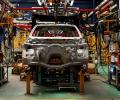
Passenger vehicle dispatches from companies to dealers in the domestic market declined marginally year-on-year in July, hit by muted demand, industry body SIAM said on Thursday. Passenger vehicle dispatches declined to 340,772 units in July, compared to 341,510 units in the same month last year.

Qualcomm has partnered with eyewear brand Lenskart to build glasses using its Snapdragon XR chipsets, which allow for on-device AI processing and spatial computing.

For UK automakers, market access to India will be limited by quantity caps and phased tariff cuts, especially on petrol, diesel and electric vehicles.
Indian auto component exporters may suffer a hit of 2,700 crore to 4,500 crore on their earnings after the imposition of steep US tariffs on key automotive parts, credit rating agency ICRA said in a note on Monday. The new 25 per cent tariff on engines, transmission, electrical components, and other auto parts may moderate the overall auto component industry's revenue growth to 6-8 per cent in 2025-26 (FY26), down from an earlier projection of 8-10 per cent.
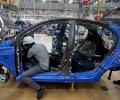
An ACMA-BCG report has targeted Indian auto component exports to hit $100 billion - nearly a fivefold increase from $21 billion currently

The 17 rare earth elements that are at the centre of the current crisis are critical components of everyday products -- from cars to jet engines to electronics like smartphones and flat-screen TVs.

'We remain in touch with the Chinese side, in Beijing as well as in Delhi, to bring predictability in the supply chain.'
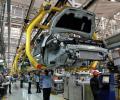
Auto parts exports from India may see a slight slowdown as US President Donald Trump's 25 per cent tariff could increase car prices for buyers by 8-25 per cent, thereby affecting demand, experts believe.

Tesla needs to either sell the same models with reduced features to lower the cost for Indian market, or incur losses.

With nearly 100 launches and unveils, the Bharat Mobility Global Expo 2025, held in Delhi from January 17 to 22, made one thing clear to automobile enthusiasts: Electric vehicles (EVs) are the way ahead for the Indian auto market for years to come.

'Reduce your equity allocation, put that allocation into gold and fixed income.'
Indian passenger vehicles market registered record wholesales of 43 lakh units in 2024, with companies like market leader Maruti Suzuki, Hyundai, Tata Motors, Toyota Kirloskar Motor, and Kia posting their best-ever annual domestic sales. The continued growth of SUVs, along with rural markets playing a key role in driving up car sales, helped the industry better the previous best of nearly 41.1 lakh units posted in 2023.

The company is eyeing sales of 8,000 units per month for the Kylaq, which starts at Rs 7.89 lakh (ex-showroom) and boasts 96 per cent localisation.

Maruti Suzuki India on Tuesday said it has commenced export of its sports utility vehicle Fronx to Japan. The first consignment of over 1,600 vehicles left for Japan from Gujarat's Pipavav port, the country's largest carmaker said in a statement. Fronx will be the first SUV from Maruti Suzuki stable to be launched in Japan, it added.

Snapping the two months slide, the country's merchandise exports rose marginally by 0.5 per cent to $34.58 billion in September while trade deficit narrowed to $20.78 billion. According to official data released on Wednesday, imports increased by 1.6 per cent to $55.36 billion in September compared to $54.49 billion in the year-ago period. The trade deficit, or the gap between imports and exports, was $20.8 billion during the same month last year.

As there is a moderation in car sales, dealer stock levels across the entire industry have surged to alarming heights. However, the situation is under control at HMIL.

Industry leaders on Thursday mourned the death of Ratan Tata saying with his demise India has lost a visionary who shaped its industrial and philanthropic landscape. Tata was a truly remarkable business leader who placed the country before business interests, and whose vision was truly transformational for a country and its people, TVS Motor Co Chairman Emeritus Venu Srinivasan said in a statement. "Mr Tata was a truly remarkable business leader, the likes of whom nations get only once in a century," he added.

The proposed exemption in customs duty on import of lithium, cobalt and other rare minerals in the Union Budget 2024-25 is likely to lower the battery production cost and help in making electric vehicles more affordable for the buyers, auto industry leaders said on Tuesday.

India's gain will be an additional business of $300 million to $400 million per month if 10-11% of Bangladesh's export is diverted to Indian hubs like Tiruppur.

Notwithstanding robust volume growth and a strong performance from Jaguar Land Rover (JLR), Tata Motors, the country's second-largest automobile (auto) manufacturer by market capitalisation, disappointed the Street with its January-March quarter (Q4) results for 2023-24 (FY24). While consolidated revenues saw a 13 per cent increase, lower-than-expected realisations in the Indian operations weighed down overall performance.

'Bilateral trade has suffered seriously because of the growing unrest.' 'There is a standstill on both sides amid the curfew.'

That is not out of choice, but because of the new European Union norms for automobile recycling, which comes into effect in 2010, and prescribes that once a vehicle is destined for the scrap heap in the EU territory, 80-85 per cent of its parts ought to be recyclable or reusable. That means every component -- batteries, airbags, catalytic converters, and auto plastics -- have to be safely disposed.
With an eye to the large and growing market for their products, Indian auto component and tyre companies are making a beeline to set shop in Europe (especially Eastern Europe). Just last month Apollo Tyres announced that it was setting up a euro 200 million green field venture outside Hungary. And Delhi based Amtek Auto will set up a production base which will come in to operation in 2009 in Romania.
In 2006, components worth $2 billion, around Rs 90,000 crore were exported by Indian companies, 75 percent of which were bought directly by car companies.

From setting up cutting-edge facilities to cater to the domestic market and building capabilities of global standards, the action is building up.

Indian auto manufacturers are well poised to become "winners" in terms of global market share in the next five years to join the ranks of established players like Hyundai, Toyota, Honda and Volkswagen.

Ratings firm Fitch on Wednesday assigned a stable outlook to the Indian auto components sector in 2012 and said it is expected to perform well on the back of demand from original equipment manufacturers for localised content.
Bharat Forge and and Motherson Sumi have market caps ahead of Delphi and Vistion in the US.

The auto show from April 10 to 18 will also have global equipment manufacturers, like BMW, Skoda and Renault, besides around 600 exhibitors from across the globe, Indo German Export Promotion Foundation said.
 © 2026 Rediff.com - Investor Information - Advertise with us - Disclaimer - Privacy Policy - Sitemap - Feedback - About us - Terms of use - Grievances