

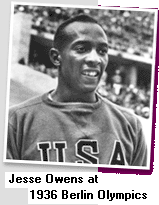
Time and Money
Eric: Sometimes statistics are deceptive, Jesse. There are 360 million people in India now, but 300 million of them live in villages and if you visit one of our villages; you will realise that they are really in a backward state. It will require a lot of time and money to put them into anything like the type of villages you know of in the United States.
Jesse: Well Eric, let us stop and think for a moment. You take some of the great champions in America. You take, for instance, a person like Joe Louis, the former heavyweight champion of the world. Joe Louis came out of a village in Alabama and then he moved into the big city and then he got his change in amateur athletics and amateur boxing, and then he went on to be the heavyweight champion of the world.
Take, for instance, one of the small villages you have in your country -- that is where you are going to find a great deal of talent and a great deal of wisdom. An institution in the United States was built by a man who was born in a log cabin and lived in a very small village, and that institution is Tuksegee, Alabama, and the man who founded it was Booker T Washington, who is one of our great men in America, as far as education or educators are concerned. So you see, it does not have to be a person born in a large city. It does not mean that he has to have all the things that are going to make him a champion. Champions are born in hamlets and villages all over the world, so I still say that we are going to have one here too.
Beginning of Career
Eric: Well talking of champions being born, when was your genius for speed, your talent, first discovered -- at what age?
Jesse: At the age of 13, I was in junior high school, in the seventh grade, and I went out for one of the athletic teams we had. Of course, I went out for baseball, basketball, American football and soccer too, but I ran better than anyone else. I was rather a large lad for 13 years and, the coach who had to pick the seventh grade team, after he checked the time on his watch twice, figured that there was something I could actually do. That was the beginning of my career.
Eric: And from then on, did you have specialised training and coaching in athletics?
Jesse: It was not specialised. I got the same training as everyone else got, but there is one thing in the States you do not have here, and that is we have to practice every day at a certain time and in no haphazard manner either. I had to do it each and every day because I had to get so much out of every day's practice, because if I was to improve, I had to watch the thing I did day by day. Then we had trials at least once a week and we could notice the progress from week to week. It was a strict rule that no one could cut the practice classes: we had to be there each and every day.
World Standard
Eric: Well, when did you first come into prominence, Jesse? I was told that was a schoolboy you reached almost world standards in sprinting.
) Jesse: Yes, it was in 1933, when I was a senior in high school. We had the 1933 World Fair in Chicago. We also had the National Unischolastics and I was running the 100 yards and 220 yards, and taking part in the broad Jump (long jump). I happened to win the 100 yards in 9.6 seconds, which was a new world record for high school boys and tied the accepted world record, then I ran the 220 yards in 20.7 seconds, which created a new world record for high school boys, and a week after that I had broken the world record for high schools for the broad jump -- 24' 11.75'. That gave me the opportunity to go to the college that I attended.
Jesse: Yes, it was in 1933, when I was a senior in high school. We had the 1933 World Fair in Chicago. We also had the National Unischolastics and I was running the 100 yards and 220 yards, and taking part in the broad Jump (long jump). I happened to win the 100 yards in 9.6 seconds, which was a new world record for high school boys and tied the accepted world record, then I ran the 220 yards in 20.7 seconds, which created a new world record for high school boys, and a week after that I had broken the world record for high schools for the broad jump -- 24' 11.75'. That gave me the opportunity to go to the college that I attended.
Eric: For your information, Jesse, if you do not know already, all those three high school records are much better than existing men's records in India. For the 100 metres, as far as I know, the record is 10.6 seconds, which is equivalent to 9.8 for 100 yards, and 21.8 seconds for the 220 yards and about 23 feet for the long jump. So you can imagine the amount of leeway we have to make up.
Jesse: Well, let us put it in this way, Eric. Even though you might say that the records you have in India, from the world record's viewpoint, might not look so good, but if you will take country by country, there are very few of them, even though they have advanced further in athletics, than India, whose records are more impressive than what India has.
So, I would say that I know you are a little behind some, but it is people like you, Eric, who have gone ahead. You know what you can do and did it -- a wonderful job in athletics. You went to England in 1948, and from there you went into another field, in which you are making greater strides.
So, if we are speaking in terms of what the youngsters of this country are doing, then I think the people of India should be very happy and proud of the record you have made as a Rhodes Scholar. There are many youngsters in America who would love to go to England as a Rhodes Scholar, but you have to have certain grades, so in that field you are just as great as the boys are in athletics.