

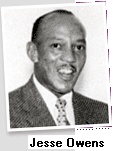
Jesse Owens was the greatest of them all. In 1935, a year before the Berlin Olympics where he won four gold medals, he broke four world records in the space of 45 minutes at Ann Arbor, Michigan; at 1515 hours, running the 100 yards in 9.4 seconds; at 1525 hours, leaping 26 feet 8 1/4 inches to set a long jump mark which remained unbeaten for 25 years; at 1545 hours, running the 220 yards in 20.3 seconds; and at 1600 hours, going over the hurdles, it was a 220 yards race in those days, in 22.6 seconds.
Despite Hitler's declaration of Aryan supremacy, a street in Berlin today bears this black athlete's name.
He was born in 1913, the grandson of slaves, and by the age of seven Owens was picking 100 pounds of cotton a day. His parents moved north to Cleveland, Ohio, where Jesse Owens, as a nine year old, continued to work, but now as a gas station (petrol bunk) attendant and as a delivery boy.
But it was not long before Owens demonstrated the democratic principle underpinning his great country; that opportunities to strive for rewards should be equally accessible to each person, no matter his colour, lineage or race. This Olympian was the product of meritocracy. He was the embodiment of the concept that measurably superior accomplishment is the basis of material reward. Twenty-two colleges offered him comprehensive scholarships, but he chose to stay close to home, at Ohic State.
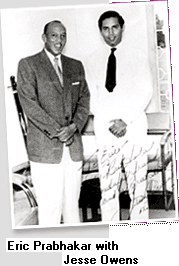
When I met him in Madras in 1955, he had become a sports ambassador, an accomplished speaker who had a successful public relations firm. He was the modern sports hero. During his three days in Madras, I pursued him at every function, had him home for dinner, took him out to the Marina for early morning walks.
He was my apotheosis, the mould in which I had tried, all my youth, to cast myself. He also became my friend. 'A friend is,' as Emerson said, 'a person with whom I may be sincere; before whom I may think aloud.' All champion athletes are not alike; no one type of personality is better suited to athletics than another.
All India Radio requested me in 1956 to interview Bob Mathias, the decathlon gold medalist in the 1948 London Olympics, as my interview with Jesse Owens the previous year had been considered a success. They were two diametrically opposite personalities.
Mathias, six foot six American white, was soft-spoken and reticent. I found the 15-minute interview with him a strenuous, never ending one. I got monosyllabic replies to my leading questions. 'What do you think of women in sport?' The reply was, 'I don't like it'. So I had to hurriedly come up with the next question to fill the time available for the interview's completion, to use a Parkinsonian aphorism.
Owens, on the other hand, was radiant and communicative. The 15 minutes in the All India Radio studio was too short and, as you will see below (in the article that appeared in the AIR bulletin of the interview), it ended with Owens interviewing me.
Eric: Jesse, let me welcome you to Madras. I do hope you will enjoy your stay in the city and I am sure your experience as well as your very presence here is going to price a very great inspiration to your athletes.
Jesse: Well Eric, I am very happy to be in Madras. As I have often said since I have been in India, I am sure my stay in India is going to be a most pleasant one.
Eric: Is there any possibility of your coming to India again?
Jesse: I don't think so, not in the near future. It, however, depends on the young people of India, whether or not I would like to do so. A number of people here have been talking about the Olympic Games in 1956 -- they are very concerned about the athletes of India and why India has never won an international championship. I don't think that they should become discouraged, because there are many countries which have had more opportunities than India has had and they have never won a championship.
But I do make this prediction: There are 300 million people in this country and if the youngsters among them get any kind of co-operation from the elders, I would like to come to India and stand next to the boy who is going to be your first international champion.