

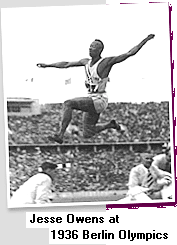
Berlin Olympics
Eric: Thank you very much. Very kind words, indeed. Tell me, Jesse, about the Berlin Olympics. Was that the culmination of your career?
Jesse: Yes, I would say everything after that was an anti-climax. I had one more year in college after the 1936 Olympic Games and I completed that year, but nothing was as exciting as it was before and during the Olympic games because, well, it is a funny thing about athletics -- or anything -- once you reach the top, people expect a great deal of you. They expect you to maintain that form at all times; and there are times when you cannot do it because in trying to maintain it, you will have a tendency to over-train and thus become stale and be unable to do the job. So, when that one year was over, I got out of athletics entirely, because I have always felt it better to have people remember you for what you have done.
Eric: I quite agree with you. Now, during the Berlin Olympics, did you find the whole show was being run by Nazi Germany under the dictatorship of Hitler? Was there any colour prejudice at all?
Jesse: Well, you did not find any colour prejudice on the field of competition -- after all, that was what I was there for. I was not interested in politics. I was interested in the events that I was entered in, in the relationships that I had with the boys from various countries in the Olympic Village in which we lived.
You see, there is one thing that an athlete will always learn. If he is going to compete, there are certain things he learns about sportsmanship and the love of the game regardless of what the leadership of the country may be trying to instil in him. He may have imbibed some of the political feelings and beliefs, but there is no evidence of it on the field. Lutz Long was my competitor on the field and he was a very, very fine competitor and a very fine person indeed. We corresponded with one another for many years before he was called into service. Then I heard no more from him. I later found that he was killed with Rommel's corps in the desert.
) In 1951, when I was with the Hollandville Basketball team in Europe. I met his son and he showed me his father's scrapbook and the letter that I had sent him. Now, as a result of that, I have renewed acquaintance with the man through his son, to whom I regularly write.
In 1951, when I was with the Hollandville Basketball team in Europe. I met his son and he showed me his father's scrapbook and the letter that I had sent him. Now, as a result of that, I have renewed acquaintance with the man through his son, to whom I regularly write.
Broad Jump
Eric: I have heard all about that thrilling competition when you jumped 26' 5.75". But your world long jump records stands at 26' 8.25", and no one has approached that so far.
Jesse: Well, the closest they have got to it is 26' 5.5". As it goes further out, the longer those inches become.
Eric: It is one of the oldest records standing.
Jesse: Yes, it is. At present, it is the oldest record.
Eric: Have you anything to suggest for Indian athletics?
Jesse: Eric, you are living in a new world -- this is a new world, for your freedom is less than ten years. It is going to take men like you and others of your age to instil in your sons and the young people of India a love for the things you cherish and an appreciation of the struggles and the tribulations that you have undergone for them. I know, if India can progress at this rate, then in the next 10 or 20 years, you will be the kind of nation that you want it to be.
Eric: Thank you very much, Jesse. More visits from you and people of your calibre will help us in our work and certainly provide inspiration for us in the future.
Note what Jesse Owens said in this interview. He had tried out for athletics, basketball, American football and soccer and it was in these trials his talent for running was discovered. Talent is that magic and mysterious something that is easy to recognise, but difficult to acquire, for it is not acquired from without but released from within. To tap this talent, to take it to a new range of power, a new level of energy, discipline is required.
And I quote Jesse Owens again on the discipline required '... but there is one thing in the states you do not have here, and that is we have to practice every day at a certain time and in no haphazard manner either. I had to do it each and every day because I had to get so much out of every day's practice, because if I was to improve, I had to watch the things I did day by day…'
This book is inspired by the Jesse Owens story. It is written for the young persons in our country whose athletic talents have been identified. It is aimed to take these young talents to a new range of power and a new level of energy. It introduces our young athletes to a new level of discipline in order that they may attain the highest levels of performance.
There is nothing wrong with us. There is plenty of athletic talent in India. This book is aimed to help the talented ones to reach the pinnacle of fame.
Courtesy: The way to Athletic Gold by Eric Prabhakar, East West Publishing.
<< Back