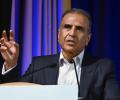
Bharti Airtel is strategically shifting its focus towards data centres, cloud services, and financial services as key drivers for its next phase of growth, leveraging significant past investments in digital infrastructure, as outlined by Chairman Sunil Mittal in the company's Annual Report for 2025-26.

American industry groups sought punitive tariffs on Indian goods at USTR hearings, while Indian officials defended the country's manufacturing growth as demand-led and WTO-compliant.

Foreign investors have largely been exiting one part of the market while domestic investors have been enthusiastically accumulating another, points out Debashis Basu.

Trump's outburst comes amid escalating tensions between the US and its northern neighbour, following recent remarks by Canadian Prime Minister Mark Carney at the World Economic Forum (WEF) in Davos.

The Swadeshi Jagran Manch (SJM) is advocating for the termination of the moratorium on customs duties for electronically transmitted digital products, arguing that it hinders self-reliance, causes revenue losses, and restricts India's ability to tax emerging technologies like AI.
The US Trade Representative has proposed an additional 12.5 per cent duty on goods from 54 countries, including India, citing their failure to prohibit the import of goods produced with forced labour. India has denied the allegations and called for the matter to be resolved through bilateral trade negotiations.

The Congress MP said he had been "troubled" by the US tariff regime from the very beginning, adding that India was already at a disadvantage compared to its regional competitors.

Indian equities on Dalal Street saw volatility as global market trends and fresh tariff concerns linked to Donald Trump impacted investor sentiment. Track Sensex, Nifty50 movement and key market drivers for Feb 24, 2026.
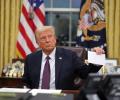
The US Supreme Court has struck down an executive order by President Donald Trump that sought to restrict birthright citizenship. The ruling reaffirms that the 14th Amendment guarantees citizenship to all persons born on American soil, including children of undocumented or temporarily present parents. This decision overturns a key policy initiative from Trump's second term.

He said that the US is financially and from a national security standpoint 'far stronger' and more respected than ever before because of tariffs.

India's marine product exports facing rough weather from punitive US tariffs are expected to get a big boost following the reduction of 26 per cent tariff as part of the India-EU Free Trade Agreement (FTA), but concerns over non-tariff barriers, which are a dominant aspect of marine trade to the EU, still remain.
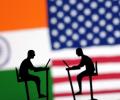
The US said India will lower tariffs on a "vast array" of American industrial and agricultural goods, such as "fruits, vegetables", to zero per cent under the trade deal announced by President Donald Trump.
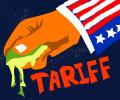
India must focus on building enduring national capabilities and economic sovereignty in the face of shrinking space for rules-based trading, anti-immigrant stance, weaponization of energy sources and growing use of export controls in critical sectors, the Economic Survey said on Thursday.

The remarkable rise of smallcaps reflects the emergence of a broad set of specialised businesses operating in industries where the sectoral tailwinds remain considerably stronger than macroeconomic headwinds, points out Debashis Basu.

India and the US are reportedly exploring a potential meeting between Prime Minister Narendra Modi and US President Donald Trump on the sidelines of the G7 summit in France next week, aiming to rebuild bilateral ties after recent tensions.

'This has translated into a combined daily loss of 60 crore in revenues for exporters in Tiruppur, Coimbatore, Erode and Karur districts, pushing many small and medium enterprises to the brink of collapse.'

'Why not aspire for 8 or 9 or even 10 per cent?'

Trump has repeatedly asserted that Greenland is important to safeguard the US from Russia and China's presence in the Arctic Ocean, and has demanded that the Kingdom of Denmark sell the self-governed territory.

Canadian Prime Minister Mark Carney on Tuesday warned that the world is witnessing a fundamental 'rupture' in the global order rather than a gradual transition, cautioning against weaponising trade, finance, and supply chains.

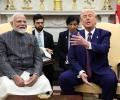
Prime Minister Narendra Modi and US President Donald Trump exchanged pleasantries and held a brief conversation at the G7 summit, their first in-person encounter in 16 months, setting the stage for high-stakes bilateral talks amidst continuing strain in India-US relations.

Representatives Deborah Ross of North Carolina, Marc Veasey of Texas and Raja Krishnamoorthi of Illinois introduced the resolution on Friday in the House of Representatives to terminate Trump's national emergency authorising tariffs of up to 50 per cent on imports from India, helping to restore Congress' constitutional authority over trade.

Prime Minister Narendra Modi and US President Donald Trump are set to hold comprehensive talks focusing on a bilateral trade deal, defence cooperation, and energy and critical minerals sectors during the G7 summit in Evian-les-Bains, France.

IT stocks had their worst first half fall in decades, with the Nifty IT index declining 31% in the January-June 2026 period, its biggest decline in the first six months of a calendar year since 2003.

'The real shock is going to be from a deficient monsoon.'

India and New Zealand have signed a comprehensive Free Trade Agreement (FTA) aimed at significantly boosting bilateral commerce and investments, providing duty-free access for 100 per cent of India's exports to New Zealand and securing duty-free inputs for India's manufacturing sector.

Indian startup funding plummeted by 43 per cent year-on-year to $7.81 billion between March 1 and June 15, 2026, largely due to the West Asia conflict, which has amplified global risk perceptions, tightened liquidity, and led to rupee depreciation, making global investors cautious.

In a veiled attack on US President Donald Trump, Canada's Minister of Energy and Natural Resources Tim Hodgson on Tuesday said India's free trade agreement with the European Union is a "perfect" answer to global hegemons that use tariffs and economic integration as tools of coercion.
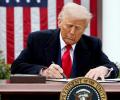
President Donald Trump on Friday signed an executive order retroactively lowering tariffs on a range of agricultural imports, including beef, tomatoes, coffee and bananas, with the change taking effect from November 20, CNN reported.
India and the US have reported positive progress in recent trade talks in Washington, agreeing to maintain engagement to finalise a bilateral trade agreement, which now requires recalibration following new US tariffs.

United States President Donald Trump on Monday floated the proposal of imposing 200% tariff on French wine and champagne after French President Emmanuel Macron's reported refusal to sit on the so-called Board of Peace, an initiative created by Trump to mediate global conflict, EuroNews reported.

External Affairs Minister S Jaishankar and US Secretary of State Marco Rubio discussed cooperation in trade, critical minerals, nuclear energy, and defence, reaffirming commitment to a free and open Indo-Pacific.

Prime Minister Narendra Modi urged US President Donald Trump to prioritise the safety of Indian seafarers in the Strait of Hormuz during the implementation of Washington's proposed Iran peace deal, as both leaders focused on repairing strained bilateral relations at the G7 summit.

'The flip side of this is that he won't hesitate to call out India if he thinks its policies are hurting US economic interests or border US foreign policy goals.'

India is evaluating its involvement in the Chabahar port project in Iran due to potential US tariffs. The US had granted India a waiver for the project, but it expires soon. India is exploring options to continue supporting the port's development while minimizing exposure to US sanctions.

'You have seen the retrenchments by big corporates in the IT industry because they are not getting enough offers.' 'MSMEs in the manufacturing sector are really struggling. They do not know what to do. They are not able to predict what will happen tomorrow.'

'Actual implementation of the 14-point agreement is proving hard to achieve let alone striking and sustaining a long-term treaty or deal.'
Chief negotiators from India and the US are set to begin three-day talks in Washington to recalibrate the bilateral trade agreement (BTA) framework, following significant changes in the US tariff landscape, including a new 10 per cent tariff imposed on all countries.

Trump repeated the assertion that Sharif had claimed he saved "25 million lives" when he stopped the war between India and Pakistan.

The Beijing summit may have reduced immediate diplomatic uncertainty, but it did not resolve the deeper structural contest between the United States and China. That contest appears likely to define the coming decade, notes Varun Arya.
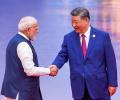
India's dual pursuit of a robust strategic partnership with Washington and a pragmatic, tension-management policy with Beijing represents the essence of modern multi-alignment. By embracing economic pragmatism, learning to compartmentalize political differences, and engaging in continuous dialogue, India can secure its borders, grow its economy, and contribute to a stable, multipolar Asian century, points out Ambassador Rajasekhar.
