
Central tax authorities detected input tax credit (ITC) fraud worth Rs 74,781.56 crore across 30,162 cases in FY26, more than doubling the number of cases from the previous year, according to the Ministry of Finance.

Fitch Ratings forecasts a 9 per cent aggregate revenue increase for rated Indian corporates in the current fiscal year (FY27), a stronger outlook compared to the 5 per cent estimated for FY26, which is expected to keep credit metrics stable despite potential global and domestic challenges.

State-owned refiners Bharat Petroleum Corporation Ltd (BPCL) and Hindustan Petroleum Corporation Ltd (HPCL) have reported substantial losses for the first quarter of financial year 2026-27 (Q1FY27), primarily driven by a sharp increase in crude oil prices exacerbated by the ongoing West Asia crisis and suppressed marketing margins on petroleum products.

Infosys has revised down the upper end of its revenue growth target for financial year 2027 (FY27) to 1.5-3 per cent, from the earlier 1.5-3.5 per cent, attributing the change to persistent macroeconomic uncertainty and a one-time client impact.

'Banking is the only sector that can see double-digit growth in FY27.'

India's leading FMCG companies, including Hindustan Unilever and Dabur, reduced their permanent workforce in FY26, even as most firms in the sector, such as Tata Consumer Products and Marico, increased median employee remuneration, reflecting a mixed trend in staffing and compensation strategies.

HCLTech CEO C Vijayakumar's total salary for the financial year 2025-26 surged by nearly 66.9 per cent to $18.13 million, primarily driven by long-term incentives and stock options, placing him at the top among his Indian IT sector peers.

L&T Finance reported a robust Q1FY27 with net profit growing 29% year-on-year to 900 crore, driven by strong asset growth and strategic initiatives including accelerating cross-selling, improving productivity, and fostering a technology-first, AI-led culture, alongside significant expansion in gold loans.

Divestment has emerged as a priority for the government following a moderation in direct tax collections.

State-owned Bank of Baroda (BoB) reported a 72 per cent year-on-year (Y-o-Y) drop in net profit to 1,278 crore for Q1FY27 due to a $600 million out-of-court settlement related to NMC Health Plc. In contrast, Bank of India (BoI) saw its net profit rise by 36.23 per cent Y-o-Y to 3,068 crore for the same quarter, driven by healthy loan growth and improved asset quality.

A PL Capital report projects India's LPG subsidy bill to exceed Rs 1 lakh crore in FY27, creating a significant Rs 70,000 crore gap over the Union Budget's Rs 30,000 crore allocation, driven by the government and OMCs absorbing higher fuel and LPG price increases.

HDFC Bank, India's largest private sector lender, reported a reduction of 3,343 employees in FY26, bringing its total workforce to 2,11,178, even as its balance sheet expanded by 12 per cent. The bank's MD and CEO, Sashidhar Jagdishan, attributed the headcount reduction to redeploying talent from back-end functions to customer-facing roles due to technology-led efficiencies. The annual report also addressed the challenging resignation of part-time chairman Atanu Chakraborty, which raised questions about the bank's governance standards.

IT major Wipro reported a nearly flat consolidated net profit of Rs 3,352 crore in the April-June quarter of FY27, a marginal increase from Rs 3,330.4 crore in the year-ago period, while revenue from operations grew 10.6 per cent to Rs 24,478.6 crore.

HCL Technologies reported a significant 20 per cent year-on-year increase in its consolidated net profit for the June quarter of FY27, reaching Rs 4,624 crore, while maintaining its revenue growth guidance of 1-4 per cent for the fiscal year.

The Asian Development Bank (ADB) has revised down India's GDP growth forecast for fiscal year 2026-27 (FY27) to 6.6 per cent from an earlier 6.9 per cent, primarily attributing the change to elevated energy prices stemming from the Middle East conflict. Despite this moderation, India is still expected to remain the world's fastest-growing major economy.

Tata Steel plans to invest approximately Rs 20,000 crore in capital expenditure during the current financial year (FY27), a significant increase from the previous year, with 60 per cent of this allocation directed towards its India business for expansion, new technologies, and sustainability.
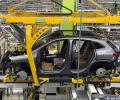
Domestic passenger vehicle dispatches in India reached a record 12,73,811 units in the first quarter of FY27, marking a 25.9 per cent growth, driven by robust domestic demand despite geopolitical headwinds, according to SIAM.

S&P Global Ratings projects India's economic growth to slow to 6.6 per cent in FY27, down from 7.7 per cent in FY26, citing energy stress and a potential sub-par monsoon.

Dubai-based Danube Group plans to launch projects with a combined sales potential of approximately $4 billion in fiscal year 2026-27 (FY27), adopting a more selective approach to new developments as the Emirati property market enters a correction phase.

India's economy in FY26 saw significant momentum from investment demand, with gross fixed capital formation (GFCF) accelerating to 8.2 per cent, while private final consumption expenditure (PFCE) also grew steadily, according to provisional estimates.

Brokerages are forecasting a strong first quarter (April-June/Q1) for Reliance Industries Ltd (RIL) in FY2026-27, with double-digit revenue growth, Ebitda increases of around 12 per cent, and net profit rising up to 10 per cent, primarily driven by its oil-to-chemicals (O2C), retail, and Jio businesses.

Tata Motors Passenger Vehicles is gearing up for the next phase of electric vehicle adoption in India, targeting over 30% EV penetration by FY31. The company plans to launch four new products and over ten refreshes by FY31, expanding its portfolio to ten EV nameplates. This strategy aims to move beyond early adopters to engage the early and late majority consumers, focusing on enhanced range, faster charging, and improved battery technology.
The International Monetary Fund (IMF) has reduced India's growth forecast for FY27 to 6.4 per cent, citing the potential impact of higher energy prices offsetting the country's economic resilience. Despite this, India remains among the fastest-growing major economies.

Leading Fast-Moving Consumer Goods (FMCG) companies in India are expressing strong optimism for the current fiscal year, anticipating robust consumption trends, significant growth, and improved profit margins. This positive outlook is largely driven by resilient demand and the expected easing of elevated input costs, despite ongoing inflationary pressures and potential weather volatility.

Bajaj Finance, India's largest private-sector NBFC, reported a 29 per cent year-on-year increase in standalone net profit to 5,346 crore for Q1FY27, propelled by robust growth in net interest income and assets under management, which surpassed 4 trillion.

The World Bank has increased India's economic growth projection for FY27 to 6.6 per cent, citing resilient domestic demand, while simultaneously cutting its global economic growth outlook due to the conflict in West Asia.

Indian Hotels Company (IHCL) reported a healthy 14.6 per cent consolidated revenue growth in Q1 FY27, largely driven by a robust 17.6 per cent increase in domestic operations, offsetting geopolitical disruptions. Brokerages anticipate sustained growth, with Motilal Oswal Research projecting 12-14 per cent growth in FY27, supported by strong leisure demand and an asset-light expansion pipeline.

India's Central government is likely to see its fertiliser subsidy bill double to a record 3.4 trillion in FY27, up from the Budget estimate of 1.7 trillion, due to surging global fertiliser prices exacerbated by the West Asia war. This significant increase, coupled with revenue losses from excise duty cuts for oil-marketing companies, is straining the government's fiscal space, though capital expenditure plans remain unchanged.
State-owned enterprises in India are projected to significantly increase their overseas borrowings, potentially exceeding $15 billion in FY27, driven by the Reserve Bank of India's new concessional forex swap facility which offers a 3 per cent funding-cost advantage.

India's net direct tax collection has seen a robust 15 per cent increase, reaching approximately 5.21 trillion in the first two and a half months of FY27, as on June 17, driven by strong growth in both corporate and non-corporate tax segments.

Ed-tech unicorn PhysicsWallah is strategically targeting a 30% revenue improvement by FY27, leveraging AI-led automation, aggressive expansion into southern Indian markets, and a strong focus on student learning outcomes and enrolment growth.

Hyundai Motor India Ltd reported a 35 per cent decline in consolidated profit after tax to Rs 888.62 crore in the first quarter ended June 30, impacted by lower revenue and higher expenses, with MD & CEO Tarun Garg noting it was a "challenging quarter".

Jaguar Land Rover (JLR) India reported its highest-ever first-quarter retail sales for FY27, with 1,665 vehicles retailed, an 11 per cent year-on-year increase, largely due to sustained demand for premium SUVs and the benefits of the India-UK Free Trade Agreement.

Chief Economic Advisor V Anantha Nageswaran stated that India's economy is projected to return to a 7 per cent-plus growth trajectory by 2027-28 (FY28), or sooner if external conditions improve, despite near-term challenges from the West Asia crisis.

Eternal's quick commerce platform, Blinkit, significantly outperformed in Q1 FY27, with net order value (NOV) rising 19.1 per cent quarter-on-quarter, indicating strong market share gains driven by increased monthly transacting users and transaction frequency.

India's public sector banks (PSBs) have seen their net profit nearly treble over the past five years, reaching a record Rs 1.98 trillion in FY26, driven by significant improvements in asset quality and sustained lending growth across key economic sectors.

The Reserve Bank of India (RBI) reported a significant 52 per cent year-on-year increase in gains from foreign exchange transactions, reaching 1.69 trillion in FY26. This surge occurred despite the central bank selling a gross $195 billion in the spot market to manage rupee volatility, which saw a 9.85 per cent depreciation.

Larsen & Toubro (L&T) reported a 14 per cent year-on-year increase in Q1 FY27 profit attributable to owners, reaching Rs 3,926 crore, surpassing analyst estimates, despite facing significant supply-chain disruptions in West Asia.

Reliance Industries (RIL) delivered a better-than-expected operational performance in Q1FY27, driven by a recovery in its oil-to-chemicals (O2C) business and robust gains in the telecom (Jio) segment, though its retail arm missed estimates. Analysts highlight the upcoming Jio Platforms IPO and execution in new energy and consumer businesses as key triggers for the stock's future growth.

Indian benchmark indices, Sensex and Nifty, opened higher on Friday, primarily driven by a significant surge in Bajaj Finance shares following its strong Q1 FY27 earnings report, coupled with continued foreign fund inflows and a dip in crude oil prices. Track Sensex, Nifty on July 31.
