This article was first published 14 years ago
Home »
News » PHOTOS: When Indian and US navies met in Pacific
PHOTOS: When Indian and US navies met in Pacific
Last updated on: April 13, 2011 13:19 IST
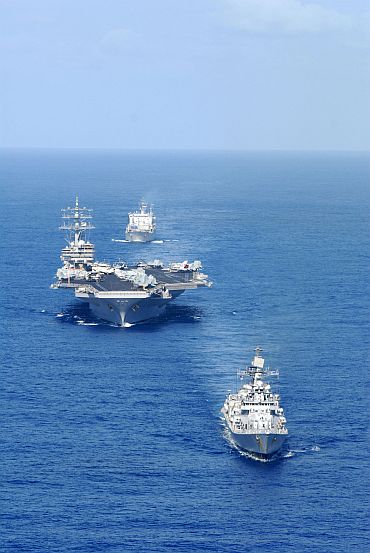
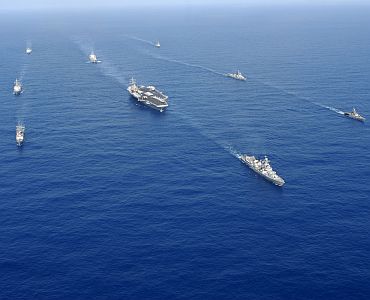
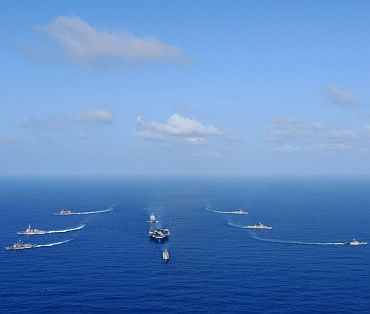
Image: Aircraft carrier USS Ronald Reagan (CVN 76) and ships from Ronald Reagan Strike Group transit the Pacific Ocean in a nine ship formation with the Indian Navy
Photographs: Mass Communication Specialist 3rd Class Dylan McCord/US Navy
Navies of India and the United States recently took part in the annual Malabar training exercise.
Malabar 2011 is the latest in a continuing series of exercises conducted to advance multinational maritime relationships and mutual security issues.
The bilateral naval field training exercise has grown in scope and complexity over the years.
Click on NEXT to see PHOTOS of Malabar 2011...
Image: Aircraft carrier USS Ronald Reagan (CVN 76) and ships from Ronald Reagan Strike Group transit the Pacific Ocean in a nine ship formation with the Indian Navy
Photographs: Mass Communication Specialist 3rd Class Dylan McCord/US Navy
US Navy participants was led by the USS Ronald Reagan strike group.
The strike group brought new participants to join Malabar including Carrier Strike Group 7; Destroyer Squadron 7; Carrier Air Wing (CVW) 14; USS Chancellorsville (CG 63); and USS Pebble. These additions brought approximately 5,000 Sailors to the exercise to work with other US Navy units already participating since April 3 which include USS Stethem (DDG 63); USS Sterett (DDG 104); USS Reuben James (FFG 57); and a nuclear-powered attack submarine.
Indian Navy was represented by INS Delhi, INS Ranvijay, INS Ranvir, INS Jyoti and INS Kirch.
Image: Aircraft carrier USS Ronald Reagan (CVN 76) and ships from Ronald Reagan Strike Group transit the Pacific Ocean in a nine ship formation with the Indian Navy
Photographs: Mass Communication Specialist 3rd Class Dylan McCord/US Navy
The at-sea portions were conducted in the western Pacific Ocean, east of the Luzon Strait and east of Okinawa.
The location coincided with the Indian Navy's western Pacific deployment.
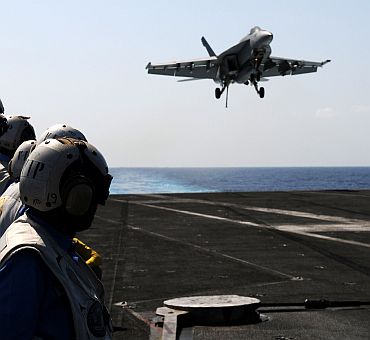
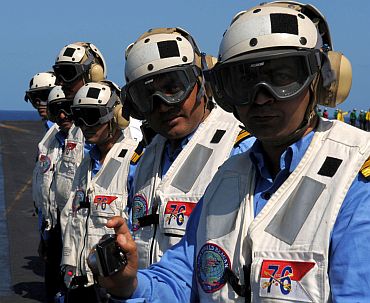
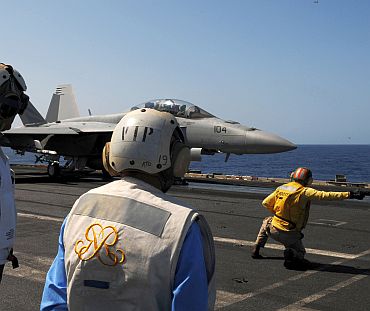
Image: Indian naval officers observe flight operations aboard the aircraft carrier USS Ronald Reagan (CVN 76)
Photographs: Mass Communication Specialist 3rd Class Kevin B Gray/US Navy
The exercise is designed to advance Indio-US military-to-military coordination and capacity to plan and execute tactical operations.
Events planned during the exercise included liaison officer professional exchanges and embarks; communications exercises; surface action group exercise operations; formation maneuvering; helicopter cross deck evolutions; underway replenishments; humanitarian assistance and disaster relief; gunnery exercises; visit, board, search and seizure; maritime strike; air defense; screen exercise; and anti-submarine warfare.
Image: Rear Adm Robert Girrier, commander of Carrier Strike Group 7, observes flight operations on board the aircraft carrier USS Ronald Reagan's (CVN 76) with Indian naval officers
Indian pilot Lt K Srinivasan from the Indian Navy guided-missile destroyer INS Delhi (D 61), embarked aboard the guided-missile destroyer USS Stethem (DDG 63) as a liaison officer, said the exercise fosters a good environment for the two navies to learn from each other and test their compatibility.
"I've seen two Malabar exercises as a pilot and there's always a lot for the Indian navy to learn and the American navy as well," said Srinivasan. "The exercise is very important Very important. You don't really know how well two navies will perform together until you operate together."
Image: Rear Adm Robert Girrier, commander of Carrier Strike Group 7, observes flight operations on board the aircraft carrier USS Ronald Reagan
The Indian Navy Rajput-class guided-missile destroyer INS Ranvijay (D 55) Commanding Officer Capt Dil Bag-Singh, said he looks forward to exercises like this, because it strengthens the bond and personal relationship between the two navies.
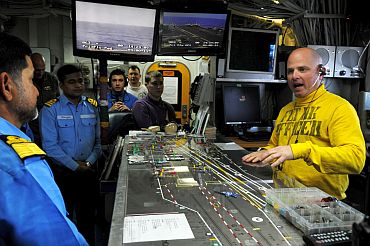
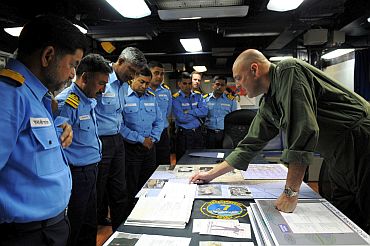
Image: Flight Deck Officer Lt Brian Zimmerman explains how flight deck control manages the aircraft on board the aircraft carrier USS Ronald Reagan (CVN 76) to Indian naval officers
"It's a pleasure to be in an exercise with the US Navy. It's the largest most powerful Navy in the world," said Bag-Singh.
"This exercise helps us strengthen our interoperability and work on strategy. We have common goals and interests in this region and I'm sure this exercise will be a success," he added.
Image: Rear Adm Robert Girrier, commander of Carrier Strike Group (CSG) 7, explains the role of the aircraft carrier USS Ronald Reagan (CVN 76) in Operation Tomodachi to Indian naval officers
The guided-missile frigate USS Reuben James (FFG 57) Commanding Officer Cmdr. David Miller, said it is important to have exercises like Malabar.
"In today's global environment all actions are in conjunction with a multilateral partner," said Miller. As the U.S. and India are two of the largest democracies in the world, it's important to conduct exercises like Malabar so we're able to work effectively."
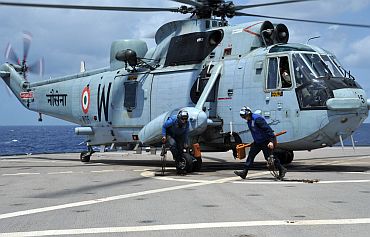
Image: Flight crew members aboard 7th Fleet command ship USS Blue Ridge (LCC 19) remove the chains that secured an Indian MK42 Sea Hawk to the flight deck
Photographs: Mass Communication Specialist 3rd Class Fidel C Hart/US Navy
Miller also commented on how Malabar strengthens ties between people of each Navy.
"Any time we're able to work with the Indian Navy our ties are strengthened. A major component of the exercise is trading liaison officers and having officers from their Navy, Marine, and Special Operations board our ships as well as having our officers board theirs," said Miller.
Image: Flight crew members aboard 7th Fleet command ship USS Blue Ridge (LCC 19) prepare to chain an SH-60F Sea Hawk to the flight deck. The Sea Hawk is attached to the Black Knights of Helicopter Anti-Submarine Squadron 4 (HS-4), embarked on USS Ronald Reagan
Miller pointed out how Malabar helps both navies accomplish common objectives in the region.
"One of our big objectives is theater security operations. That involves strengthening ties, freedom of seas, combating piracy, and helping secure worldwide trade. The Indian Navy provides a big piece of that and this exercise prepares us for any future requirements," said Miller.
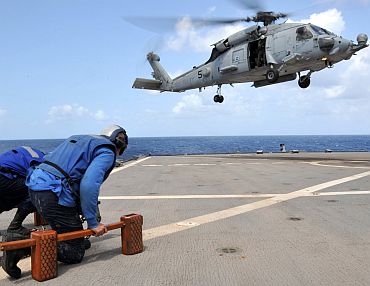
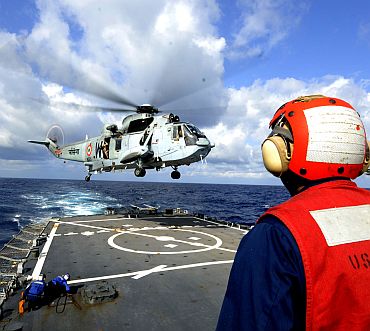
Image: A Sailor attached to the guided-missile destroyer USS Stethem (DDG 63) watches as an Indian MK 42 Sea King helicopter prepares to land on the flight deck, as part of exercise Malabar 2011
Miller added that the cross-training between the two navies made the exercise a success.
"My crew learned a lot. We had very successful training with special warfare teams, and operations with other ships. Being able to meet CO's from Indian vessels was a great opportunity to share experiences," said Miller.
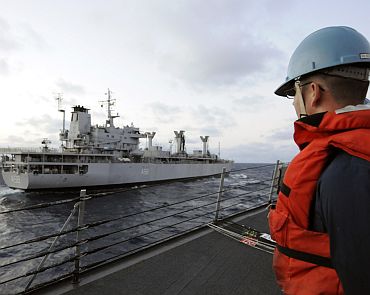
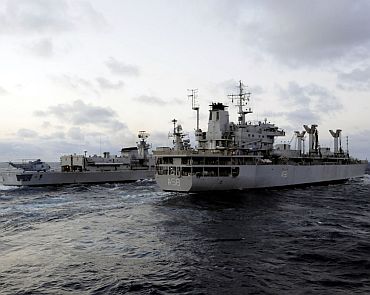
Image: A Sailor attached to the guided-missile destroyer USS Stethem (DDG 63) watches as the Indian fuel tanker INS Jyoti (A 58) pulls alongside during a simulated replenishment-at-sea operation as part of exercise Malabar 2011
Photographs: Mass Communication Specialist 2nd Class Aaron M Pineda/US Navy
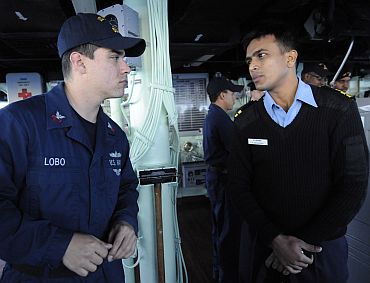
Image: Indian Navy Liaison Officer LT K Srinivasan speaks with Quartermaster 1st Class Carlos Lobo about bridge wing operations aboard the guided-missile destroyer USS Stethem (DDG 63), as part of exercise Malabar 2011
Photographs: Mass Communication Specialist 2nd Class Aaron M Pineda/US Navy
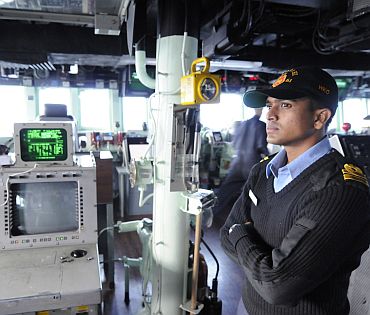
Image: Indian Navy Liaison Officer Lt K Srinivasan observes bridge wing operations aboard the guided-missile destroyer USS Stehem (DDG 63), as part of exercise Malabar 2011
Photographs: Mass Communication Specialist 2nd Class Aaron M Pineda/US Navy
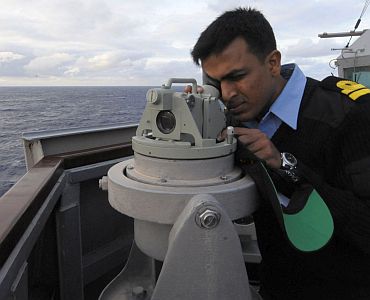
Image: Indian Navy Liaison Officer Lt K Srinivasan looks through a gyro repeater aboard guided-missile destroyer USS Stethem (DDG 63)
Photographs: Mass Communication Specialist 2nd Class Aaron M Pineda/Reuters
Image: The Indian navy fuel tanker INS Jyoti (A 58) and guided-missile destroyer INS Delhi (D 61) sail side-by-side as part of exercise Malabar 2011
Photographs: Mass Communication Specialist 2nd Class Aaron M Pineda/US Navy
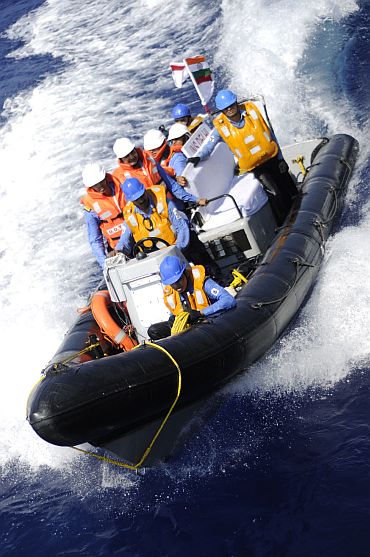
Image: Sailors from the Indian Navy prepare to maneuver a rigid hull inflatable boat into position alongside the guided-missile destroyer USS Stethem (DDG 63), to pick up Indian Navy officers as part of exercise Malabar 2011
Photographs: Mass Communication Specialist 2nd Class Aaron M Pineda/US Navy
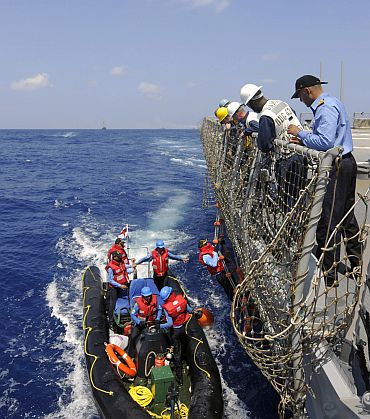
Image: Sailors stationed aboard the guided-missile destroyer USS Stethem (DDG 63) stand by to assist Indian Navy officers climb a pilots ladder, as they embark the ship for exercise Malabar 2011
Photographs: Mass Communication Specialist 2nd Class Aaron M Pineda/US Navy
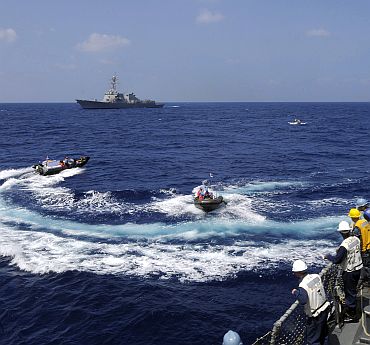
Image: Sailors stationed aboard the guided-missile destroyer USS Stethem (DDG 63) watch Indian sailors transport officers in rigid hull inflatable boats, as part of exercise Malabar 2011
Photographs: Mass Communication Specialist 2nd Class Aaron M Pineda/US Navy
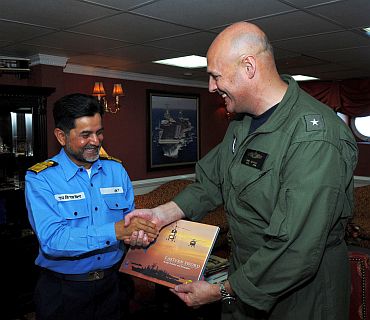
Image: Capt Thom Burke, commanding officer of the aircraft carrier USS Ronald Reagan (CVN 76), exchanges a gift with Indian navy Rear Adm. Harish Bisht, flag officer of Commanding Eastern Fleet in the captain's in-port cabin aboard Ronald Reagan
Photographs: Mass Communication Specialist 3rd Class Kevin B Gray/US Navy
 © 2025 Rediff.com - Investor Information - Advertise with us - Disclaimer - Privacy Policy - Feedback - About us - Terms of use - Grievances