

Photographs: B Mathur/Reuters
This Republic Day one of the most distinguished leaders of South East Asia, Indonesian President Susilo Bambang Yudhoyono, will be India's chief guest.
Widely known in Indonesia with his initials 'SBY', President Yudhoyono, a retired Indonesian army general, was elected as the 6th President defeating incumbent President Megawati Soekarnoputri in 2004.
He again ran for re-election in 2009 and won with an outright majority of the votes in the first round of balloting.
A musician at heart and an avid scholar, President Yudhoyono, during his 27 years of distinguished military service, took an extensive range of training, education and courses, both in Indonesia and overseas.
President Yudhoyono also held numerous important positions as troop and territorial commander, staff officer, trainer and lecturer. He served both in the field and at headquarters, as well as missions overseas.
He was the commander of the United Nations Military Observers and commander of the Indonesian Military Contingent in Bosnia-Herzegovina from 1995-1996.
President Yudhoyana has released three pop albums, and has authored a number of books and articles including Revitalization of the Indonesian Economy: Business, Politics and Good Governance (2002), Coping with the Crisis -- Securing the Reform (1999), and his anthology Taman Kehidupan (Garden of Life).
Please ...
From an 'underdog' to the leader of the people

Photographs: Reuters
Prior to being elected, President Yudhoyono held various important government positions, including minister of mining and energy and coordinating minister for political, social, and security affairs in the National Unity Cabinet under President Abdurrahman Wahid.
He again served as coordinating minister for political, social, and security affairs in the Gotong Royong cabinet under President Megawati Soekarnoputri. It was in his capacity as coordinating minister that he became internationally recognised for leading Indonesia's counter-terrorism efforts, especially after the 2002 Bali bombing, which killed 202 people.
By 2003 there was a gathering momentum behind the possibility of Yudhoyono being a presidential candidate. In September 2003, Yudhoyono's The Democratic Party began to make preparations in case Yudhoyono was willing to accept a presidential nomination.
The Democratic Party then initiated a publicity campaign to promote Yudhoyono as a candidate.
In March 2004, Yudhoyono resigned from the post of coordinating minister of political and security affairs after a fallout with then President Soekarnoputri. His popularity skyrocketed ever since, as he was perceived as the 'underdog' by the people of Indonesia.
His Democratic Party won by a slender 7.5 per cent of the votes in 2004 presidential elections, which was still enough to nominate Yudhoyono as a presidential candidate. Yudhoyono accepted the nomination and picked alliance partner Golkar party's Jusuf Kalla as his running mate.
Yudhoyono's manifesto for the future of Indonesia, summarised in a book titled Vision For Change written by him, was built on four pillars: prosperity, peace, justice and democracy.
At the top of his agenda was a plan for increasing economic prosperity, aiming for economic growth of at least 7 per cent and a revival of small and medium-sized enterprises. He also put forward policies to offer better credit lines, to cut red tape, improve labour laws and to root out corruption from the top down.
President Yudhoyono's packed schedule in India
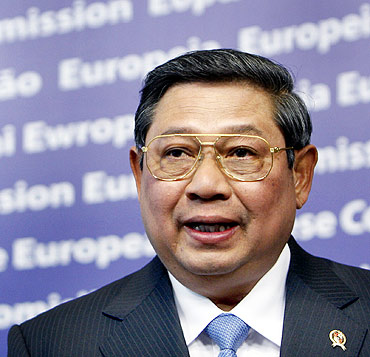
Photographs: Thierry Roge/Reuters
President Yudhoyono arrived in New Delhi on Monday on a three-day state visit. There will be a ceremonial welcome for the visiting President at the Rashtrapati Bhavan on Tuesday. Thereafter, he will place a wreath at Mahatma Gandhi's memorial at Raj Ghat.
External Affairs Minister S M Krishna will call on President Yudhoyono at Hotel Taj Palace later on Tuesday.
The Indonesian President will meet the Prime Minister Dr Manmohan Singh, at around 12.15 pm at Hyderabad House on Tuesday. There would be delegation level talks later during which several agreements are expected to be signed between both nations.
After his meeting with Dr Singh, the visiting dignitary will attend a business meeting at Hotel Taj Palace at around 1:30 pm, which is being jointly organised by the Associated Chambers of Commerce and Industry of India
Leader of Opposition in the Lok Sabha Sushma Swaraj, will call on President Yudhoyono at 3.30 pm on Tuesday.
Indonesian President will then meet Vice President Mohammad Hamid Ansari, which would be followed by a call on by Congress President Sonia Gandhi.
President Yudhoyono will then call on President Pratibha Devisingh Patil on Tuesday evening, who will host a banquet in his honour at the Rashtrapati Bhavan.
On Wednesday, he will participate in the Republic Day Parade 2011 as the chief guest.
article