
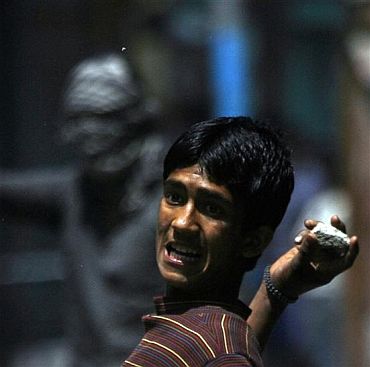
Photographs: Reuters Abhishek Mande
Clinical psychologist Sadia Raval talks about what drives young teenagers today to take drastic steps like killing their family members to support their lifestyle.
Earlier this month, a 16-year-old boy killed his grandmother, stole money and jewellery from his family home in Mumbai because he wanted to buy a bike and splurge on 'hookah' and pool parlours.
The story of this nameless boy -- the media is not allowed to reveal his name since he is a minor -- has not only shaken up his neighbours and friends but has also brought to light the oft talked about issue of dealing with teenagers.
Clinical psychologist Sadia Raval points out that while the issue of parents not being able to understand teenagers is perhaps one of the oldest concerns, the fact also remains that the 'generation gap' has over the last few years widened more than ever.
Much of this, she suggests, is because of the lifestyle the parents lead.
"People today don't have the time the way their parents did. There is so little space and time to exchange real feelings, emotions and ideas that it is leading to a rather narrow emotional development of a child.
Even in school, the focus is on competition and how many marks you score in your exams. We seem to forget to tell the kids that it is okay to lose. No one seems to say that any more," Raval says.
'We've become more indulgent and pleasure-oriented'

Sadia Raval also points to another evolving but overlooked sociological fact.
The Mumbai boy's actions, she says is a culmination of what we as a society have turned out to be in the last 20 years.
She continues, "We've become more indulgent and pleasure oriented (as a society) and dont do too well while (dealing with) difficult situations
We have become more complaining and less tolerant. We don't see not having enough as being a part of life.
Rather than making the most of all the things we have, we tend to focus on and bicker about the one thing we don't. The kids do the same.
Today, if a child doesn't have a game on her/his computer it is a big deal. It wasn't always like this. Even if they didn't have something they could somehow still be happy.
But when the entire society has become more pleasure seeking and indulgent, it makes not having something intolerable for teenagers."
According to Raval, stealing small amounts of money from home is more common than one would like to believe.
She adds that while earlier conflicts between teenagers and parents were largely restricted to freedom to choose what to wear and when to return home, today's teenager is acutely concerned with how much money is at her/his disposal.
"Children often steal money to splurge on their friends rather than on themselves because how their peers perceive them is extremely important to them," she says.
While Raval admits there are teenagers who are concerned about their achievements, the need to belong is on the top of the minds of most others.
"These teenagers are worried about how many boyfriends or girlfriends their friends have or how many friends they have on Facebook or even the parties they are or arent invited to.
They often want to be seen as being hip and be in the limelight all the time."
And to be the centre of attention they tend to do everything they can.
The key, Sadia Raval says, is to look for certain traits of 'conduct disorder'.
Illustration: Uttam Ghosh
What appears to be fun isn't necessarily fun

The National Center for Biotechnology Information (NCBI) at the US National Library of Medicine (NLM) describes it as 'a disorder of childhood and adolescence that involves long-term (chronic) behaviour problems such as defiant or impulsive behaviour, drug use and criminal activity'.
According to Raval, children with conduct disorders are aggressive in their behaviour, tend to bully and intimidate others, initiate fights, steal, derive satisfaction from physically hurting persons or animals and seemingly have no empathy, remorse or awareness of what they are doing.
"You have to see the indulgence pattern of the child and understand what kind of impulse control they have and whether they can stop or delay themselves when they really want something.
Raval says that there could have been a lot of factors that may have led the boy to do what he did and one may never know the reason that triggered this action but as someone who specialises in dealing with children and teenagers every day, she probably also isn't surprised.
"A lot of teenagers are taken in by the 'fun pictures' their friends post on the Internet and attempt to be them or if not, be accepted by them," Raval says adding that in their attempt to be 'cool' and 'in' they stress themselves out so much that the whole idea of having fun is lost.
"What they don't appears to be fun to them, she concludes, is not such great fun after all."
Comment
article