
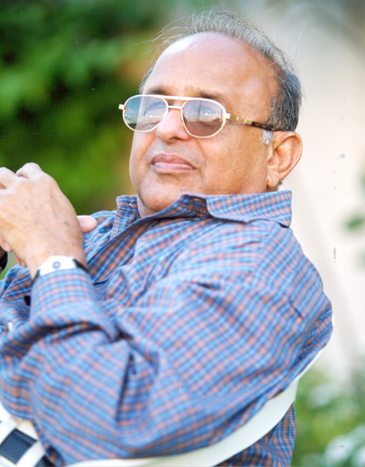
At the height of the match-fixing saga a decade ago, Kapil Dev, then India coach, had overruled captain Sachin Tendulkar's decision to enforce the follow-on against New Zealand in the Ahmedabad Test, recalls former Board of Control for Cricket in India secretary Jaywant Lele in a new book.
"The subject of match-fixing was riding very high at that time (1999-2000). It was a Test match in Ahmedabad against New Zealand. India had put on a mammoth total of 583 runs in the first innings, against which, the visitors could post only 308. Everyone expected India to impose a follow-on," Lele has written in his autobiography I was There – Memoirs of a Cricket Administrator.
"Sachin Tendulkar, the captain of the Indian team, went to the opposition captain (Stephen) Fleming, and told him that they had to bat again. He told the umpires that India was imposing a follow-on and told them to show a few balls to our opening bowlers for selection.
"From there, he walked to the dressing room and instructed (Javagal) Srinath and Venkatesh Prasad to select the new ball. They nodded, and, as they spoke, Kapil Dev, the Indian coach, who was some distance away, shouted to Sachin, 'Captain no follow-on! Our bowlers are tired. We will bat'."
Borde and I exclaimed: 'What? Why, why not impose a follow-on'
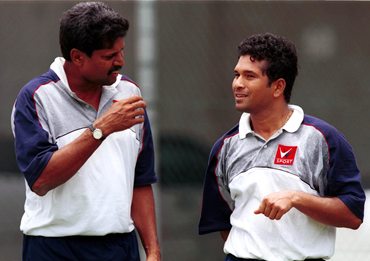
Photographs: Getty Images
Lele recalls how the then chairman of the selection committee, Chandu Borde, was taken by surprise by the decision of not imposing the follow-on.
"Chandu Borde, the then chairman of the selection committee and I, exclaimed, 'What? Why, why not impose a follow-on.'
"Sachin, as he is a gentleman par excellence (in fact, sometimes more than required), tamely obeyed. After all, the coach of the stature of Kapil was ordering him!
"(Sachin): 'Haan, theek hai, paaji. Lekin maine to unko bol diya hai ki hum follow-on de rehe hai' (Okay, but I have already told them that we are enforcing a follow-on).
"(Kapil): 'To phire se jaake bol do, woh maan jaayenge' (So what? Tell them we are changing the decision. They will agree).
"It was ridiculous! No opening bowler had ever said they were tired. Where was the question of objection by the opponents? In fact, they would be happy that they were being saved from the disgrace of a follow-on! So, New Zealand captain Fleming gladly agreed and the match proceeded. It ended in a draw," wrote Lele.
'Naturally, the rumours of match-fixing and betting reached a peak'
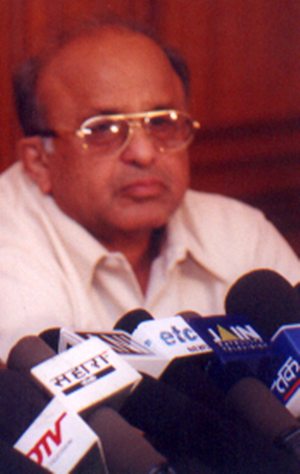
Photographs: Getty Images
"If the decision of not imposing a follow-on at that stage was a great shock for persons like Chandu Borde, why talk about me? What about the reaction of crores of Indian cricket fans?
"It created a huge wave of shock in the country. Naturally, the rumours of match-fixing and betting reached a peak! It took some time for us to recover from that shock," Lele adds in the book.
Lele felt that the move not to impose the follow-on was a bad and extra-cautious decision.
"It was a sheer bad and extra-cautious decision on the part of the Indian captain/coach to ensure that their side does not lose the match under any circumstances.
"A local cricket lover hosted a party for the Indian team at his farm-house that night. Many BCCI officials, former players, cricket pundits and some top personalities from Ahmedabad were present. I understand that while investigating the matter for match-fixing/betting, CBI questioned Kapil on this point. Sachin was also called as a witness, and I am told that he deposed that it was a team decision.
"All said and done, I believe it was strange and unusual, but a bad decision in retrospect, and it had nothing to do with match-fixing or betting. However, the decision remained one of the most controversial, as not very surprisingly, it generated rumours about the credibility of some individuals."
Kapil, India's 1983 World Cup-winning captain, was later replaced by former New Zealand opener John Wright, which paved the way for foreigners donning the coach's mantle that has continued till now barring brief periods of transition, notably, when Australia's Greg Chappell stepped down after the 2007 World Cup disaster, later to be replaced by South Africa's Gary Kirsten.
Comment
article