
Chips based on ARM processor technology would be linked together to simulate the highly-complex workings of the brain, whose functionality derives from networks of billions of interacting, highly-connected neurons.
The chips upon which this work critically depends have passed functionality tests and were delivered last month, according to a University of Manchester press statement.
A massive computer called SpiNNaker (Spiking Neural Network architecture) aims to map out the brain's individual functions. SpiNNaker could also be a vital tool for neuroscientists, psychologists and doctors to help understand complex brain injuries, diseases and conditions, and identify the most effective therapies.
...
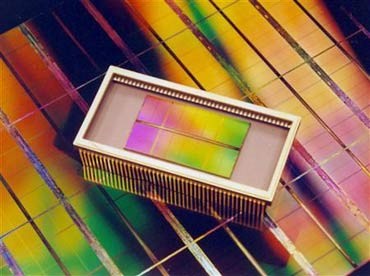
The University of Manchester was selected to design the system architecture for the project. It received half the 㵭million EPSRC grant that supported the work, while the universities of Southampton, Cambridge and Sheffield share the rest to work on other parts of the project.
Even though there would be up to one million ARM processors, the technology used in most mobile phones, in the final SpiNNaker machine, computer scientists say this would enable them to recreate models of only up to one per cent of the human brain.
The researchers, lead by Professor Steve Furber, believe the machine would be a vital tool for neuroscientists and psychologists to test hypotheses on individual brain characteristics.
The key challenge is developing and understanding information processing in the brain and the extremely high connectivity of the brain cells.
...

There are 100 billion neurons with 1,000 million connections in the human brain. The neurons emit spikes which are relayed as tiny electrical signals.
Each impulse is modelled in SpiNNaker as a 'packet' of data, a scaled down version of the way the internet carries information. This packet is then sent to all connected neurons that are represented by small simple equations, which are solved in real-time by software running on the ARM processors.
The electronic connections in SpiNNaker convey these spikes much quicker than the biological connections in the brain.
The SpiNNaker can thus transmit spikes as effectively and quickly, with fewer connections.

 © 2025 Rediff.com - Investor Information - Advertise with us - Disclaimer - Privacy Policy - Feedback - About us - Terms of use - Grievances