There is need for trans-national political mobilization in favour of more equitable systems, says Rajni Bakshi.
The threat of a United States debt default seems to have dissolved, for now.
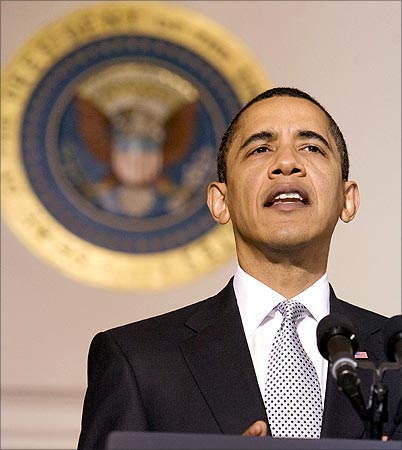
Late on Sunday night President Obama announced that US lawmakers have come to an agreement to reduce their country's budgetary deficit and avert an unprecedented default that would have devastating effects on the American economy and grim repercussions internationally.
This does not mean that global financial markets are no longer hanging off a cliff by a slender thread.
Paul Krugman, the Nobel Prize winning economist, has called the agreement a disaster for the US economy, President Obama and his party.
Krugman predicts that the deal struck over the weekend will further damage an already depressed economy and probably make America's long-run deficit problem worse, not better.
Last week, noted economist Nouriel Roubini had called Capitol Hill's turmoil over the issue of raising the debt ceiling a 'farce'. Noting that almost no democracy has a debt ceiling, Roubini said: 'A decade of bipartisan deficits and tax cuts led us here. Raise the ceiling!'
Roubini, who is famous as one of the few people who foretold the financial meltdown of 2008, said in a tweet posted last week that tax cuts of the past were ill-advised.
. . .
'Federal taxes were 20% of GDP at time of a balanced budget. Now down to 14% the lowest in 60 years. So any deficit reduction requires tax hikes,' he tweeted.
Over the next few days we will hear more detailed critiques and, perhaps even some favourable analysis, from leading economists and players in the financial markets.
What is not likely to get much, or any, space in the mainstream media is the continuing clamour for profound monetary reforms. That is because this activity tends to remain relatively on the fringes of public life in the US.
In his statement late on Sunday night President Obama claimed that the deal he has struck to prevent a default of the US debt will also '. . . allow us to turn to the very important business of doing everything we can to create jobs, boost wages, and grow this economy faster than it's currently growing'.
However, a wide variety of monetary reform advocates believe that none of this is possible without major changes in the way the money system works.
There is at least one Congressman in the US Congress who agrees with this analysis and is pushing for legislation that would bring about monetary reform. Rep. Dennis Kucinich, a Democrat from Ohio, has been in the House of Representatives since 1997.
He is affiliated with the American Monetary Institute (AMI), an organisation committed to 'the independent study of monetary history, theory and reform'.
. . .
Over the last few years an expanding range of monetary reform groups have come up. That is because the basic proposition of an entity like the American Monetary Institute is rather compelling: 'Over time, whoever controls the money system controls the nation.'
In December, 2010, Kucinich introduced a bill that aims to establish fiscal integrity by reasserting Congressional sovereignty and regaining control of monetary policy from private banks.
Kucinich's proposal, called The National Emergency Employment Defense (NEED) Act, would end the current practice of fractional reserve lending, in which the economy depends on private financial institutions to lend money into circulation.
If enacted, this bill would replace the Federal Reserve System's dependence on private banks to create credit. It would be replaced by a Monetary Authority, under the Treasury Department, that would directly inject liquidity into the economy by facilitating much needed repair of public infrastructure.
This, argues Kucinich, is one way to resolve a painful anomaly. The US economy has idle capital, millions of able-bodied but unemployed workers, unused equipment, and record low interest rates -- yet all of this is not coming together.
Speaking in Congress last week, Kucinich argued that if the US pulls out of the war in Iraq and Afghanistan it will save $1 trillion over ten years.
Repealing tax cuts to the wealthy will save another $1 trillion. Medicare for all will end the $400 billion yearly subsidies for the health insurance industry.
. . .

Given the political climate in the US such proposals have no chance of moving to centre stage on Capitol Hill.
Several commentators have condemned President Obama for appeasing the far-right which opposes reforms in favour of greater equity.
Robert Kuttner, business writer and author, has described the US as having been rendered ungovernable except on the extortionate terms of the far-right: 'For the first time in modern history, one of the two major parties is in the hands of a faction so extreme that it is willing to destroy the economy if it doesn't get its way.'
Even if Congress votes to accept the deal struck over the weekend it is still possible that the USA's AAA credit rating may be downgraded.
Thomas Greco, who hosts a website called Rethinking Money, argues that the situation calls for a wider recognition of a core flaw in a global economic system -- namely that debt has been growing much faster than any measure of economic output.
'The financial crises we are seeing in various countries and economic sectors are evidence that the debt burdens have grown far beyond what can be borne by either the private sector or by governments,' writes Greco, who is the author of a book titled The End of Money and the Future of Civilization.
But how do you stop the growth of debt? Detailed answers to this tend to be complicated. But the essence of it is simple enough. There is need for trans-national political mobilization in favour of more equitable systems.
 © 2025 Rediff.com - Investor Information - Advertise with us - Disclaimer - Privacy Policy - Feedback - About us - Terms of use - Grievances