Cross-check key documents, maximise your deductions, avoid errors, and ensure you get your refund smoothly.
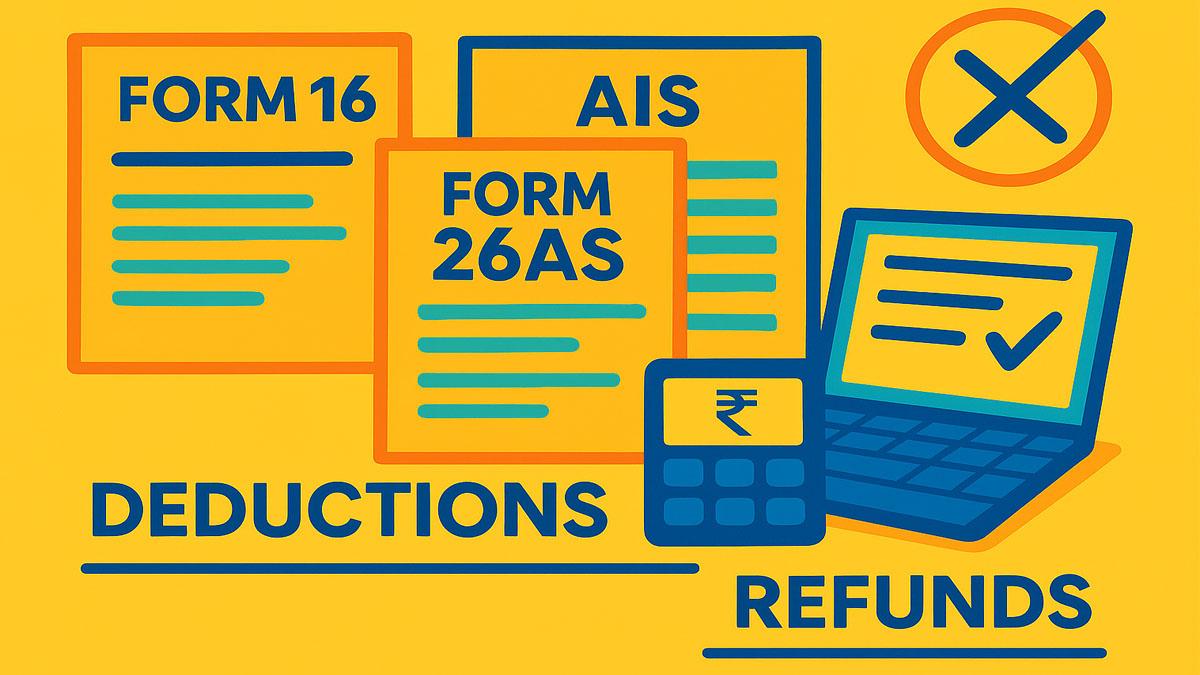
Kindly note that this illustration generated using Microsoft CoPilot has only been posted for representational purposes.
Ensuring your ITR is accurate goes beyond just filling out the right form. This combined section dives deep into the must-see documents (Form 16, Form 26AS, and AIS, also explained earlier in Part 2), explains how to cross-check every detail and why this matters for your refund or compliance, unpacks the most valuable deductions you can claim (and how to prove them), and highlights the most common filing mistakes -- whether it's choosing the wrong form, missing interest income, or forgetting to e-verify.
By mastering these details, you can maximise your tax savings, minimise your risk, and get your refund faster.
What Are Form 16, Form 26AS, and AIS?
Three essential documents smooth the tax puzzle:
Form 16 -- The Salary Certificate
- Issued by your employer after the financial year ends. Splits into:
- Part A: Details of TDS deducted and deposited to the government.
- Part B: Breakdown of salary, allowances, deductions (under Section 80C, etc.), and tax computation.
Use: Cross-check your employer-reported income and TDS with your actual salary slips.
Form 26AS -- Your Tax 'Passbook'
- Downloaded from the tax portal.
- Shows all TDS (on salary, FD, rent, etc.), tax paid by you (advance/self-assessment), and some high-value transactions.
- Acts as a record of all tax deposited against your PAN.
Use: Verify all tax paid IT matches what's in the department's records.
AIS (Annual Information Statement)
- A new portal feature listing all financial data reported by banks, mutual funds, employers, etc.
- AIS includes financial information -- such as interest, dividends, mutual fund redemptions, share transactions, and even property purchases or rent received -- reported by various entities that may not be covered in Form 16 or 26AS..
Use: Spot if you missed anything -- report accordingly to avoid tax notices.
Why Cross-Checking Matters:
- Mismatches can lead to processing delays, refunds held up, or even penalties.
- Fix errors with your employer/bank before filing the return.
Practical Steps:
- Always download all three: Form 16 (from employer), 26AS (from the portal), and AIS (also from the portal).
- Match every number -- especially TDS, interest, and side income -- between documents and your ITR.
Claiming Tax Deductions and Getting Refunds
Deductions lower your taxable income. Claiming them properly maximises legal savings and boosts your chance for refunds.
Popular Deductions:
- Section 80C: Life insurance, PPF, EPF, NSC, ELSS, tuition fees, principal of home loan (limit: Rs 1.5 lakh only).
- Section 80D: Health insurance premium (yourself, family, parents).
- Section 24(b): Home loan interest (limit: up to Rs 2 lakh).
- Section 80E: Interest on educational loans.
- Section 80TTA: Deduction up to Rs 10,000 on savings bank interest (for individuals below 60).
- Section 80TTB: Deduction up to Rs 50,000 on savings and fixed deposit interest (for senior citizens only)
How to Claim:
- Collect all investment proofs -- mutual fund, insurance premium receipts, etc.
- Enter amounts in the relevant ITR fields -- keep proofs if tax office asks later.
- Salaried? Check employer's year-end tax declaration for entries missed there; you can still claim them in your return.
Refunds:
- If TDS/advance tax paid > actual tax due, you're eligible for a refund.
- Ensure your bank account is pre-validated and linked to your PAN on the income tax portal to receive refunds smoothly.
- Track status using 'Refund/Demand' on the income tax portal.
Tips:
- Only claim legitimate deductions -- don't round up or 'guess'.
- Keep receipts and proofs for at least 6 years -- and up to 10 years in case of high-value transactions or queries.
- File ITR early for faster refunds.
Mistakes To Avoid While Filing ITR
Even smart filers can make basic errors. Here's what to watch out for:
Most Common Errors:
- Wrong ITR form: May lead to defective return notice.
- Missing interest income: Banks report savings/fixed deposit interest to the tax department -- a common audit trigger.
- Mismatched TDS: Not matching what's in Form 26AS/AIS versus your calculation.
- Skipping previous employer's salary: If you changed jobs, add all incomes.
- Not e-verifying the return: If you don't e-verify your return within 30 days of filing, it will be treated as not filed -- leading to penalties and refund delays.
Financial Consequences:
- Interest and penalties on underreported or misreported income.
- Loss of refund if mistakes are not fixed in time.
- Rejection or long hold on finance/visa/legal requests if return is found defective.
Quick Fixes:
- Always check and compare your numbers with Form 16, Form 26AS, and AIS.
- If you spot a mistake after filing, you can revise your return within the due date.
- Use available helpdesks and FAQs if stuck.
Checklist Before Submission:
- Correct ITR form
- No missing incomes/interest
- Deductions supported by proof
- Bank account checks for refunds
- Return e-verified
By routinely reviewing your tax documents, claiming all eligible deductions, and watching out for common pitfalls, you'll not only avoid delays and penalties but also make your ITR filing a much smoother, more rewarding process. These steps ensure your return is accurate, complete, and sets you up for future success.
Now that you've mastered the ITR filing basics, what remains is handling multiple Form 16s -- especially if you switched jobs during the year -- and resolving issues that arise from them. That's what we'll tackle tomorrow.
