
'Such stocks may be useful for aggressive portfolios, but should not be part of the core holdings.'

Securities and Exchange Board of India Chairman Tuhin Kanta Pandey recently cautioned mutual funds against investing heavily in microcap companies, citing liquidity constraints and volatility.
Retail investors who invest directly in these stocks or indirectly through mutual funds need to be mindful of the associated risks.
Microcaps are firms ranked beyond the top 500 by market cap.
High return potential
Microcaps offer early-stage growth opportunities.
"If the business model scales up, wealth creation can be significant as today's microcaps become tomorrow's midcaps," says Shrikant Chouhan, head of equity research, Kotak Securities.
"A successful new product, expansion into new markets, or a strategic partnership can lead to rapid growth and significant returns," says Devarsh Vakil, head of Prime Research, HDFC Securities.
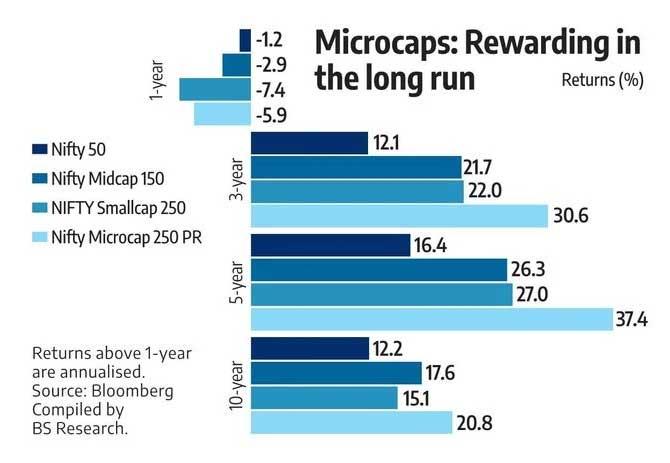
Over the long run, microcaps have delivered strong performance.
Volatile and illiquid
Microcap stocks have been more volatile than large-caps in the past 15 years.
"The Nifty Microcap 250 Index has shown 21 to 24 per cent yearly volatility versus 13 to 17 per cent for the Nifty 50," says Varun N Joshi, smallcase manager and director, GoalFi.
Thin trading volumes result in high impact cost.
"Even a few lakh rupees worth of buying or selling can move the stock significantly," says Chouhan.
Vakil adds that these stocks are vulnerable to market fluctuations, economic changes, and company-specific news.
Poor execution means many good ideas fail to scale.
Are they right for you?
Investors need strong conviction and a high risk appetite.
"They should be mentally prepared for portfolio drawdowns of 30 per cent or more," says Pawan Bharaddia, co-founder and chief investment officer, Equitree Capital.
"Such stocks may be useful for aggressive portfolios, but should not be part of the core holdings," says Umeshkumar Mehta, CIO, SAMCO MF.
Due diligence is critical
Retail investors need to look out for red flags.
"These include accounting irregularities, poor liquidity (daily trading volume less than Rs 5 crore), excessive promoter pledges, high frequency of management changes, and abnormal trading activity," says Joshi.
Investors should check debt levels, quality of cash flow, and reliance on a single customer or supplier.
Pay attention to issues like resignation by the auditor and related party dependencies.
Mehta specifies that the promoter's shareholding should be above 40 per cent, and not more than 5 per cent should be pledged.
On financials, he suggests that the company's profitability should have grown at 25 per cent or above over the past three years.
Avoid companies red-flagged by regulators.
Bharaddia warns against investing in fashionable sectors without adequate knowledge, entering at stretched valuations, or betting on companies that frequently issue equity.
"Investors should limit exposure to 5 to 10 per cent of the portfolio and have a 5 to 7 year horizon," says Joshi.
One open-end passive mutual fund option exists: Motilal Oswal Nifty Microcap 250 Index Fund.
"Seasoned investors with high risk tolerance, surplus capital not required for essential goals, and who can stay invested for 8 to 10 years can consider a measured allocation in their satellite portfolio," says Charu Pahuja, certified financial planner, group director and chief operating officer, Wise Finserv.
Disclaimer: This article is meant for information purposes only. This article and information do not constitute a distribution, an endorsement, an investment advice, an offer to buy or sell or the solicitation of an offer to buy or sell any securities/schemes or any other financial products/investment products mentioned in this article to influence the opinion or behaviour of the investors/recipients.
Any use of the information/any investment and investment related decisions of the investors/recipients are at their sole discretion and risk. Any advice herein is made on a general basis and does not take into account the specific investment objectives of the specific person or group of persons. Opinions expressed herein are subject to change without notice.
Feature Presentation: Ashish Narsale/Rediff
