|
|
 Email this Page | Email this Page |  Write to us Write to us
'Don't get up till the bear goes away'
The Himalayan black bear is abundant in the Govind Wildlife Sanctuary, and it is a big, aggressive animal. It is also widely hunted for its gall bladder, which is used in Chinese medicine, and can fetch a poacher anything from Rs 90,000 to Rs 4,50,000.
The bears being 7 foot tall -- they can easily stand on their hind legs, which makes them perfect circus animals -- it is a moot point who will extract whose gall bladder in an even encounter.
When we asked Irbir what to do if we come across a bear, he said "Lait jana, aur uthna nai jab tak ki bhalu chala na jaye [Lie down, and don't get up till the bear goes away]." Then he proceeded to narrate how a bear waited beside his uncle on the road to Har Ki Dun. His uncle had to play dead for half an hour, it seems.
Man-animal conflicts abound in this land of the gods -- Uttarakhand is called 'Devbhumi' -- and big sheep dogs have iron collars with spikes on them, so that they can fight leopards if need be.
• Airfare for Rs 599 and less!
Most of the villagers rear sheep and cattle, which they take higher up to graze as the snow melts from May to October, and bring down as the snow takes over November to April. In the nights, they keep vigil for animals, and almost every villager will have some animal tale to tell.
In winters, Seema and Osla -- which is the main village, Seema is just a four-hut trekker's halt -- are buried under eight to 10 feet of snow. And with little to fight the cold, the villagers mostly stay inside their little log huts, eating lots of meat and drinking just as much to keep warm. This way of life has remained untouched for decades, except that there is now solar powered lights -- provided by the government -- in the 120 houses of Osla.
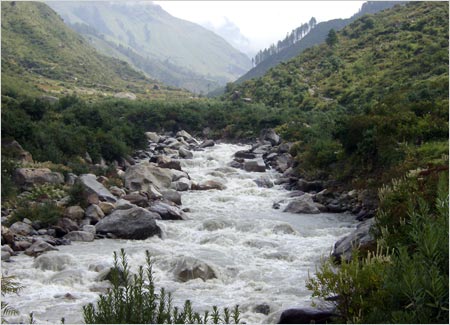
Another government presence and sign of 'development' is the new bridge across the Supin. The last time I was here, it was a makeshift bridge that the gushing Supin broke four times a year, mostly during the monsoons.
Text and Photographs: Sumit Bhattacharya
 Also read: The magic and mystery of Arunachal
Share YOUR travel stories and pix!
Have you been to Har Ki Dun? What was your favourite sight there? Where did you have the best meal? Do you have a hotel to recommend?
Do post details on the message board below so other readers can benefit from your advice. Remember to add information on what was special about the restaurant, hotel or sight you visited, along with relevant telephone numbers and addresses.
|
|
|
 Advertisement