
'I knew the finger was broken but I told the physio that I don't want to take any painkillers.'
'I was in very good rhythm and I just wanted to carry on.'
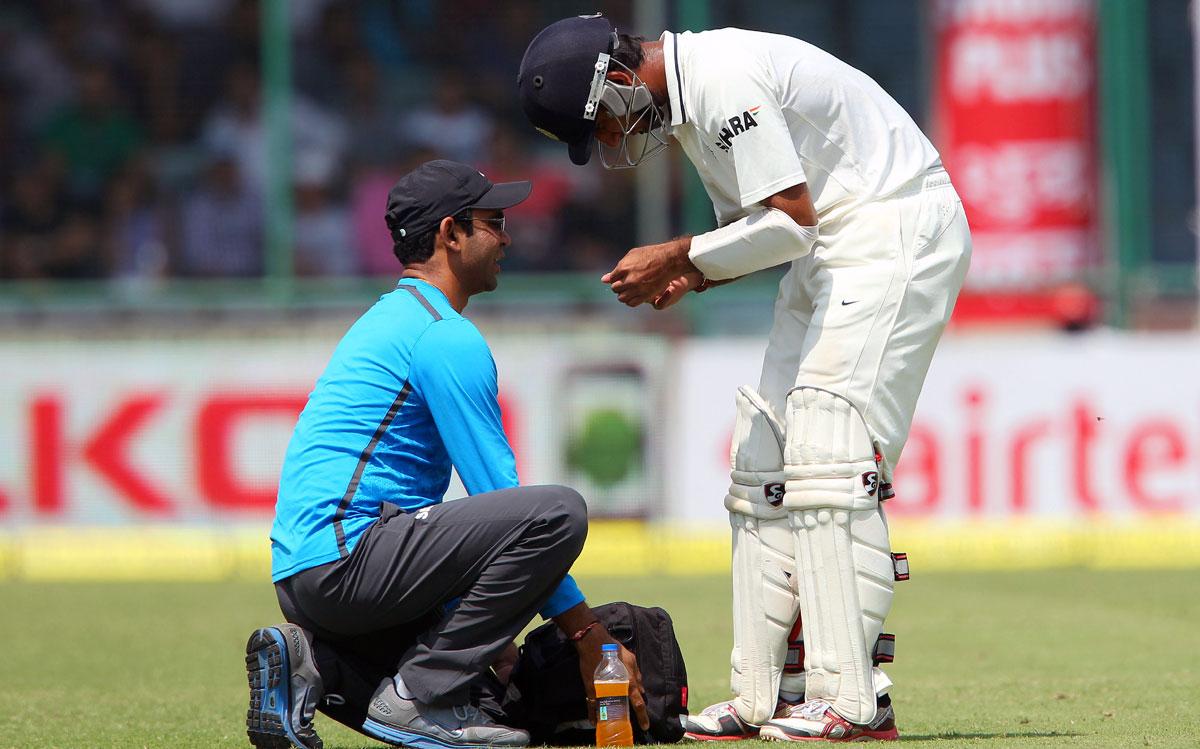
Cheteshwar Pujara played the innings of his life when he took as many as 11 blows on his body for a defiant half-century (56 from 211 balls) to set up India's historic series-clinching victory against Australia in the Brisbane Test in 2020-2021.
What was even more remarkable was that he came out to bat with a broken finger, refused to take painkillers and continued to bat despite getting hit on that same finger again, playing a major role in India's second successive Test series triumph in Australia.
This was not the first time that Pujara had defied pain for the his country.
During the Delhi Test against Australia in 2013, the Saurashtra right-hander walked out to open the innings with a fractured finger and ended up scoring an unbeaten 82 to guide India to victory.
"It was tough. I was in a lot of pain. But you always look at the bigger picture. You always put your team first," Pujara tells Rediff's Harish Kotian in the concluding segment of a two-part interview.
You have defied pain many times while playing for India in Tests. During India's historic 2021 Brisbane Test win, you were hit by the Australian bowlers 11 times on your body, scoring a vital 56.
And before that you batted with a broken finger during the Delhi Test against Australia in 2013, scoring 82 not out to help India chase down 155 on a rank turner?
How did you manage to bat for such long period of time despite the pain?
Talking about that injury in 2013 actually, not many people are aware about that particular knock because I had opened the innings. I had a fractured finger, it happened during the game.
And then everyone knew that if I had to bat, I had to take local anesthesia on my finger and then go out and bat. But there wasn't enough time for me to just take that and then wait for me to bat at No 3.
So, what the management and the physio decided that we will take the anesthesia and I will the open the innings because the effect of anesthesia lasts for a couple of hours and I can carry on batting.
I took the anesthesia and I carried on batting and then during the middle session, I remember I had to take another anesthesia. I had to take it twice during the break and that lasted for the entire innings and we ended up winning that Test match. I was not out on 82 and Mahi bhai (Dhoni) was the other end.
I remember that innings because we were in a spot of bother at one point but eventually, we won that game. It was a tricky phase, it was a tough pitch.
It was one of the most satisfying knocks for sure without any doubt because when you are playing with a broken finger, you know that you can't bat the same way. Psychologically, it affects you when you know that you have a broken finger and then if you get hit on that spot again while batting, then anything can happen.
But yeah, I managed that. And similarly, even in 2020-2021 in the Gabba Test, I got hit on the finger. I knew that my finger is broken because the amount of pain I was having.
I knew the finger was broken but I told the physio that I don't want to take any painkillers. I was in very good rhythm and I just wanted to carry on. And anyways, I was getting hit on the body quite often.
So, I told him that I am able to bear the pain and I will carry on doing that and we will see what happens ultimately.
So you batted in the entire Brisbane Test with a broken finger? It must have been very painful and tough...
Yes, because I got injured during a net session at Sydney before the match started.
And we knew at that moment that there might be a hairline fracture. But we didn't end up scanning that finger. I was just trying to protect it.
There was no point in us going for the scan and thinking about that injury because I had to play the last Test match. We didn't have enough players. So, I spoke to the physio and the management and they agreed that there is no point in me going for a scan.
And if the scan revealed that I had a fractured finger, then it might affect me psychologically. But eventually, after the Brisbane Test, I went for a scan and the results showed that I had a broken finger.
It could have been during the Sydney Test, or during one of the practice sessions, or it could have been at Gabba when I got hit on the same spot again while batting.
So we didn't know when the actual fracture happened. But the fact was that I did have a fracture.
Was it possible to bat without any painkillers and then you got hit on that finger again. How did you manage the pain because you never really showed any emotions on the outside?
Yeah, it was tough. I was in a lot of pain. But you always look at the bigger picture. You always put your team first.
You think about either ensuring a draw or ensuring a victory for the Indian team. So, at that time, yes, I didn't think about anything else.
Eventually, all the pain went away when we ended up winning that Test match because it was one of our best Test victories and also one of the best Test series I have been part of.

Which are your five best Test knocks for India?
I will start with my debut match when I scored 72 in the second innings (against Australia in Bengaluru) in 2010 -- (India won by 7 wickets).
Next is 123 at Adelaide in the first Test in 2018-2019 -- (India won by 31 runs).
Then 145 not out at Sri Lanka in 2015 in Colombo. That was the third Test match when I opened the innings -- (India won by 117 runs).
Then 56 in the Brisbane Test in 2020-2021 -- (India won by 3 wickets).
Next is the 92 against Australia at Bengaluru in 2017. That was the second innings of the Test match where we were put under pressure. We were behind in the game but we managed to bounce back -- (India won by 75 runs).
How has the art of batting in Test cricket changed in the last 15 years since you made your debut in 2010?
Firstly, the players are getting picked from the performances in IPL, in India's T20 matches or the ODI format. They are picked into the Test squad. So their style of play is to play positively and that's why I think the game is also moving forward that way.
Not just in India, but across the world, players are playing a lot more positively, even in the Test format. So they are sticking to their strength and the game is moving forward.
But at the same time, you also need to look at the situation, assess the conditions and then bat accordingly. There is still value for proper Test cricketers, no doubt about that.
The game is moving forward and we are seeing more multi-format players who are playing Tests and that's the reason they are playing aggressively. Their strength is to play more shots and they are sticking to that.
At the same time, we have also seen players like Karun Nair and Abhimanyu Easwaran who are performing well in the Ranji Trophy and they are still getting their opportunity to represent the Indian Test team, which is very good to see.
Having played so much of first class cricket, do you think our first class cricket structure needs any changes? What could be done to bring in more fans into the stadiums for domestic matches?
Well, it will be tough for me to answer that. I don't think structurally there is any change which is needed. I am sure the importance of Ranji Trophy is there.
Yes, if more people come in to watch Ranji Trophy matches, the players will get a lot of motivation. And the importance of the Ranji Trophy is there. It's just that players need to be looked after and the BCCI is ensuring that by increasing the match fees.
Going forward the players should be benefitted and they should be earning decent money to make a career out of the Ranji Trophy.

You boast of a superb List A record where you average 57.01 for 5.759 runs in 130 matches with 16 centuries. Did it get overshadowed by your impressive record in Tests?
Do you feel you didn't get enough chances in white ball cricket for India?
I want to say that I have enjoyed my journey thoroughly. Yes, I always believed that I could play all the formats of the game. But if I didn't get that opportunity, I was at peace with whatever I had.
If you look at my last 5, 7 years, I knew that I will have to focus more on Test cricket because that's where I was getting my opportunity. I wasn't getting enough opportunity in white ball cricket.
So, I accepted that fact that I wouldn't get that opportunity to play white ball cricket for the Indian team.
I have enjoyed my white ball cricket. I performed well whenever I played for Saurashtra, whether it was Sussex or anywhere else. Whether I played ODI cricket, one-day format in domestic cricket or the T20 format in domestic cricket, I have scored a lot of runs.
That is something which I have enjoyed. So, for me the enjoyment was very important. If I didn't get an opportunity to play all the formats, towards the end, I was at peace with it.
In today's time, would it be possible for any young player to come out and say that he will work his batting only towards playing only Test cricket. Would it be possible in the T20 era?
I think for the younger players, it will be challenging because they need to play multi-formats. Also, the players are getting more opportunities in the Test squad if they perform well in white-ball.
So, I think it wouldn't be fair on a young player to just focus on red ball cricket. We might see one or two odd players who might just continue playing Test cricket and focus on red ball.
But overall, I think we are seeing more multi-format players and that will continue. The youngsters should be looking at that because you get more matches,you get to play more cricket and they need to learn to play all the formats.

You taking up cricket and aiming to play for India began as your father's dream, who was a former Ranji Trophy player for Saurashtra. When did it become your dream and was there ever any pressure on you that you have to play for India?
My parents were the ones who inspired me to play this game also, the belief that I could represent the country. So, yes, there was pressure but at the same time, when you have that pressure, you start working hard on your game.
So, from the under-19s, my dream was to represent the country and I got an opportunity and I got selected for the India under-19 team.
After that, things started progressing really well and I never had to look back. I performed well in the Ranji Trophy and overall things were progressing really well.
Also, I had to wait for my opportunity to represent the country because I had to perform really well in domestic circuit for 2, 3 years to get recognised and then get picked for the Indian team.
So, I'm thankful to my parents for supporting me in that journey and also once I got picked in the Indian team and from the time I got engaged and got married, my wife (Puja) has been very supportive.
When you are playing Test cricket, it requires a lot of discipline and lot of commitment.
You have to make a lot of sacrifices as a family and my wife has been doing that. Since the arrival of our child, because I am away from home and she is not able to travel all the time, my wife had to do the parenting job single-handedly. My family has been very supportive in this journey and I would like to thank them.
Do you enjoy your sleep now because you were always stressed about getting your eight hours of sleep while playing a Test match?
I do got a lot of sleep, I am a lot more relaxed. But at the same time you have some other commitments with your family or your friends. I do get my sleep now. It's been just one week since I retired and I have been quite occupied with my family and friends, some media commitments, so it has been hectic.
You said you took up commentary to stay attached to the game and would love to help the younger players if anyone wants to consult you. Any chance of taking up coaching in the future?
As of now, honestly I haven't given it a thought but in the future if any opportunity arises in the future I will definitely be open to it. But for the time being I will continue enjoy my media work, I enjoy that. But along the way if any coaching opportunity arises in the future I will be open to it.
How would you like your fans to remember Cheteshwar Pujara's legacy as a cricketer?
I have received a lot of wishes. Last week, so many people have reached out and they have passed on all the accolades, all the well wishes. The kind of messages I have received it has been phenomenal and I'm very thankful to all the cricket fans who have supported me through this journey.
It has been an honour to represent the country. I am really honoured and really happy that I have been able to contribute in some memorable series wins and made the people smile.
Whenever I meet someone, they always tell me that when India beat Australia in Australia for the first time (in the 2018-2019 series), that was the proudest moment of their life.
So, if I have brought joy to any cricket fans, I am really happy about it.