"No we did not get sick!", 2
... an American couple's honeymoon encounter in wonderful India
TJ Mark
 James protested that we had confirmed tickets and the
conductor, sensing that something was wrong, promptly left, never
to be seen again. Chances are he accepted a bribe at an earlier
stop to give our seats away and was now hiding at the back of
the train. James protested that we had confirmed tickets and the
conductor, sensing that something was wrong, promptly left, never
to be seen again. Chances are he accepted a bribe at an earlier
stop to give our seats away and was now hiding at the back of
the train.
A crowd materialized for the show, as we refused to
let the train -- the Bombay-Calcutta Mail -- leave without
us. Every excuse was tried to show us we were mistaken... including
the outrageous leap in deductive reasoning that our tickets were
no longer valid as it was now past midnight and, therefore the
next day.
After one and a half hours of the most circuitous and
ridiculous debating in the chronicles of man, the train was still
a hostage to the fact that nobody would take responsibility for
rectifying a situation. Unless it became clear that they might
get into trouble with their superiors, if they didn't.
Motivated
by a series of imaginative threats by James, in which he cleverly
invoked the actual name of the Director of Transportation in India,
and other notables, we were given a couple of beds in coach class.
As the train began to roll out of the station, we began a restless
night of fearful sleep, surrounded by all the nameless faces whose
blatant, blank stares reflected neither anger nor sympathy.
Perhaps the most difficult adjustment Slobhan and I underwent,
was the psychological necessity we felt to ignore or overlook or
dismiss many things to preserve our exhausted peace of mind. Although
we never felt physically threatened, most peddlers were extremely
aggressive and persistent. Many times we were offered a service
to which we adamantly said "No!" only to be followed
for twenty minutes, being offered the same or other services.
Intersection
after intersection, we were approached by women, with babies in
their arms, tapping expectantly upon our taxi windows. At train
stations, we carried on awkward conversations above a faceless
swarm of begging children. At times, we avoided eye contact, acquiesced
to see through those we did not wish to see and remained guarded
against the hidden agenda of even the most innocuous of exchanges.
India is supposedly home to one fifth or more of the world's population. The homes of the wealthiest are surrounded by the shanties of the
poorest. The night streets are blanketed by slumbering bodies
and, even a bicycle is deemed suitable transportation for four
or five people. Against the backdrop of such a concentrated mass
of humanity, you realize it is easier to be philanthropic in America -- the land of plenty, where poverty is neatly segregated. To
be idealistic in India takes a saint! Even the phenomenal Mother
Teresa had to specialise in helping the dying in order not to
be consumed by all of India's ills!
Despite these harsh realities, our predominate sensation of India
was of an ancient country teeming with life and energy. And, thanks
James' tremendous planning, we had the perfect itinerary to explore
India's wonders. By the time the travel induced haze of crossing
half the world wore off, we were in the fortress town of Jaisalmer
in the middle of the desert.
Our lodgings were in what was once
a castle, accessible only by foot through winding alleys within
a wealth of craggy sandstone buildings. Given the absence of
vehicles, the presence of so many people and animals, street stalls
selling handicrafts and produce, the smells and sounds of a marketplace,
one could only think of "travel through time" and how subtle a leap it would
be. Beyond the castle walls and in the small villages of Rajasthan,
we saw women in beautiful, colorful saris, against
the backdrop of their dusty toll in the dry fields.
In a land
that absorbs invading influences like a sponge, we spent Christmas
Mass in a carnival-like atmosphere in a large tent at the foot
of the Sacred Heart Cathedral in New Delhi. The holy cacophony
of an utterly flat chorus, was combined with the boisterous pitch of
the crowd of vendors and followers, celebrating outside the
canvas cathedral.
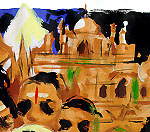
With India's rich history glimmering in white
marble, we sat at the base of the Taj Mahal in Agra basking in
its glory while praising the absence of street vendors in this
protected pocket of tourism. In Varanasi on the banks of the Ganges
(appropriately nicknamed the river "Grunges"), the river
dutifully serves the profound and the profane. It is used for bathing,
washing clothes, disposal, sanitation and drinking water... and it is
also the holiest spot for a Hindu to die. The banks are lined
with burning ghats (steps leading to water) intended for the ceremonial cremation
of the dead, before they are floated downstream among flickering
candles.
In stark contrast to these challenging environs, remained the final
leg of our trip spent in the foothills of the Himalayas -- Darjeeling
and Sikkim. Started by the East India Company, Darjeeling was
and still is a retreat from the crowds and heat of the plains.
The surrounding hills are lustily forested and there is a storybook quality
to their precipitous rise and fall.
From Darjeeling, one can see
beyond the world famous tea plantations to the inspiring peak
of Mount Kanchendzonga, the third highest mountain in the world.
As refreshing as the change of scenery in this amazing region
was the quiet nature of its people, embodied in the gracious and
respectful gesture of using two hands to offer you an object (or,
at least, by touching their elbow). Look at a map and you will
realize that this region of India hangs on by a thread, separated
from the mass of India by the intrusion of Bangladesh.
Politically,
its ties are equally strained. Plastered on many walls are the
words: "Gorkhaland Now" and "We Want Gorkhaland."
Strong separatist currents run through all of the states in this
portion of India. The prevalence of the Indian Army attests to
this. (It was separatists from the neighboring state of Assam
that blew up a train en route to Calcutta the day after our troublesome
train trip.)
Beyond Darjeeling in the tranquil state of Sikkim,
we were stopped at military checkpoints in every town, although
there was something more quaint than threatening of the sight
of a soldier at his shady wooden table with an inflated sense
of ceremony. There on the edge of Nepal and China, Sikkim is the
most peaceful and beautiful landscape on earth -- populated by small
villages and colourful monasteries against the backdrop of the
Himalayas.
India is a taxing country -- full of breathtaking sights, absurd
contrasts, tremendous diversity and a phenomenal wealth of cultural
and architectural history. Travelling books assert that you can
not pass through India without changing. I don't know if we have
changed. But in exploring a land with such abundant humanity we certainly tested what we know about ourselves and each other.
We probably wouldn't recommend India to anyone who didn't already
have the desire to go. It was an unusual destination for a honeymoon. As
odd was spending it with your little brother...but we wouldn't have
it any other way.
This was a trip of a lifetime and Slobhan, James and I now have
our lifetime to share it. Thanks for reading this lengthy letter
and travelling vicariously with us on this journey.
Love, TJ and Slobhan
The author of this piece, TJ Mark is an architect and lives in Berkeley, California. This is a letter -- which we published, as is -- he wrote to his younger brother, James, an investment banker in Bombay on his return from his honeymoon-trip to India in December.
Sketches by Dominic Xavier
|