 The state's showpiece. The only remnant of the massive and overpowering
Portuguese presence which established its capital on the southern
bank of the Mandovi river, about 10 km east from present day Panjim.
The state's showpiece. The only remnant of the massive and overpowering
Portuguese presence which established its capital on the southern
bank of the Mandovi river, about 10 km east from present day Panjim.
In its day, the 1500s, it was the largest and most flourishing of the great Asian cities. Its population then was 300,000: much bigger than the contemporary London and Lisbon. It was called `Goa Dourada' - golden Goa - in its time of glory. The monuments and cathedrals today represent just a fraction of the urban development that was Old Goa. It was the empire's Asian seat of power, and the port did enormous commerce. Near the port were the religious centres and the administrative buildings, while the suburbs reached out as far as the north banks of the Zuari river.
The settlement though dates back to the early 12th century, when it was the capital of a local king. It expanded under the Vijaynagar empire, was captured by the Muslim Bahmani rulers, and then by Afonso de Albuquerque to mark its beginning as a colony capital.
Old Goa is a Unesco World Heritage site. The most interesting monuments to visit have been individually dealt with and described in this section
*Se:**:
Se Cathedral
 The largest church in Asia the cathedral in Old Goa, is a mighty 16th century
monument to the Roman Catholic rule of Goa under the Portuguese.
It took eighty years to build and was financed to a good extent
by the wealth realised from estates of Goan Hindu who died un-Proselyzed.
Se Cathedral is a fine example of Jesuit architecture. However
its bell towers -- which house the largest bell in Asia -- are
very Goan
The largest church in Asia the cathedral in Old Goa, is a mighty 16th century
monument to the Roman Catholic rule of Goa under the Portuguese.
It took eighty years to build and was financed to a good extent
by the wealth realised from estates of Goan Hindu who died un-Proselyzed.
Se Cathedral is a fine example of Jesuit architecture. However
its bell towers -- which house the largest bell in Asia -- are
very Goan
The church houses a rather pretty shrine to St Catherine called the Chapel of the Blessed Sacramentt.
 *Bom:**:
Basilica of Bom Jesus
*Bom:**:
Basilica of Bom Jesus
The tomb of Saint Francis Xavier, the Basilica of Bom Jesus, in Old Goa, has an elaborate
design that takes a few minutes to get used to. Completed in 1605,
the church, three centuries later is one of the most important
churches of India. A detailed tour, with time given to absorb
the various architectural facades, is advised.
*Francis:**:
Church of St Francis of Assisi
Built in 1661, a peep into the fascinating interior of this church, situated in Old Goa,
makes a visit worthwhile. Sumptuously ornate and replete with much
carving and paintings the inside decoration takes one's breath
away.
*Survey:**:
Archaeological Survey of India Museum
 Housed in a former Franciscan monastery, the museum, located in Old Goa, contains interesting
relics of Goa's Portuguese history. Of interest too is a grand
carving of Vishnu. Closed Fridays.
Housed in a former Franciscan monastery, the museum, located in Old Goa, contains interesting
relics of Goa's Portuguese history. Of interest too is a grand
carving of Vishnu. Closed Fridays.
*Arch:**:
Viceroy's Archway
 The very pretentious gateway into Old Goa which today is like
a grand footnote to Goa's history; only palm trees remain of the
once bustling avenue, Rua Direita that led from the gateway into
the town. Erected by the grandson of Vasco da Gama to honour his
grandfather.
The very pretentious gateway into Old Goa which today is like
a grand footnote to Goa's history; only palm trees remain of the
once bustling avenue, Rua Direita that led from the gateway into
the town. Erected by the grandson of Vasco da Gama to honour his
grandfather.
*Cajetan:**:
Church of St Cajetan
 A replica of the famous St Peter's Basilica in Vatican City, located
however at 74 degrees into the eastern hemisphere, in Old Goa. The soaring domes are probably the only one of its kind east of the Red Sea. Of interest
is the covered well inside that indicates that the site was one
perhaps a temple. Walk over to the side to see the doorway that
once was the entrance to an Islamic palace belonging to Adil Shah,
the ruler of Goa before the Portuguese disembarked. Adjoining the church is a rectory too
A replica of the famous St Peter's Basilica in Vatican City, located
however at 74 degrees into the eastern hemisphere, in Old Goa. The soaring domes are probably the only one of its kind east of the Red Sea. Of interest
is the covered well inside that indicates that the site was one
perhaps a temple. Walk over to the side to see the doorway that
once was the entrance to an Islamic palace belonging to Adil Shah,
the ruler of Goa before the Portuguese disembarked. Adjoining the church is a rectory too
*Monica:**:
Santa Monica Cloister
 Located on the Holy Hill, in Old Goa, a visit into this crumbling convent , that
is still occupied by nuns and is one of the largest in Asia, transports one quickly into another
era.
Located on the Holy Hill, in Old Goa, a visit into this crumbling convent , that
is still occupied by nuns and is one of the largest in Asia, transports one quickly into another
era.
*Augustine:**:
Ruins of St Augustine Church
 Also located on the Holy Hill, in Old Goa, this church and monastery was once
the most beautiful building of the settlement. Bear with the weeds
and rubble to visit the spot where the Augustinians lived when
they first arrived in Goa in the 1500s.
Also located on the Holy Hill, in Old Goa, this church and monastery was once
the most beautiful building of the settlement. Bear with the weeds
and rubble to visit the spot where the Augustinians lived when
they first arrived in Goa in the 1500s.
*Mount:**:
Church of Our Lady of the Mount
 This old abandoned church is almost impossible to find. But bear with the search because being on this abandoned overgrown hill top takes one a few centuries back into history. The church does not have an "overawe-ing" architectural style, but it is grey and mildewed and imparts a strange melancholy air.
Apparently this was the vantage point from where the artillery of Adil Shah bested the forces of Alfonso de Albuquerque in 1510, only to meet his doom few months later. Ironically the view from this hill of the imposing and towering churches below, built by the Portuguese, who finally wrested Goa from the Muslims, is wonderful yet poignant. Interestingly mass is still held at this church on the 8th of every month at 1700 hours and the feast day is celebrated on September 8 every year. A look at its interior makes one wonder how this is possible.
Directions: Take the road to Ponda out of Old Goa. Immediately out of Old Goa is a road leading off on the left near a gas station. The church is located on a summit at the end of this road, long after it ceases to be a road and twists and winds into the grass.
*Temples:**:
Temples
 Scattered around the wooded valleys and hills in region around
Ponda (30 km east from Panjim) of central Goa are the premier
temples of Goa. In the face of Portuguese aggression and expansion
from the coast of Goa, and retreating from conversion, the Hindus
went into the state's hinter land and re-established their worship.
Several of the temples here are not extremely old structures,
but their deities are ancient and are revered so.
Scattered around the wooded valleys and hills in region around
Ponda (30 km east from Panjim) of central Goa are the premier
temples of Goa. In the face of Portuguese aggression and expansion
from the coast of Goa, and retreating from conversion, the Hindus
went into the state's hinter land and re-established their worship.
Several of the temples here are not extremely old structures,
but their deities are ancient and are revered so.
 The Shri Manguesh temple is the most famous in Goa, about 10 km
north of Ponda near the village of Priol. The main deity, a stone
lingam, was brought here over 300 years ago from its earlier concealment
on the south bank of the Zuari river. Goan Hindu religious traditions
have endured unchanged for over 15 centuries. The early temples
were as richly carved and embellished as the famous examples of
the Deccan, but first Muslim invasions and then Portuguese intolerance
led to their destruction, so much that dieties were routinely
smuggled out of temples to protect them from ruin.
The Shri Manguesh temple is the most famous in Goa, about 10 km
north of Ponda near the village of Priol. The main deity, a stone
lingam, was brought here over 300 years ago from its earlier concealment
on the south bank of the Zuari river. Goan Hindu religious traditions
have endured unchanged for over 15 centuries. The early temples
were as richly carved and embellished as the famous examples of
the Deccan, but first Muslim invasions and then Portuguese intolerance
led to their destruction, so much that dieties were routinely
smuggled out of temples to protect them from ruin.
 Goan temple architecture, when the structures have been rebuilt
during the Portuguese era (although the colonial masters destroyed
the originals) display a fusion of styles not found elsewhere
in India. There are elements of the Catholic geometry to be seen
in for example Old Goa, Latin eaves and roofs, Far Eastern glazed
ceramic figures (trade with Macao was big business), Roman balustrades
and Islamic domes. Other temples worth visiting are Mahalsa, Laxmi
Narsimha, Naguesh, Shantadurga, Ramnath. A visit to the Tambdi
Surla temple starkly situated in dense wilderness is highly recommended.
Located 12 kilometres out of Molem on the road from Ponda, the
beautifully constructed temple in the middle of nowhere evokes
a dreamlike feeling.
Goan temple architecture, when the structures have been rebuilt
during the Portuguese era (although the colonial masters destroyed
the originals) display a fusion of styles not found elsewhere
in India. There are elements of the Catholic geometry to be seen
in for example Old Goa, Latin eaves and roofs, Far Eastern glazed
ceramic figures (trade with Macao was big business), Roman balustrades
and Islamic domes. Other temples worth visiting are Mahalsa, Laxmi
Narsimha, Naguesh, Shantadurga, Ramnath. A visit to the Tambdi
Surla temple starkly situated in dense wilderness is highly recommended.
Located 12 kilometres out of Molem on the road from Ponda, the
beautifully constructed temple in the middle of nowhere evokes
a dreamlike feeling.
*Mapusa:**:
Mapusa Friday Market
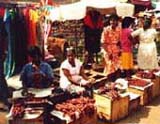 Mapusa in north Goa is 12 km from Panjim. A trading and commodities oriented
settlement, the Friday market is its chief attraction. Like the
souvenir and curio stalls that dot the main beaches, the market has
these, set up by the colourful Lamanis of Karnataka. It's popular
mainly for the range of foodstuffs - strings of Goa sausages,
piles of local bread, plenty of fruit, and fish: at least two
dozen types including crab, prawn and shellfish. Farmers from
the region bring their produce here. An excellent snapshot of
a rural bazaar.
Mapusa in north Goa is 12 km from Panjim. A trading and commodities oriented
settlement, the Friday market is its chief attraction. Like the
souvenir and curio stalls that dot the main beaches, the market has
these, set up by the colourful Lamanis of Karnataka. It's popular
mainly for the range of foodstuffs - strings of Goa sausages,
piles of local bread, plenty of fruit, and fish: at least two
dozen types including crab, prawn and shellfish. Farmers from
the region bring their produce here. An excellent snapshot of
a rural bazaar.
... Back to Where to shop.
*Mansions:**:
Old Mansions of Goa
 The massive old country houses that dot coastal Goa are usually
around 150-300 years old. Their owners were not always Portuguese
though but Goans, often families who had been converted: influential
and rich merchants and officials who were given titles and land
to ensure their loyalty to the colonial regime. The families -
known as `bhatkars' (landlords) in Konkani - lived off the rent
paid to them by the cultivators on their land. In later years,
they often intermarried to preserve this aristocracy.
The massive old country houses that dot coastal Goa are usually
around 150-300 years old. Their owners were not always Portuguese
though but Goans, often families who had been converted: influential
and rich merchants and officials who were given titles and land
to ensure their loyalty to the colonial regime. The families -
known as `bhatkars' (landlords) in Konkani - lived off the rent
paid to them by the cultivators on their land. In later years,
they often intermarried to preserve this aristocracy.
The best known and largest of these palatial mansions are in the Salcete `taluka' (county) of south Goa. But they are also commonplacein the north, near Panjim and its neighbouring village of Santa Cruz, on Divar island in the Mandovi river estuary, and around the Anjuna village and beach area. Their architecture was predominantly European but relied heavily on traditional building material -the red laterite stone of Goa, and the distinctive Mangalore tiles. The furnishings were almost always imported. Excellent examples of glazed pottery came from Macao, China and Korea; cut glass, mirrors and chandeliers from Belgium and Venice; tapestries from Portugal or Spain. One typical Goan feature of the houses is the oyster shell sunscreens on the windows and for the huge porches. The thin inner layer of the shells is cut into rectangles and squares and fitted into wooden frames to shade the interior from the sun. It is an art that is in decline, but examples abound in numerous smaller houses all over coastal Goa.
The south Goa village of Loutulim, about 10 km north of Margao, has a countryside peppered with the stately homes. Chief among these are the Miranda house, built in the early 18th century, the Salvador Costa house, and the Roque Caetan Miranda house. In the village of Chandor, about 12 km east of Margao, is the most famous of the stately Goan homes: the Menezes-Braganza house. Its enormous frontage decided the size of the square that abuts it. The Grand Salon and its Chinese porcelain collection are famous. In Margao, just off the central Largo de Igreja square, is the Seven Gables house built in the late 18th century belonging to the da Silva family. Worth seeing for its rococo facade.
*Anjuna:**:
Anjuna Flea Market
 Held on Wednesdays, a good place for souvenirs. It used to be
set up mainly by backpackers and dope heads selling anything from
tattered tents to dubious tea bags. Now its turned into an ersatz
handicrafts beach mall and the main chunk of what you get is embroidered
and mirrorworked knick-knacks like tote bags, bedspreads, waistcoats, waist
pouches and other curios and accessory jewellery.
Held on Wednesdays, a good place for souvenirs. It used to be
set up mainly by backpackers and dope heads selling anything from
tattered tents to dubious tea bags. Now its turned into an ersatz
handicrafts beach mall and the main chunk of what you get is embroidered
and mirrorworked knick-knacks like tote bags, bedspreads, waistcoats, waist
pouches and other curios and accessory jewellery.
The displays are sort of segregated culture wise: Indian, backpacker, long term Goa resident, New Ager, rave maniac. The most colourful by far are the Lamanis from Karnataka, the neighbouring state. The women wear multihued tribal costumes and lend a festival air to the place.
Bargaining is absolutely essential, and those with the requisite patience will usually walk away with a good deal. Otherwise, the flea market is just a good place to experience Goa's multinational, multi cultural life.
... Back to Where to shop.
*Rachol:**:
Rachol Museum of Christian Art
About 7 km from Margao eastwards the Rachol seminary was the unofficial
border between the coastal Catholicism and the interior Hinduism.
It dates back to the 16th century. The complex houses a seminary,
and the main attraction: the Christian art museum, the only one
in South Asia, which was set up by the Indian National Trust for
Architecture and Cultural Heritage and the Gulbenkian Foundation
of Portugal. The collection is an accumulation of artefacts from
Goa's dozens of churches and chapels, private collections and
donations.
*Forts:**:
Forts
The Cabo de Rama fort, located at the southern end of Colva is
said to be the place where Ram and Sita took shelter after their
exile from Ayodhya. Once a Hindu and subsequently a Portuguese
fort the promontory commands a splendid view of the Colva Beach.
Exercise caution while climbing among the rocks.
The Chap ora fort located 10 kilometres out of Mapusa has a splendid view of nearby Anjuna and Vagator beaches,. The fort once Muslim before the Portuguese wrested it away affords some interesting ruins to pick around at.
*End:**:


