'There is much to glean from such exercises. And make it known that we are ready to take them on together!', says Air Commodore Nition Sathe (retd).

In continuation of the series of joint exercises between India and China, the exercise 'Hand-in-Hand 2014' is all set to commence at Pune's Aundh Camp on November 16.
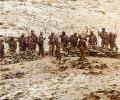
Chinese troops made a fresh attempt to violate the border with India in Chumar area in Ladakh on Sunday and retreated only after the Indo-Tibetan Border Police and the army jawans formed a human wall to block their incursion bid.
'This is the first time that active PLA army personnel would be reduced to below one million,' PLA Daily said.

Why is China's supreme leader promoting Han Chauvinism so aggressively, asks Claude Arpi.
The president said China would never allow "any people, organisation or political party to split any part of Chinese territory out of the country at any time, in any form."

'Galwan has turned everything.' 'The casualties on both sides alerted the Chinese to the fact that Indians are not going to take it lying down.'
The Indian Army has been slow to react. Indian troops have deployed in the vicinity of PLA incursions, but there are no attempts to outflank Chinese positions.

Hydrography (underwater geography) prevents the Indian Navy for opting for an all-conventional, or all-nuclear submarine fleet.
'They talk about their 2021 centenary goal, their 2035 goal, and their 2049 goal. They're accelerating. There's also been this unfortunately bashing of nationalism inside the People's Republic of China by the government'
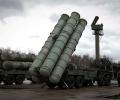
RInstead of disengagement, the Indian and Chinese armies have deployed an estimated 35,000 to 40,000 soldiers each along the LAC. The PLA has deployed S-400 air defence missiles to neutralise the IAF's advantage in air power

China has not limited the 'battle' to the diplomatic field alone; the People's Liberation Army has become aggressive on the ground too. The recent 'fights' in Northern Sikkim and Ladakh are part of the pattern, asserts Claude Arpi.
Who knows, the moment of truth in Ladakh may also augur for a giant leap toward boundary settlement with China in the fulness of time. The news that the special representatives of the two countries are planning to meet gives a positive signal, suggests Ambassador M K Bhadrakumar.

The government on Wednesday said the cadre strength of the Maoist organisations is around 8,500 and they have forged tactical understanding with some insurgent groups in the Northeast for procuring arms and ammunition.

China will flood direct flights to India with wholesale takeaways of the authentic stuff; Indian businessmen will fight for the commission and the consumers for the cuisine, predicts Sunanda K Datta-Ray.

Will China's new military reforms endanger Xi Jinping's rule?

Both sides have completed creation of a buffer zone of three kilometres in the three friction points of Galwan Valley, Gogra and Hot Springs as part of a temporary measure aimed at reducing the possibility of any confrontation.

Official sources said withdrawal of tanks and other armoured elements from certain friction points is nearing completion while pulling back of troops from the North bank areas is being undertaken.

As per the agreement reached by the two sides, India and China will withdraw the forward deployment in a phased and coordinated manner, the defence minister said.

Though it is often said that Indian Railways is the largest employer in the world, but it seems it is not
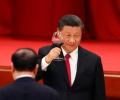
'Having tied himself in knots, he just might take a decision which is dangerous, one that could take his nation to war.'

Indian Army officers are convinced China is maintaining the pretence of dialogue and negotiations in order to create the opportunity to occupy more Indian territory. Senior Indian planners apprehend this might be a Chinese ploy to divert attention from Depsang, in Northern Ladakh, which might be China's actual target.

The deployment seems to be more than what is needed.

'If the Chinese intent is to be gauged based on its aggression in the South China Sea, greater forays in the Indian Ocean, a hawk's attitude towards Taiwan, flying its fighters repeatedly over the Senkaku islands in the East China Sea and creating strategic assets globally, there would be a requirement for strategic partnerships for India,' says Brigadier S K Chatterji (retd).

An all-out offensive was launched to trace and eliminate the militants involved in massacre of 20 army men in Manipur on Thursday.

The Chinese have only created limited defences for protection of their posts which are located well in depth and much away from the Line of Actual Control, notes Colonel S Dinny (retd).

China plans to divert about 200 billion cubic metres of water annually from the Brahmaputra at its highest point, namely the Great Bend, where it turns into India. China's Brahmaputra dam will severely impact India, warns former senior RA&W officer and China expert Jayadeva Ranade.

To rise quickly in the PLA's hierarchy, you need to be close to Xi Jinping. Retired RA&W officer Jayadeva Ranade on the changes in China's military leadership.
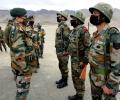
The seventh round of military talks between India and China held on Monday was "positive and constructive", and both sides agreed to earnestly implement the understanding reached by their leaders to not turn differences into disputes, a joint statement by the two armies said on Tuesday.
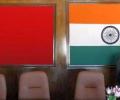
As the border standoff entered the sixth month, an early resolution to the row appeared dim with close to 100,000 Indian and Chinese troops remaining deployed in the high-altitude region and showing readiness for a long-haul. There is no official word on the talks yet but sources said the agenda was to finalise a roadmap for disengagement of troops from all the friction points.
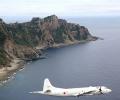
China on Saturday said it "expelled" foreign military planes from its airspace, the first such incident after Beijing unilaterally declared an air defence zone over islands disputed with Japan in the East China Sea.

'Today, our vast green pastures where local herders used to take their cattle to graze have been taken over by the Chinese.' 'The people in the Galwan Valley have lost their lands where their cattle used to graze.'

'One must remember that a dragon has a forked tongue,' warns Vivek Gumaste.
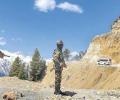
'India is not going to accept whatever the Chinese say. That is not going to happen.'
Twenty Chinese soldiers, who had last week entered Indian territory near the Line of Actual Control and pitched their tents in the Chepzi area in Ladakh, have returned after a flag meeting between the two sides, sources said on Monday.
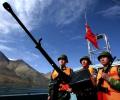
The Chinese side has particularly bolstered its presence in the Galwan Valley, erecting around 100 tents in the last two weeks and bringing in heavy equipment for construction of bunkers, notwithstanding the stiff protest by Indian troops. There have been reports of multiple incidents of transgressions by Chinese troops in several areas in Eastern Ladakh.
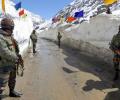
The clear assertion by New Delhi came ahead of a fresh round of Lt General-level talks between the Indian army and the Chinese PLA which government sources said is set to take place within the next two days.
The intrusions into India were likely carried out by the PLA's better trained and equipped 'mobile operational units'.

Modi's hardline policy towards Pakistan and J&K has created numerous leverages and bargaining positions that New Delhi can bring to the bargaining table and translate into concessions, argues Ajai Shukla.
On the shopping list: Light tanks, anti-tank guided missiles, UAVs, assault rifles, fighter aircraft.
 © 2026 Rediff.com - Advertise with us - Disclaimer - Privacy Policy - Sitemap - Feedback - About us - Terms of use - Grievances