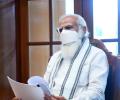
In the meeting on the prevailing COVID-19 situation, Modi reviewed the availability of medical infrastructure and directed officials to ensure rapid upgradation of health facilities, the PMO said in a statement.
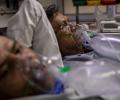
According to industry figures, the pre-Covid demand for liquid medical oxygen (LMO) before the pandemic was 700 tonnes per day across the country. Now, with the second wave, the demand has gone up more than seven times, reports Jyoti Mukul.

Across the country, the number of patients in ICU beds is 4,88,861 while 1,70,841 patients were on ventilators and 9,02,291 patients were on oxygen support.
PM also said that states must act against any hoarding of oxygen and directed officials to ensure that the oxygen supply to various states happens in a smooth, unhindered manner and called for fixing responsibility with the local administration in cases of obstruction.
The Government of India has supported the states and undertook a series of actions including provisioning medical oxygen, and other consumables to ensure clinical care of COVID-19 patients in view of the steep rise of COVID-19 trajectory in the country during April- May 2021.
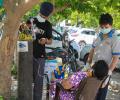
Over the weekend, many companies stepped in to ease the bottleneck in supply and transportation of oxygen, as demand ran high with the surge in cases.

The second wave of the pandemic has not only crippled medical infrastructure in terms of hospital beds, but has also led to bottlenecks in invasive ventilators and medical oxygen capacities and supplies.
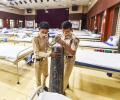
The official said that the Centre needs to intervene as a large number of hospitals are affected due to the "stoppage of oxygen supply from Haryana".
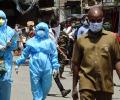
The March 2020 lockdown did not stop the spread of infection (as it triggered a huge reverse migration from cities), but it did help to flatten the curve and gave time to scale up health infrastructure.

In his monthly Mann ki Baat broadcast, Modi noted that the country was also faced with several natural disasters, including cyclones, landslide and earthquakes, during the pandemic, and said more lives were saved than the past with the Centre, states and local administration coming together to carry out relief and rescue operations.

The Tatas, L&T and Bharat Forge expressed interest in building pressure swing adsorption oxygen plants at hospital sites, while IOC and RIL are pitching in with both oxygen and cryogenic tankers needed for its transportation.

The Delhi high court had directed the Centre on Tuesday to show cause as to why contempt should not be initiated against it for failing to comply with its order.

With several states taking steps towards unlocking and easing of restrictions amid a decline in COVID-19 cases, Prime Minister Narendra Modi on Monday cautioned people against any laxity and asserted that COVID-appropriate protocol is the 'most effective weapon' against an unseen adversary like coronavirus that keeps changing its form.
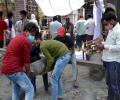
The oxygen shortage was inevitable to an extent given the tsunami of Covid cases, but the problem is the lack of even basic preparation by both the Centre and states, notes Shyamal Majumdar.

Various industry bodies have sought immediate government intervention through the imposition of anti-dumping duties, claiming India has seen a surge in imports of Chinese goods over the past two weeks.

The country's top carmaker Maruti Suzuki India (MSI) on Wednesday said it has decided to advance maintenance shutdown at its two Haryana-based manufacturing plants by a month amid a surge in the COVID-19 cases across the country. The auto major was supposed to take the shutdown at its two plants in Gurugram and Manesar in June, but due to the tsunami of COVID-19 cases, it decided to take it one month earlier to save oxygen for medical needs. MSI noted that as part of the car manufacturing process, it uses a small amount of oxygen in its factories, while relatively much larger quantities are used by the manufacturers of components.
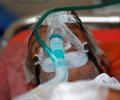
India is struggling with a second wave of the pandemic with more than 3,00,000 daily new coronavirus cases being reported in the past few days, and hospitals in several states are reeling under a shortage of medical oxygen and beds.

'We would love to have more players entering the market because that is how the business will grow.'

"They are extending support as they feel that this is the time we must help India. 'India has helped us and we must help India'. So I do not think we are looking at it in policy terms," the foreign secretary said.

Dr Rajendra Bharud has done what no other district collector in India could do as the pandemic ravaged the nation. He not only made Nandurbar district oxygen surplus, but ensured that the supply of life-saving oxygen remained uninterrupted for patients -- something even Delhi and Mumbai hospitals have not achieved yet.

'If it works, something good can come out of this tragedy for the common public good,' say Dr Prasad Gadgil and Dr Kunal Basu.

'There is no vaccine and no specific antiviral medicines against #COVID19' the World Health Organization tweeted.

'We should not forget the core purpose of the lockdown -- to buy time to implement a strategy to tackle the virus, to prepare for the final lifting of the lockdown and to prepare for a 'new tomorrow',' notes Dr Sanjeeth Peter.
 © 2026 Rediff.com - Advertise with us - Disclaimer - Privacy Policy - Sitemap - Feedback - About us - Terms of use - Grievances