
Tata Motors' commercial vehicle (CV) business debuted on the BSE on Wednesday, completing the automaker's long-planned demerger into separate listed entities for its passenger and CV operations.

The passenger vehicle (PV) business of Tata Motors, which also includes the electric vehicle and Jaguar Land Rover businesses, post-demerger is now valued at Rs 1.45 trillion.
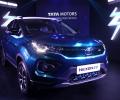
Tata Motors reported a consolidated net profit of Rs 17,483 crore (adjusted for exceptional gains and losses) for Q4FY24, surpassing TCS' consolidated net earnings of Rs 12,434 crore. For the automotive major, this marked a 213.7 per cent year-on-year increase in the bottom line, from Rs 5,573.8 crore a year ago. In contrast, India's biggest IT firm saw a more modest Y-o-Y growth of 9.1 per cent in net profit, from Rs 11,392 crore.

Tata Motors on Friday reported a 62.2 per cent decline in consolidated net profit to Rs 4,003 crore in the June quarter, impacted by volume decline across segments, drop in JLR profits due to US tariffs and high base effect due to gain from sale of discontinued operations. The auto major had posted a consolidated net profit of Rs 10,587 crore in the April-June quarter of the previous fiscal, Tata Motors Ltd (TML) said in a regulatory filing.

'The reported deal between the European Union and China should mitigate it (shortage) for the medium to long term. Let's wait and watch how this plays out.'

Auto major Tata Motors on Monday said it appointed Carl-Peter Forster as the new group chief executive of the company.

Tata Motors on Monday announced the demerger of its commercial and passenger vehicle segments into two separate listed entities to better capitalise on growth opportunities. The commercial vehicles business and its related investments would be housed in one entity while the passenger vehicle business, including electric vehicles, Jaguar Land Rover (JLR) and its related investments, would be part of the second entity, the auto major said in a regulatory filing. Tata Motors chairman N Chandrasekaran said that Tata Motors has scripted a strong turnaround in the last few years.

Tata Motors is hoping to beat its target year of 2030 and have 30 per cent of its portfolio comprising electric vehicles (EVs), according to Chairman N Chandrasekaran, who was speaking at the company's last annual general meeting (AGM) ahead if its demerger.
Tata Motors' MD and CEO, Girish Wagh, has identified rising diesel prices as the most significant threat to India's commercial vehicle (CV) industry recovery, despite the sector recently surpassing its pre-FY19 wholesale peak. Diesel costs account for 25-50% of a truck operator's total cost of ownership, making any increase a critical concern for fleet economics.
Tata Sons' unlisted ventures, including Air India, Tata Digital, and Tata Electronics, reported combined net losses of approximately 25,568.8 crore in FY25, a 58.3 per cent increase from the previous year, despite Tata Sons itself remaining profitable for over a decade.

The Tata Sons board has deferred a decision on the re-appointment of Natarajan Chandrasekaran as Chairman, signaling potential differences within the group. Concerns were raised about losses in certain group companies and the listing of Tata Sons.

S&P Global Ratings on Thursday upgraded ratings of five companies of the Tata group including Tata Steel, Tata Motors and Jaguar Land Rover (JLR) reflecting its reassessment of the ongoing influence and the potential for 'extraordinary financial support' from the parent, Tata Sons. Under the revised exercise, S&P Global said ratings on Tata Steel Ltd and its 100 per cent-owned financing subsidiary ABJA Investment Co Pte Ltd have been upgraded to 'BBB-' from 'BB' with stable outlook. Similarly, Tata Motors Ltd and its wholly-owned arm TML Holdings Pte Ltd have been upgraded to 'BB-' from 'B' ratings with stable outlook.

Three disappointing experiences with Tata companies made me question whether the group's historic values of customer focus and accountability are slowly fading, notes Dr N Ravichandran.

The group began to outperform the broader market only with the onset of the pandemic in March 2020 while earlier it was largely keeping pace with the Sensex. The group's market cap is up 164.4 per cent since the end of March 2020 against a 105 per cent rally in the Sensex.

Seven listed Tata companies together own 12.1 per cent in Tata Sons with a combined book value worth around Rs 30,700 crore.

India's leading passenger vehicle manufacturers are significantly increasing investments and factory capacities, alongside planning major product launches for FY27, driven by strong confidence in sustained domestic demand growth despite global geopolitical tensions and supply chain risks.

As industrial plants boost the village's profile, locals demand priority hiring, alongside better storage facilities and water security.

The chairmanship of Tata Motors and Tata Steel after Ratan N Tata steps down at the end of 2012 appears to be an open question. It will be up to the new Tata group chairman, Cyrus Mistry, whether he decides to succeed Tata in heading two of the largest group companies or opt for new chairpersons for them.

Tata Motors on Monday said its president for the passenger car division, Rajiv Dube has resigned from the company.

'Favourable product mix, sales recovery, and cost saving initiatives are expected to support margins going ahead while focus on debt reduction (target of debt free by FY24) will aid balance sheet strength'
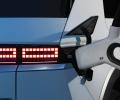
Under FAME-II, automakers provided subsidies to electric vehicle (EV) customers at the time of purchase, with the understanding that the government would reimburse the firms later.
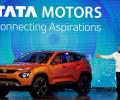
Notwithstanding robust volume growth and a strong performance from Jaguar Land Rover (JLR), Tata Motors, the country's second-largest automobile (auto) manufacturer by market capitalisation, disappointed the Street with its January-March quarter (Q4) results for 2023-24 (FY24). While consolidated revenues saw a 13 per cent increase, lower-than-expected realisations in the Indian operations weighed down overall performance.

Surinder Kapur, president of the company's 'vendor council,' said it has about a dozen representatives from Tata Motors and an equal number from the vendors. "We supply for about 4-5 per cent of our revenues to Tata Motors and we do not have payment issues," he said. Lumax, which derives about 15 per cent of its turnover by supplying almost half of the lighting solutions for Tata Motors worth about Rs 60 crore a year, said they had not experienced any payment issues.

India's first trillion-dollar company will be built on technology it owns, not just operates, predicts Ajay Kumar.

Historically, Tata Steel has always been among the biggest companies in the group in terms of m-cap, revenue, and profit but its fortunes began to decline after 2010 due to a sharp decline in the profitability of its European operations that it had acquired in 2007. The company was hit by a sharp rise in its debt level after this acquisition. First, it lost out to Tata Motors in terms of revenue in FY11 and then in March 2015, Titan beat it to become the third-biggest firm in the group in terms of m-cap. In FY20, TCS reported higher revenue and Tata Steel had become the third biggest company in that terms.
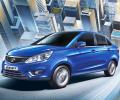
Zest buyers are forced to wait up to six weeks for the automated manual transmission version, available only on this car in the compact sedan segment.
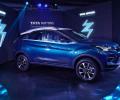
Powered by Ziptron technology, the electric SUV for the personal segment comes with a range of 312 km on a single charge and a high voltage system, fast charging capability, extended battery life and class leading safety features. Besides, it has 35 connected car features as well. The Nexon EV will be available in three trim levels across 60 authorised dealerships in 22 cities, the company said at the launch.

Recently, TPEM's first born electric concept, Avinya broke cover. The model promises a minimum range of 500 kilometres and advanced technology features, aimed at buyers in India and outside. TPEM, the newly formed entity may also consider a separate dedicated sales channel for the EVs with a distinctive corporate identity once the volumes reach a critical mass and throughput is large enough for the dealers to be profitable, said Chandra. Elaborating further on the hiring strategy he said, "We will hire from everywhere-wherever the talent of the required competency is available."
There is no impediment to normal operations as Tata Motors puts in place the demerger process of its commercial and passenger vehicles businesses. Instead, the demerger would provide greater manoeuvrability for both new entities to operate independently, according to Tata Motors management. While there may not be immediate value unlocking, it will give investors clarity about future growth and the financials across different segments.
After clocking losses for seven straight quarters, Tata Motors on Wednesday posted a consolidated net profit of Rs 3,043 crore in the third quarter (Q3) of 2022-23. This came on the back of a strong order book, better semiconductor chip supply, tempered commodity prices, and a better product mix. "We remain cautiously optimistic about the demand situation, notwithstanding the global uncertainty.

In a major victory for Tatas, an arbitral tribunal has awarded Tata Motors a compensation of over Rs 766 crore for the losses incurred because of protests by Trinamool Congress that stalled its small car project at Singur in West Bengal. The tribunal asked the West Bengal government to pay Tata Motors the compensation, along with interest, according to a stock exchange filing by the Mumbai-based auto major on Monday. The company stated that the arbitral tribunal has asked the West Bengal Industrial Development Corp (WBIDC) to pay the company Rs 766 crore compensation, in connection with losses incurred on its manufacturing site in Singur.

Food delivery and quick commerce (qcom) service application (app), Zomato, now commands a market capitalisation (mcap) higher than automobile giants Tata Motors and Bajaj Auto. Zomato, whose shares closed 1.18 per cent lower on Thursday at Rs 288.45 per share, has an mcap of Rs 2.78 trillion, according to BSE data. By comparison, Tata Motors' mcap stood at Rs 2.74 trillion, while Bajaj Auto's was Rs 2.5 trillion on the BSE.

"After sinking in Rs 6,000-7,000 crore in the Nano till date, what is the result?"

Ratan N Tata, chairman of the Board of Tata Motors, said, "Board respects Carl-Peter's personal circumstances that led to this move. We would like to thank him for his contributions to the successful development of our company in his role as Group chief executive officer and managing director."

Usually, in the western view, corporate success is attributed to efficiency, organisational structure, and scale. R Gopalakrishnan and Harish Bhat argue that philosophy, culture, and the transmission of values are more important for sustaining growth and profitability of an enterprise over a period of time.
Tata Motors is actively considering tapping into some of the export markets beyond South Asia, for its range of electric vehicles (EVs) as it sees an opportunity of selling affordable EVs in markets outside India. The export plans will coincide with the commercial launch of the Curvve - an electric SUV concept that broke cover on Wednesday, in two years from now, Shailesh Chandra, MD, Tata Motors PVs and Electric Mobility, told Business Standard. "We are actively thinking of the international markets and we would like to go with a portfolio of products. "We have identified a few markets and in a couple of years, we should commence the same," said Chandra.

The net proceeds of the fund raising will be used to repurchase certain equity shares issued to Tata Motors and for general corporate purpose.

Tata Motors, the market leader in electric four-wheeler space, has sought incentives for its Tiago EV under the government's production-linked incentive (PLI) scheme, group chief financial officer P B Balaji said on Tuesday. The Mumbai-headquartered firm has applied for all variants of the Tiago, which recently hit a sales milestone of 10,000 units. "The Automotive Research Association of India certification is done.

Tata Motors, India's third largest passenger vehicle maker, took pole position in the competitive sport utility vehicle (SUV) market in October, reveals the data from industry sources. Riding high on the Punch - the sub-compact SUV offering launched on October 18 - the Tata group flagship sold a record 23,381 units in October, higher than 20,022 units sold by archrival Mahindra & Mahindra, 18,538 units sold by Hyundai Motor India, and 15,931 units sold by Kia Motors India. Utility vehicles - that include SUVs and multipurpose vehicles - accounted for almost one in every two passenger vehicles sold in India in the first seven months of the current financial year, according to the Society of Indian Automobile Manufacturers.

Companies are ranked by total revenues.
 © 2026 Rediff.com - Advertise with us - Disclaimer - Privacy Policy - Sitemap - Feedback - About us - Terms of use - Grievances