
India successfully test-fired two Pralay missiles in quick succession off the coast of Odisha, paving the way for its induction into the military. The missile is indigenously developed and features a state-of-the-art navigation system.

India has successfully conducted the first flight trial of its indigenously developed Tactical Advanced Range Augmentation (TARA) glide weapon system off the coast of Odisha, marking a significant step in enhancing its defence capabilities.

India successfully test-fired the newly-developed tactical missile Pralay, capable of carrying conventional warheads, from APJ Abdul Kalam island off the coast of Odisha. The missile, developed by DRDO, has a range of 150 to 500 km and a payload capacity of 500-1,000 kg.
TARA is India's first indigenous modular glide weapon, capable of transforming conventional unguided warheads into long-range precision-guided weapons.

It said the tests were carried out against high-speed unmanned aerial targets under different interception scenarios.
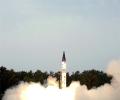
India on Friday successfully test-fired its indigenously developed nuclear-capable Agni-I ballistic missile with a strike range of 700 km from a test range off Odisha coast as part of a user trial by the army.

The Defence Research and Development Organisation on Friday successfully flight-tested a propulsion system that enables a missile to intercept aerial threats at very long range at supersonic speeds.

The conversion facilitated range enhancement and improvement in Pinaka's accuracy.

India successfully test-fired its indigenously built nuclear capable Agni-I missile, which has a strike range of 700 kilometre on Thursday, from a test range off Odisha coast as part of a user trial by the army.

Describing the trial a "complete success", sources said that all the mission objectives were met during the test.

India on Friday night successfully conducted maiden night test of its indigenously developed nuclear-capable Agni-I ballistic missile with strike range of 700 km from a test range off Odisha coast as part of a user trial by the Army.

In the QKD technology, encryption keys are sent as qubits in a fibre optic cable. Quantum computing uses qubits as basic resources, similar to how bits are used as basic resources in classical computing.

India on Monday successfully test-fired its indigenously built nuclear-capable intermediate range Agni-I ballistic missile, capable of hitting a target 700 km away, from a test range off Odisha coast as part of a user trial by the Army.
Agni-I missile is equipped with sophisticated navigation system which ensures it reaches the target with a high degree of accuracy and precision.
The surface-to-surface missile, powered by solid propellants, was test-fired from a mobile launcher at 10.10 am from launch pad-4 of the Integrated Test Range at Abdul Kalam Island (Wheeler Island), defence officials said.

The walk through enclosure is designed for personnel decontamination, one person at a time. It is a portable system equipped with sanitiser and soap dispenser, officials said.
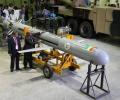
This was the fifth experimental test of the homegrown missile system.
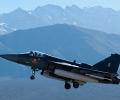
Among the programmes suffering from this lack of leadership is the Tejas Light Combat Aircraft project.

DRDO chief G Satheesh Reddy Reddy is the first Indian to be appointed Fellow of the Royal Institute of Navigation and of the Royal Aeronautical Society.

By removing Avinash Chander last week, the government has chosen to sacrifice the organisation's most potent symbol of success
 © 2026 Rediff.com - Advertise with us - Disclaimer - Privacy Policy - Sitemap - Feedback - About us - Terms of use - Grievances