
'China any day would prefer to team up with India and dump Pakistan once the resolution of the border dispute becomes an accomplished fact.'

'The softening of India's attitude towards Pakistan -- whatever the compelling reasons -- opens up the BJP to harsh scrutiny.' 'This is a high stakes gamble with the potential for devastating losses,' warns Vivek Gumaste.

Europe will have to make some hard choices if it wishes to take on the militant group responsible for the horrible attacks in Paris.
The govt must fix regulatory hurdles to ensure growth.

'One wonders if he has decided on the disastrous course of taking after Manmohan Singh, sitting like a Madam Tussaud wax figure, the same expressionless face, eyes unblinkingly staring in front, and making absolutely no difference, and no contribution, to the House proceedings,' asks B S Raghavan.

62 mass murders carried out with firearms across 30 US states. Of these, 12 were in schools, 19 at workplaces, the other 31 cases took place in shopping malls, restaurants, government buildings and military bases. The average age of the killers was 35, with the youngest only 11 years old. B S Raghavan on how the killings will continue until America confronts the urgent need for gun control.

'Anandiben is a strict taskmaster. She is accepted much less among the party cadres, but the bureaucrats in Gujarat bow to her dictates. In charisma, she is not a patch on Modi, and her acceptance among the masses will never become a reality.' Sheela Bhatt/Rediff.com reveals what Gujarat Chief Minister Anandiben Patel is really like.
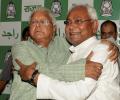
'Nitish Kumar wouldn't have won Bihar without Lalu. He needed a voter base and Lalu has a much bigger voter base than Nitish.'
On the basis of many conversations with stakeholders on the Telangana issue, Rediff.com's Sheela Bhatt presents an FAQ to help understand the politics of posturing and realpolitik on the ground to win seats. The questions are many and the answers are not straight
Digvijaya Singh is no longer in Rahul's close circle of advisers. His move to the Upper House was to ensure that the senior leader does not meddle in Madhya Pradesh politics in the run up to the crucial Lok Sabha polls. Anita Katyal reports
Deepti Priya Mehrotra, who documented Irom Sharmila's struggle for peace in Manipur in the book Burning Bright, puts the icon's electoral loss in perspective.

It is unconscionable to choose between Sardar Patel, who united India physically, and Indira Gandhi, who gave meaning, content and pride to the unity of the nation and became a martyr at the altar of national unity, says Ambassador T P Sreenivasan.

Shreekant Sambrani is confident that today's adversity will make the country emerge even stronger

Once again an Indian prime minister has realised that with Pakistan and China, things will not move as he wishes.
As the nation heads toward the general election, the Congress fortunes have most likely dipped below the point of no return. The Modi-BJP juggernaut rolls along despite some hiccups. And the meteor that rose in the form of the AAP and its leader Arvind Kejriwal seems to be disintegrating, says Shreekant Sambrani.

'To consider BRICS anything more than a temporary club with some common interests would be folly. The goal should be to induce others (Japan, ASEAN, South Africa) to align with us -- a non-threatening, democratic nation, rather than with malevolent China or waning America. For us to consider aligning with either China or the US would be absurd. India is just too big to be a sidekick,' says Rajeev Srinivasan.
The calculated playing up of confidence by Amit Shah and his team obviously means that the BJP has a strong counter-strategy in place to turn the tables on the Congress before the monsoon session is over, reports Sheela Bhatt/Rediff.com.
'Under Narendra Modi's leadership, we will be able to regain our rightful place in the community of nations,' veteran diplomat Hardeep Singh Puri, who joined the BJP on January 2, tells Rediff.com's Sheela Bhatt.

'Diplomatic engagement will continue even as India keeps all its options open with respect to discretely targeting the Pakistani military and its terrorist proxies.'

'Modi, focused on youth and their aspirations, has articulated a truly disruptive change: One of hope, of duties rather than rights, of standing up to the world instead of being bullied by it,' says Rajeev Srinivasan.

'The US wants Modi to succeed because we want India to succeed. For our part, when India thinks of its partners in the world, we want it to think of the US first. That means positioning our country as the preferred provider of the key inputs that can help to propel India's rise.' 'The meeting between Modi and Obama is, and must be, an opportunity for true strategic dialogue -- not a scripted exchange of talking points, but an open discussion of the big questions. What kind of world do we want to live in? What are our true priorities? And most importantly, why does this partnership still matter?'
 © 2026 Rediff.com - Advertise with us - Disclaimer - Privacy Policy - Sitemap - Feedback - About us - Terms of use - Grievances