
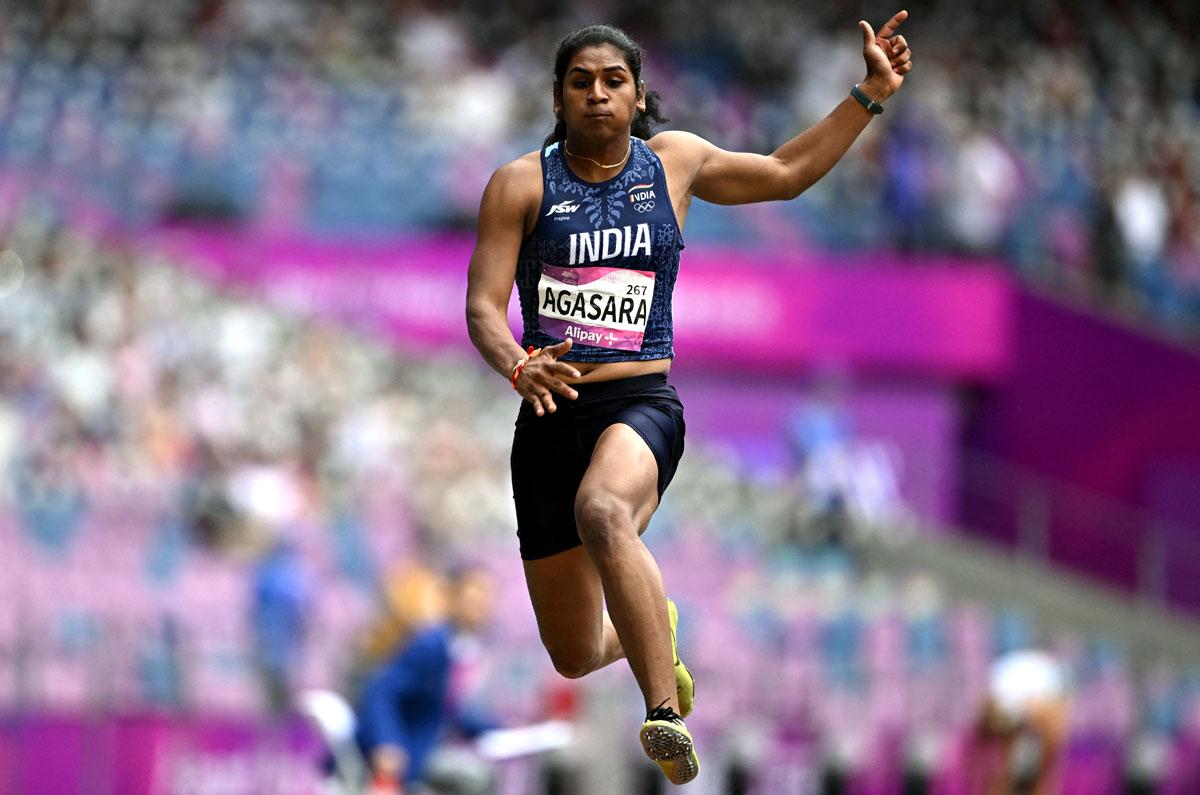
Reigning Asian champion heptathlete Nandini Agasara on Sunday said she will not compete at next month's World Athletics Championships in Tokyo despite qualifying for the showpiece due to an elbow injury she had sustained in May.
The 22-year-old Nandini received a provisional berth for the World Championships to be held from September 13-21 by virtue of winning the heptathlete gold medal at the Asian Championships in Gumi, South Korea, in May.
Under the rules, athletes can qualify for Tokyo World Championships as "area champions in all the individual events (except for the marathons) on condition that there is no better entry (by World Rankings) of another athlete from the same Area in the same event".
Since there is no other Asian athlete in the World Athletics list -- Road to Tokyo -- as of Sunday, the deadline for qualification, Nandini is expected to get an invite from the global body, though the national federation (AFI) will have the ultimate authority to enter her name or not based on its own selection criteria.
But Nandini said she is still feeling pain on her left elbow due to the injury she had sustained while winning gold in the Asian Championships.
"I am still on rehab after the injury during the Asian Championships. I am still feeling pain on my left elbow. So, after consulting with my coach (A N Shaji), I have decided not to compete at the World Championships in Tokyo," Nandini told PTI from her home in Hyderabad.
"Next year is very important as there are Asian Games and Commonwealth Games. Then there is Olympics in 2028 in which I want to focus to do well. Participating in Tokyo World Championships may aggravate my injury," she added.
She said she was getting better with rehabilitation, and should be
The SRY (Sex-determining Region Y) gene test is primarily used to identify the presence or absence of the SRY gene, which plays a crucial role in male sex determination during fetal development.
On July 30, World Athletics had made it mandatory for all athletes wishing to compete in the female category at the World Championships to undergo a "once-in-a-lifetime test" for the SRY gene -- a reliable proxy for determining biological sex.