
The Indian Army still uses old British-era names and recruits soldiers based on caste or region, which hurts national unity, argues Colonel K Thammayya Udupa (retd).
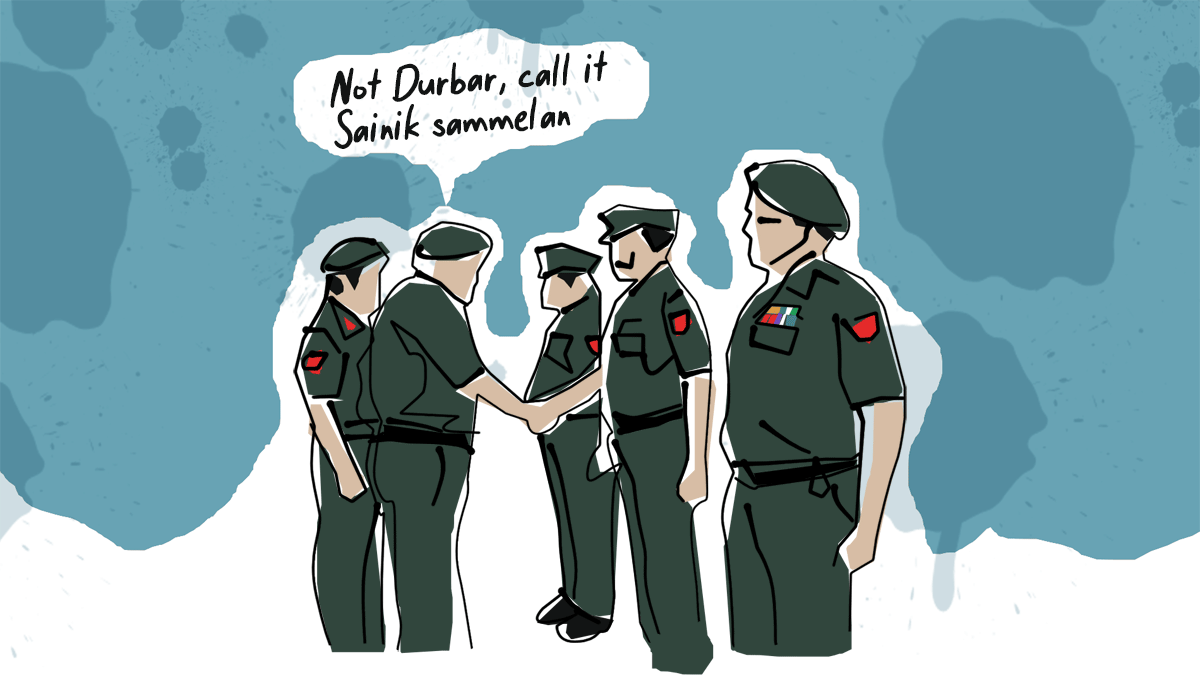
During the early days of my regimental service the term used in my regiment to refer to the monthly gatherings at unit or sub-unit level presided over by the commanding officer or the company commander respectively was durbar.
A few months later I had a new company commander who had returned to the unit on posting after a staff tenure.
He would chastise anyone who used the term durbar in his presence.
He would insist that durbar denoted the royal courts during the days of kings and queens. After the British took over the country, they became the new royalty and their ceremonial gatherings became the new durbars, he would state.
He reminded everyone that we had been independent for more than three-and-a-half decades and it was time we shed our colonial mindset and adopted democratic practices as well as nomenclature.
He insisted that we use the term sainik sammelan which -- on paper -- has been the official term to denote such gatherings.
However, some of the officers senior to him scoffed at this and felt that the word durbar signified grandeur; the notion of conducting a durbar gave them a feeling of greater importance as compared to a sainik sammelan.
I realised that there was a schism in this matter amongst some of my seniors.
While some of them would use the term, 'royal' to describe ourselves -- 'The Royal Bombay Sappers' -- my new company commander would have nothing of it.
'We are an independent, democratic country now where all citizens are equals. Why do we have to hang on to words and terms which have no relevance in our functioning today?'
When one day the discussion became slightly heated, one of the senior-most majors retorted, 'We may have become an independent, democratic country, but we will remain the British Indian Army for many more decades, if not centuries.'
'Where is your sense of equality when we still have specific caste-based units? Of what relevance is the independence to the army when we have three groups in our corps, and the names of all three are a carry-forward from the British days?'
He was alluding to the words 'Madras', 'Bengal' and 'Bombay' in the names 'Madras Engineer Group', 'Bengal Engineer Group' and 'Bombay Engineer Group' respectively which constitute the combat elements of the Corps of Engineers of the Indian Army as it exists today.
These varying views of my seniors set me thinking and have remained with me for nearly four decades now.
Let us delve into some relevant pages of history of our Indian Army.
Major Donovan Jackson writes on the evolution of the Indian Army:
Relevant Historical Aspects
'The first purely Indian troops of the British era had their foundations in the formation of watch-keepers employed by the East India Company to protect their trading stations. These evolved into battalions, and eventually, as military responsibilities of the Company grew into the three great Presidency Armies of Bombay, Madras, and Bengal; each more or less separate entities which were made necessary by conditions of communication and terrain.'
'They were, however, from 1748 all under one Commander-in-Chief, the first father of the Indian Army being Major Stringer Lawrence.
Professor Stanley Wolpert writes, 'By 1824 the company's three presidency armies contained no fewer than 170 sepoy regiments...' He further mentions, 'This military force of approximately two hundred thousand was the greatest army in Asia...'
By 1846, the number of Indians had risen to 235,446 (121,091 in Bengal Presidency, 64,482 in Madras Presidency and 49,873 in Bombay Presidency).
As a consequence of the Sepoy Revolt or the First War of Independence in 1857, though the British government took over the reins of power in India from the East India Company, the three separate presidency armies continued to exist and began to be described collectively as the Indian Army.
In 1895 the presidency armies were abolished and a fully unified Indian Army came into being.
In the second half of the nineteenth century, based on their understanding of the caste system the British divided the Indians into two-categories -- 'martial castes' and 'non-martial castes'.
Thus came into being the concept of 'martial race'. Martial castes were supposed to be brave and well-built for fighting.
Further, the British felt that the martial races were politically subservient, intellectually inferior and lacking initiative or leadership qualities to command large military formations.
Their policy was to recruit the 'martial' Indians from those who had less access to education as they were easier to control.
The non-martial races were those races which the British considered unfit for battle. According to Dr Jeffrey Greenhut, 'The Martial Race theory had an elegant symmetry. Indians who were intelligent and educated were defined as cowards, while those defined as brave were uneducated and backwarx'.
It was this Indian Army, based on the martial race concept, which participated in the First World War.
Over 1.5 million soldiers from the Indian subcontinent went to fight the First World War. They fought in all major theatres of war and continued on orders even beyond 1918 in Afghanistan and Persia (up to 1920).
Gallant Indian soldiers earned 11 Victoria Cross medals, 5 Military Cross medals, 973 Indian Order Of Merit medals, 3,130 Indian Distinguished Service Medals during World War I.
The Indian Army, at the start of World War II, had a strength of 194,373 personnel, a little more than at the start of World War I.
The number of men that India finally gave to the Allied cause -- 2,644,323 -- has not been equaled since.
The Indian Army by the end of the war was rated as among the best in the world whose officers and men displayed the highest levels of motivation and gallantry on the field of battle.
The Class System
Now, let us get acquainted with the class system in the Indian Army.
We have already learnt that the British had worked on the basis of the 'martial race' concept.
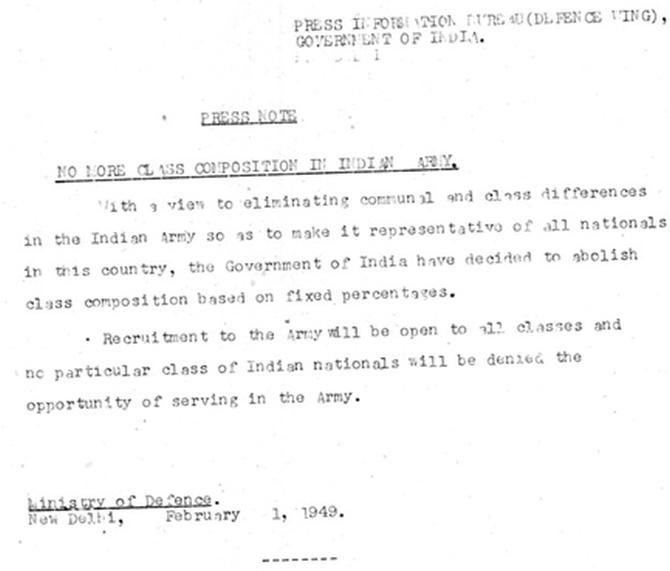
On February 1, 1949, in keeping with the spirit of equality of all its citizens, the ministry of defence, Government of India, issued a press note, 'NO MORE CLASS COMPOSITION IN INDIAN ARMY'. It read:-
'With a view to eliminating communal and class differences in the Indian Army so as to make it representative of all nationals in this country, the Government of India have decided to abolish class composition based on fixed percentages.
'Recruitment to the Army will be open to all classes and no particular class of Indian nationals will be denied the opportunity of serving in the Army.'
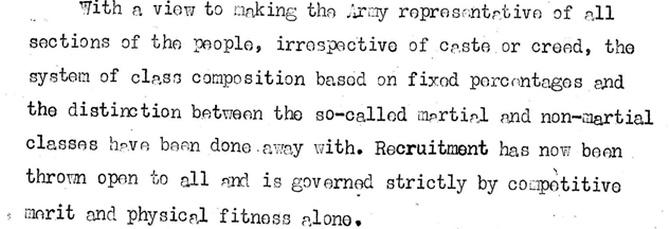
This was followed by an Independence Anniversary Issue Bureau on August 15, 1950, in which was mentioned:-
'With a view to making the Army representative of all sections of the people, irrespective of caste or creed, the system of class composition based on fixed percentages and the distinction between the so-called martial and non-martial classes have been done away with.
'Recruitment has now been thrown open to all and is governed strictly by competitive merit and physical fitness alone.'
From the above two documents dating back to 1949 and 1950, it is clear that there was a lofty and idealistic aim to achieve an 'All India All Class' status in the Indian Army.
Clearly, the intent was not matched by corresponding actions because more than seven decades later, instead of 'All India All Class' we continue to have an army with four different types of units: 'Fixed Class', 'Mixed Fixed Class', 'Single Class' and 'All India All Class' types of units.
In the 'Fixed Class' system, troops are drawn from two to three or even four types of ethnic categories and each such category forms a separate sub-unit.
The 'Mixed Fixed Class' type of unit is one wherein the men are drawn from two or more specified ethnic classes and the sub-units have men from each of these classes.
'Single Class' denotes the units where all troops are from the same ethnic class. The 'All India All Class' system has men from all states and the sub-units too represent the 'All India All Class' character.
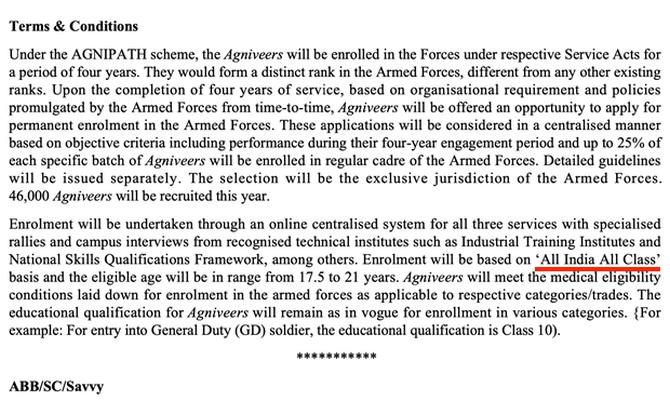
On June 14, 2022, the Government of India announced the Agnipath scheme, a recruitment scheme for Indian youth to serve in the armed forces.
The press notification released on the occasion mentions, 'Enrolment will be based on 'All India All Class' basis'...
The Existing Class System in the Corps of Engineers
With the above details as a backdrop, let me come to my own corps, The Corps of Engineers, also known as the Sappers.
Today, we have three different groups in The Corps of Engineers -- The Madras Engineer Group, the Bengal Engineer Group and the Bombay Engineer Group, which were part of the Madras Presidency Army, the Bengal Presidency Army and the Bombay Presidency Army respectively.
Madras, Bengal and Bombay are mere reminders of our colonial past and do not add any value to the professionalism or expertise of the group bearing that name in its title.
All three groups are capable of executing all Sapper tasks and no group has any claim to be professionally any different from the other (except on a couple of issues which we will come to shortly).
The city named Madras has been Chennai since long and the state named Madras is now Tamil Nadu.
The city named Bombay has become Mumbai and on May 1, 1960 the state called Bombay became two states, Maharashtra and Gujarat.
Currently, the troops who form part of the Madras Sappers are drawn from Andhra Pradesh, Karnataka, Kerala, Tamil Nadu and Telangana and some trades taken from North Indian states.
In the Bengal Sappers, the Garhwalis, Kumaonis, Rajputs and Sikhs constitute 53% and Other Indian Castes (OICs) account for 43%.
Marathas, Muslims, and Sikhs (Mazhabi and Ramdasia) make up 82% of the Bombay Sappers and the balance 18% are drawn from OICs.
Thus, each Group and correspondingly, each unit and sub-unit within the Group is of the 'Mixed Fixed Class' type.
If the 'All India All Class' concept is sincerely and strictly implemented in all the Sapper groups, as envisaged in the 'Agnipath' scheme press notification of June 14, 2022, it is only a matter of time before the class composition becomes the same in all three.
It will then become truly meaningless to persist with three different groups, each with a name reminding us of the days of British rule over India.
Having three groups in such circumstances merely creates a false sense of meaningless rivalry or superiority of the 'my daddy strongest' type, mostly amongst junior officers.
The Parachute Field Company and the Inland Water Transport Units
As all Bombay Sappers I am immensely proud of the fact that there is just one Parachute Field Company (PFC) existing today and is part of the Bombay Sappers.
The competition in the Bombay Sappers -- be it amongst officers or jawans -- to join the PFC is intense and everyone who finally gets to wear the maroon beret is justifiably proud of it.
However, by restricting the intake to just one group, two-thirds of the potential competition has been knocked out of contention.
This is just an example to show how continuance with the British laid down system of presidency based Sapper groups is coming in the way of tapping the vast pool of resources for the elite PFC.
This is not to suggest that those who now get selected to join the PFC are qualitatively any less, but for the sake of our Indian Army, for our corps and for the PFC itself, it would do no harm if the pool of aspirants could be rightly enlarged to include everyone from the corps.
Though there is no such competition, currently the Inland Water Transport units are manned exclusively by the Bombay Sappers.
Thus, back to the original question, 'Why do we need three groups in today's India?'
The Infantry
Now let us focus on the Infantry.
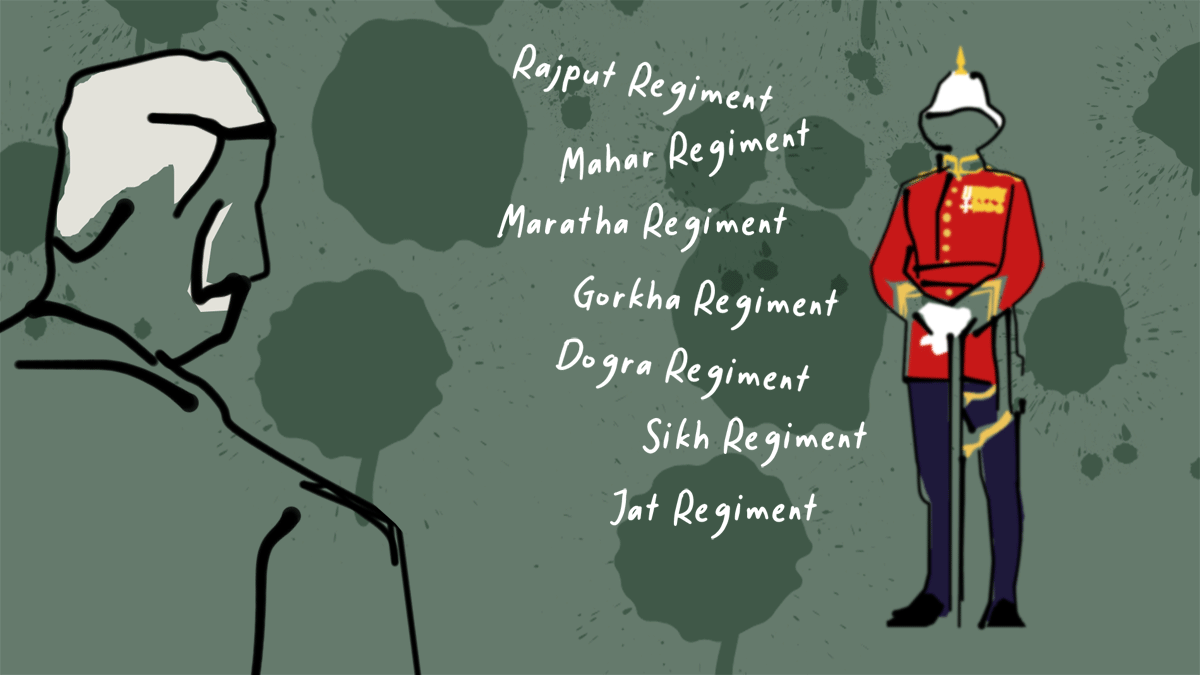
Way back in 1950 itself the Government of India had declared that the 'distinction between the so-called martial and non-martial classes have been done away with', so is it not tragic that even today we have infantry regiments based on caste names (RAJPUT, GORKHA, JAT, SIKH, DOGRA, MARATHA or MAHAR)?
Are these castes so special that we must persist with them? Is this not simply continuing the legacy of the British? Or else, why did independent India not introduce some more caste based infantry regiments, like, say NAIR, BHUMIHAR, KAYASTHA, PATIDAR, MEITEI and so on?
Similarly, in a vast country like India having 28 states and eight Union territories, to have just a few regiments named after states or regions is an insult to the other states and regions.
Why should the names of regiments be restricted to BIHAR, PUNJAB or JAMMU & KASHMIR? Why did independent India not introduce some more state based infantry regiments like say, ANDHRA or ODISHA?
Or why was a HARYANA infantry regiment not created after a separate Haryana state was carved out of Punjab in 1966?
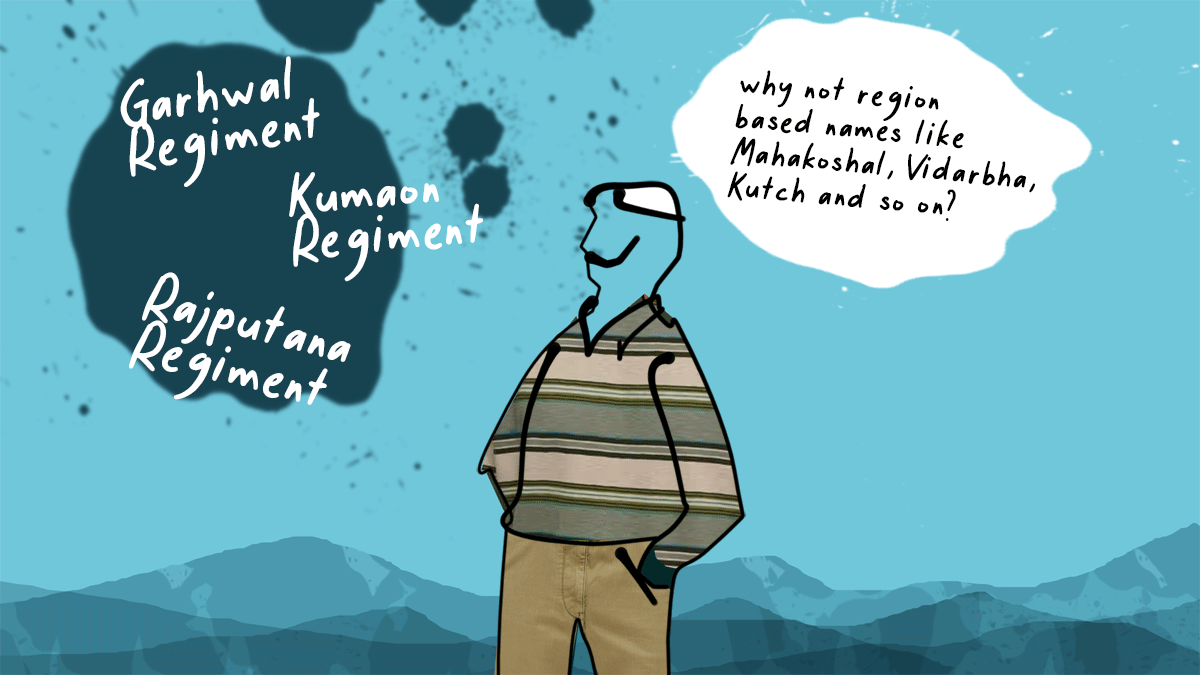
To add to infantry regiments named on the basis of regions like RAJPUTANA, GARHWAL and KUMAON why do we not have infantry regiments with region based names like MAHAKOSHAL, VIDARBHA, KUTCH and so on?
Let us closely look at the infantry regiments having the names MADRAS and ASSAM.
Great harm to India's concept of national integration is done when any Indian -- knowingly or unknowingly -- uses the term 'Madrasi' while referring to the people of any of the five southern states.
It is well known that today this umbrella term is much reviled by all those who are addressed by such a term.
There is no 'Madras' in India any more. Moreover, the Madras which existed did not represent the people from all the other regions which were clubbed under that umbrella term of 'South Indian Castes' by the British.
The use of the term 'South Indian Castes' to cover all people from the southern states, was an insulting way in which the British treated the South Indian states.
Similarly, grouping all the proud inhabitants of the eight north-eastern states as Assam is highly insulting to their identity.
These historic wrongs should have been set right on 15 August 1947 itself.
Is it not unfortunate and tragic that such ignominy heaped on people of these 13 Indian states has still not been corrected by the Indian Army, an army of an independent, democratic India and an organisation which is otherwise the epitome of national integration?
We have two 'light infantry' regiments (MARATHA LIGHT INFANTRY and SIKH LIGHT INFANTRY), though there is nothing 'light' about them any more.
So why retain such titles? Or, why did independent India not introduce some more light infantry regiments, like say GARO LIGHT INFANTRY, GURJAR LIGHT INFANTRY and so on?
The Armoured Corps
In the Armoured Corps today, other than the President's Bodyguards and the 61 Cavalry, there are 67 armoured regiments.
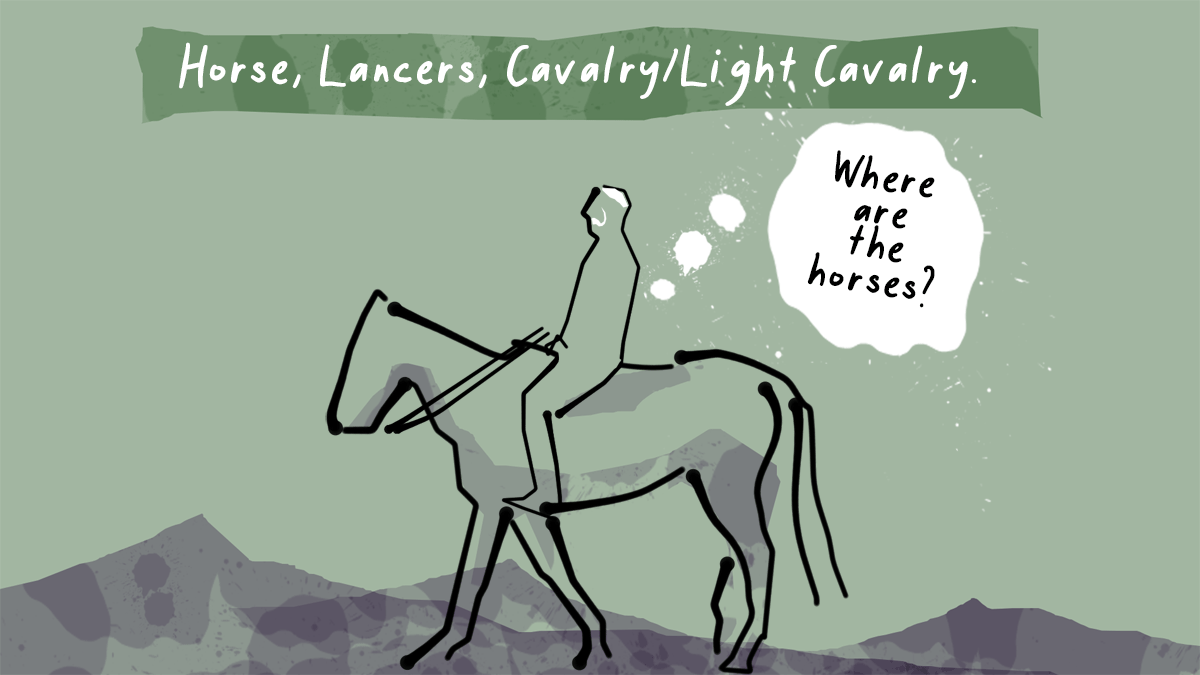
Of these there are 18 which have names like xx HORSE, xx LANCERS or xx CAVALRY/ LIGHT CAVALRY.
Where are the horses? Or, are these names merely to hold on to the connection with the British Army?
Some Other Scenarios
On and off there is a clamour for a new regiment to be created based on a caste which did well in operations in the past.
Leaders with vested interests may accept it one day. Leaders with vested interests may also agitate to change the name of Madras Sappers to Chennai Sappers or Tamil Nadu Sappers; there may be demands for the Bombay Sappers to be renamed Mumbai Sappers.
Who knows, some obliging government of the day may even acquiesce to such demands and force the army to make such changes.
One of the reasons that we often hear for continuing with the existing regiments and units as created by the British on martial race basis, is that bonding on the basis of one's caste or one's state or region helps in building greater synergy among the troops of the fighting unit or sub-unit.
This is, indeed, a valid argument. However, when we look at the performance of the units which are already 'All India All Class' type, we find that they have been second to none.
It shows that the level of training and the quality of leadership in such units has been exemplary which has surpassed the strengths ascribed to bonding achieved through caste, state and regional identities.
The Way Forward
In the course of the next one or two decades, but certainly before 2047 when India will celebrate 100 years of its independence, these historic wrongs which are continuing since August 15, 1947 should be set right.
As one would have guessed by now, there are two aspects which need to be addressed.
First is to make each and every unit and sub-unit truly 'All India All Class'. This appears to be relatively easy.
As already mentioned, if the 'All India All Class' concept as envisaged in the 'Agnipath' scheme press notification of 14 June 2022 is sincerely and strictly implemented, 'All India All Class' would be a fait accompli in a few years.
It is the second part which will test the political as well as the military leadership.
What exactly does this second part envisage?
It envisages changing the names and titles of all regiments and units from the days of the British wherever they denote either their presidency armies or their martial race theory or the states and regions as demarcated by them.
It also envisages changing the names and titles of all regiments and units if these do not reflect their current equipment and roles.
The Proposed Changes Applied to the Corps of Engineers
Once again, I start with my own Corps.
Why not amalgamate all three groups into one?
The Corps of Engineers of the Indian Army needs to be transformed into a corps in which the units do not have to carry further the burden of the three British presidency based groups.
This could be done by renumbering all the engineer regiments and their sub-units in such a manner that no trace remains of the earlier groups of which they were a part. (301 Engineer Regiment with 3011, 3012 and 3013 Field Companies and 3014 Field Park Company and so on.)
Let the new regiments so formed be populated by officers as well as the troops already in service in equal proportion from all three existing groups to wipe out the group-wise class composition as existing today. Let all three groups be disbanded and all their regimental assets be put into a huge museum at College of Military Engineering, Pune.
Maybe such an exercise, a one time effort, would help in pooling of the available training equipment and possibly result in some savings too.
The training centres (in alphabetical order) at Bengaluru, Khadki (Pune) and Roorkee could simply become 1 Engineer Training Centre (ETC), 2 ETC and 3 ETC (assuming all three would still be required).
The training of troops in the ETCs could be planned in such a manner that every soldier from the Corps of Engineers gets an opportunity to undergo some training in every ETC during his career, so that after a generation or two there are no remnants of any of the three British presidencies in the DNA of the Corps of Engineers.
The Proposed Changes Applied to the Other Arms
In the Infantry too it would be essential to create new regiments and battalions and to identify them simply by numerals.
There can be 15 to 20 infantry regiments -- 1 Infantry Regiment, 2 Infantry Regiment and so on -- with 25 to 30 battalions under each.
The troops should also be so mixed up that every legacy of the past, traceable to the existing names at regiment and battalion level, is wiped clean.
Let all the armoured regiments which hold battle tanks and not horses be renamed xx Armoured Regiment instead of xx HORSE, xx LANCERS or xx CAVALRY/LIGHT CAVALRY.
In the Regiment of Artillery, the Army Air Defence and the Mechanised Infantry, the challenges would be less as there would be no changes in names of units involved.
All that would be required would be to make the class composition in the existing units to 'All India All Class'.
The Army Aviation Corps, Corps of Signals, Parachute Regiment, Brigade of the Guards and all the services, namely Army Service Corps, Army Medical Corps, Army Dental Corps, Army Ordnance Corps, Corps of Electronics and Mechanical Engineers, Remount and Veterinary Corps, Army Education Corps, Corps of Military Police, Pioneer Corps and Army Postal Corps are all already 'All India All Class'.
Finally, here is a really low-hanging fruit just waiting to be plucked.
In the lexicon of ranks, there are two -- 'Sepoy' and 'Sowar' -- currently used in the Indian Army. 'िसपाही' and 'सवार' are the words in Hindi which mean soldier and 'the one who rides' respectively.
In Roman script they should be 'Sipahi' and 'Sawar' but for the British they became 'Sepoy' (िसपोय) and 'Sowar' (सोवार). Why not Indianise these words and change 'Sepoy' to 'Sipahi' and 'Sowar' to 'Sawar'?
Conclusion
Carrying out the changes as suggested here will in no way be detrimental to the efficiency and fighting capability of the Army.
The officers and troops who join the (hypothetical) 301 Engineer Regiment or the 1 Infantry Regiment or 1 Armoured Regiment will continue to have the same 'josh' and same pride, if not more, for their respective units as those in service today.
The greatest stumbling blocks to the proposed changes, the naysayers, are likely to be some veterans who may feel as though they have been deprived of their moorings, which is quite understandable.
Their fears and misgivings need to be addressed rationally.
We must move ahead with the changes proposed and certainly before August 15, 2047 we should have an Indian Army which reflects true Indianness in every aspect including the names of its regiments.
Colonel K Thammayya Udupa (retd) is a B Tech (Electrical) from Karnataka Regional Engineering College (now National Institute of Technology Karnataka), Surathkal.
He was commissioned into the Corps of Engineers (THE BOMBAY SAPPERS) in December 1982.
He commanded 109 RAPID (S) Engineer Regiment. He took premature retirement in April 2007.
Post retirement he served in the Indian Institute of Management, Indore.
He is settled in Udupi-Manipal and can be contacted at ktudupa@gmail.com
Feature Presentation: Rajesh Alva/Rediff