
'If this is true, the Election Commission should come forward with data and officially confirm it.'
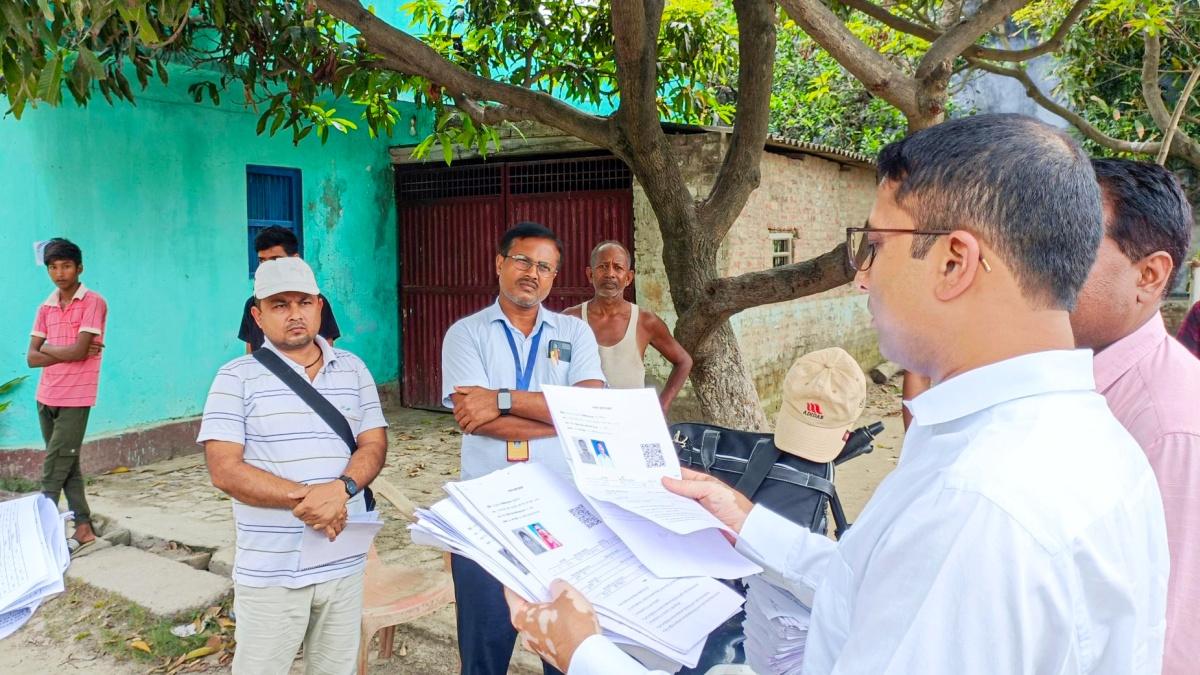
Amidst reports alleging that a large number of infiltrators from Nepal, Bangladesh and Myanmar have made their way onto Bihar's voter lists, the issue has ignited a political firestorm ahead of the state assembly elections later this year.
The controversy, as is often the case when infiltration issues arise, has drawn focus to Seemanchal, a Muslim-dominated, economically backward region of the state.
While there has been no official confirmation or official data on the exact number of alleged infiltrators on Bihar's voter rolls, the emergence of a report -- citing unnamed field-level officials of the Election Commission of India involved in the ongoing Special Intensive Revision of the electoral roll -- has triggered a fresh and heated debate: Is this claim true, or is it a fabricated?
This development follows recent reports by a section of the national media that unusually high Aadhaar enrollment rates were reported in Seemanchal compared to the Bihar average.
The media outlets claimed that while Bihar's average Aadhaar saturation stood at 94%, Seemanchal exhibited 'oversaturation'.
Specific figures cited included 126% in Kishanganj (with a 68% Muslim population), 123% in Katihar (44% Muslim population), 123% in Araria (43% Muslim population), and 121% in Purnea (38% Muslim population). Bharatiya Janata Party leaders reportedly emphasised these figures without thorough verification.
However, a more complete picture of Bihar's Aadhaar enrollment data soon emerged, suggesting that some national television anchors may have painted a wrong picture to target the Muslim community.
Official data for Bihar's 38 districts revealed that only Jehanabad district had Aadhaar coverage below 100%. Most districts reported more than 100%. Notably, Sheikhpura, with a marginal Muslim population, had an enrollment rate of 118%.

BJP leaders, including Bihar Deputy Chief Minister Samrat Chaudhary, voiced serious concerns over reports of a surge in domicile certificate applications in Kishanganj.
Chaudhary was quoted in a video clip stating, 'There is a sudden surge of over 2 lakh applications in just one week, from July 1 to 7. Earlier, we barely got 25,000 in a month. This cannot be normal. Are Bangladeshis or foreigners from other countries behind this? This is the reason we have directed the administration to issue a certificate only after intensive review.'
However, this increase in domicile certificate applications in Kishanganj was not entirely unexpected. Residents were seeking these documents for the Election Commission's ongoing special intensive revision of electoral rolls, as a domicile certificate is one of 11 listed documents required for the process.
Locals in Kishanganj and across Seemanchal expressed fears of disenfranchisement or being labeled 'illegal foreign immigrants' due to a lack of proper documentation, particularly given Seemanchal's shared borders with Nepal and Bangladesh.
There is no denying that Bangladeshi and Rohingya Muslims have settled in Seemanchal as well as in other parts of Bihar and the country.
It is also plausible that some of them may have managed to get their names included in voter lists using fraudulent Aadhaar cards and domicile certificates.
Yet, it is not true that the entire Seemanchal region is dotted with infiltrators. Local Hindi newspapers frequently report about the arrest of foreign nationals, particularly from Bangladesh, Myanmar and other countries, as they attempt to illegally enter India through various checkpoints along the India-Nepal border near Bihar.
"BJP leaders have been alleging for years, without proof, that Bangladeshis and Rohingyas are present in Bihar's Seemanchal (comprising Kishanganj, Purnea, Katihar and Araria districts). This is the first time a report, citing official sources within a Constitutional body like the Election Commission of India has claimed that a large number of Nepali, Bangladeshi and Myanmarese citizens have been found on Bihar's voter list," stated Satyanarayan Madan who runs Jan Pahal, a people's organisation in the state.
"If this is true, the ECI should come forward with data and officially confirm it."
"What is new in the report is that for the first time Nepal's citizens along with Bangladesh and Myanmar natives, have been put in the category of illegal infiltrators. Never before were Nepalese described in such a manner, because Bihar shares an open, porous border with neighbouring Nepal, and we have shared 'roti-beti' (familial and economic) relationships for centuries. Nepalese are never seen as infiltrators," Madan emphasised.
At a time when booth level officers are primarily collecting and submitting enumeration forms without documents during the ongoing door-to-door SIR of electoral rolls, Madan asked how foreign nationals were identified on voter lists before proper checks.

"How did they find the names of Nepal, Bangladesh and Myanmar citizens on the voters list when only enumeration forms were submitted, and they haven't been checked yet? Does it not sound suspicious that Election Commission officials found them on the voters list without proper document checks, scrutiny and physical verification?" Madan asked.
Reports indicated that Election Commission field-level functionaries had found 'a large number of people' from Nepal, Bangladesh and Myanmar during house-to-house visits for the ongoing intensive review of Bihar's voter list.
These functionaries reportedly asserted that a proper inquiry would be conducted after August 1, and the names of illegal migrants would not be included in the final electoral roll to be published on September 30.
"It is questionable how field-level functionaries of the Election Commission, mainly booth level officers, identified and found a large number of people from Nepal, Bangladesh, and Myanmar on the voter list when they have been accepting enumeration forms without documents. Is it possible to trace infiltrators on a voter list without checking documents and physical verification?" asked Ram Prakash Mahto, a retired college professor living in Katihar, one of the four districts comprising the backward, Muslim-populated Seemanchal region.
If the reports of a large number of infiltrators managing to register their names on Bihar's voter list are true, Mahto said it is an unfortunate development.
"It is a failure of the Bharatiya Janata Party-led National Democratic Alliance governments at the Centre and in Bihar to stop and check infiltrators and to take action against them if they entered. Who is stopping them from arresting and deporting such illegal people living in the state?" Mahto asked.
"Who made their EPIC (Electoral Photo Identity Card)?", asked social scientist D M Diwakar. "It was the Election Commission that provided them with EPICs. Why doesn't the Election Commission officially accept it if the booth level officers found a large number of people from three neighbouring countries on the voter list?"
"It appears far from the truth. This is nothing but a narrative to keep those in power happy as it suits their political agenda," added Diwakar, a former director of the Patna-based A N Sinha Institute of Social Studies.
Abdul Mannan, a school teacher in Kishanganj, said the issue of Bangladeshi and Rohingya Muslim infiltrators invariably resurfaces before elections, often as a means to target Muslims in Seemanchal.
"There is deep suspicion about the Bengali-speaking people," Mannan remarked, "because they are Muslims and an easy target for suspicion and hate."
Feature Presentation: Rajesh Alva/Rediff