
Sanctioning Russian oil would have led to a sharp surge in oil prices to above $80 per barrel levels, which would impact pump prices in the US ahead of midterm elections next year.
It might be too early to pronounce the end of the $69 billion India-Russia oil trade from the sanctions by Washington on two of Russia's biggest oil producers and new sanctions package by the European Union on Russian oil and gas.
There is a loophole: While the US sanctioned Russian firms Rosneft and Lukoil, Russian oil itself was spared by both Washington and Brussels, experts and refining officials said, with the result that it continues to trade in the world market.
Indian refiners will break no law, domestic or international, for buying Russian oil if the seller is not sanctioned, three officials from two State refiners and a private refiner said.
In other words, the sanctions regime leaves suppliers from other countries free to sell Russian oil.
There will, however, be an immediate impact on December arrivals, orders for which are placed now, a senior trader at a State refiner warned, because there is no time for Moscow to work around the sanctions.
Nearly 70 per cent of India's supplies this year came from Rosneft and Lukoil, according to shipping data.
After adding shipments from Surgutneftegaz, another leading Russian oil producer, the proportion in the Indian oil import basket creeps up to 78 per cent.
It is not clear how Surgutneftegaz, which was sanctioned by the US back in January, is still supplying India.
Tatiana Mitrova, global fellow at the Center on Global Energy Policy, Columbia University, said in a Linkedin post that whether these sanctions are a turning point or just the latest in a long series of geopolitical moves will depend on how seriously enforcement follows the headlines.
The new US sanctions, announced October 19, 2025, on Rosneft and Lukoil, Russia's two biggest oil producers, will impact combined flows of around 5 million barrels per day (bpd) of Russian oil.
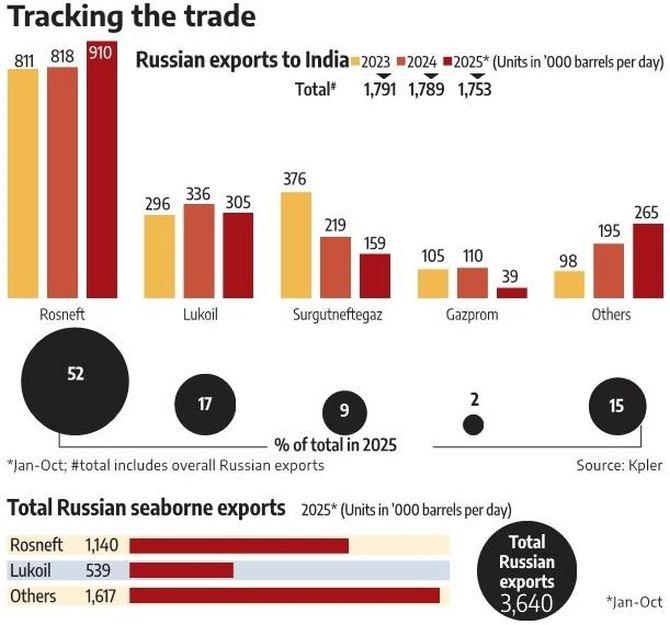
Rosneft supplied around 910,000 bpd to India this year, accounting for half of India's 1.75 million bpd of supplies from Russia; Lukoil shipped another 302,000 bpd this year, as on date, according to data from maritime intelligence agency Kpler.
This is the second time since Russia invaded Ukraine in February 2022 that Washington is sanctioning producers and not the commodity: In January this year, the outgoing Biden administration sanctioned Gazprom Neft and Surgutneftegas, impacting around 1 million bpd of oil production.
But Surgutneftegas, despite the sanctions, shipped 159,000 bpd, or 9 per cent of Russian supplies to India this year. It was the third biggest supplier of oil after Rosneft and Lukoil to India, Kpler data show.
Separately, the EU sanctioned Russian liquefied natural gas supplies this week but did not sanction Rosneft or Lukoil.
The companies were spared because of Europe's domestic compulsions, said George Voloshin, a sanctions expert at ACAMS, an international organization for anti-financial crime professionals, on Linkedin.
Voloshin pointed to another loophole in the sanctions process: The EU sanctioned Lukoil's UAE-based trading subsidiary Litasco Middle East but failed to sanction its main trading unit, Swiss-based Litasco SA.
Oil spared?
A top government official dealing with sanctions regimes said that India follows only UN sanctions and not those slapped by individual countries.
Second, unlike in the case of Iran or Venezuela where oil is sanctioned, Russian oil was never sanctioned, the official explained -- only the entities behind the trade were sanctioned.
India does not officially accept Western sanctions, but companies and banks involved in trade are free to make their own decisions, he added.
Narendra Taneja, a leading India-based oil expert, said America and Europe have been careful not to sanction oil -- which allows Chinese and other buyers of Russian oil to re-export the commodity or intermediaries and traders in Singapore or Dubai to trade and sell the oil.
"The world is still waiting for clarifications on what it means to sanction the two entities," Taneja said.
Brent oil prices have only increased marginally by 5 to 6 per cent to $65 per barrel levels, which indicates that traders expect Russian oil to stay in the global supply system one way or another, he added.
Vandana Hari, a Singapore-based energy expert, said that sanctioning Russian oil would have led to a sharp surge in oil prices to above $80 per barrel levels, which would impact pump prices in the US ahead of midterm elections next year.
It's actually a workaround, said Sumit Ritolia, an analyst at Kpler: "If they (the US) want to stop Russian crude oil, they would have sanctioned Russian oil, like Iranian oil."
Western powers cannot afford to let Russian oil disappear entirely from the system because that would affect 5 to 6 per cent of world supplies, a senior official from a State refiner said.
He expects supplies from other Russian suppliers to gradually enter the market via new intermediaries.
Tankers shipped 3.6 million bpd of Russian origin crude this year globally, with Rosneft accounting for 31 per cent of sales, Kpler data showed.
Lukoil accounted for 15 per cent. A category called 'others' -- basically unclear, crude source -- accounted for 1.6 million bpd or 44 per cent of supplies, reflecting the opacity in Russian supplies in a bid to evade sanctions.
The US Treasury Department has allowed for a wind-down of transactions with Rosneft and Lukoil by November 21. Flows until the cutoff will be strong, said Ritolia, with Russia already loading over 1.5 million bpd for November deliveries.
Ritolia expects a dip in Russian shipments to India in December and January but supplies to stabilise subsequently as Russia finds workarounds.
Importantly, he expects third- and fourth-party sales of Russian oil to gain, with more transactions turning opaque.
An analyst with a top global oil trader said that trading giants Glencore, Vitol or Trafigura would not touch Russian oil for fear of exposure to sanctions.
The trades, he said, will be carried out by relatively unknown trading entities in Dubai or Hong Kong, based out of the Dubai Multi Commodities Center or registered at Dubai's Silicon Oasis.
Leading traders of Russian oil include 2 Rivers DMCC, Amur Investments, Nexus Trading, Litasco and Coral Energy.
Price impact
If Russian crude disappears from global trade, the biggest challenge will be price, Taneja said.
Premiums on spot supplies of Middle East grades, a substitute for medium, sour Russian export benchmark Urals oil, have already tripled from pre-sanction levels, market data from UK commodity pricing service Argus shows.
Russia produced 10.2 million bpd of crude oil in 2024, which is 12 per cent of global crude oil and condensate production of 83 million bpd, according to EI Statistical Review of World Energy.
It exported 7 million bpd last year via pipelines and tankers.
China, India and Turkey are the biggest buyers of Russian oil, but they buy different grades.
Chinese independent refiners or teapots, the biggest buyers of sanctioned oil from Iran, Venezuela and Russia, prefer ESPO blend, a light grade.
Indian and Turkish refiners compete for Urals, a medium, sour and cheaper variety, which accounts for half of Russian seaborne oil exports.
The impact on Indian refiners is likely to be varied.
State-run refiners led by Indian Oil and Bharat Petroleum are still looking at ways to import Russian oil from non-sanctioned entities, expecting discounts to more than double to $4 to $5 per barrel from current levels, a senior official at a state refiner said.
But privately owned Reliance Industries may have to stop purchases under a 10-year, 500,000 bpd supply contract with Rosneft because the sanctions against Rosneft and Lukoil were pursuant to US Executive Order 14024, which carries the threat of secondary sanctions on foreign financial institutions that continue to do business with sanctioned companies, according to the US sanction notification.
This prevents Reliance from paying Rosneft via banks.
'As it is customary in the industry, supply contracts evolve to reflect changing market and regulatory conditions. Reliance will address these conditions while maintaining the relationships with its suppliers,' it said in a statement.
Indian officials pointed to key variables that could affect the direction of India-Russia oil trade in the next few months.
Politically, it includes Russia's response to US ceasefire demands and progress on the India-US trade talks, and commercially, on how effectively sanctions are enforced, by how much discounts on Russian oil expand, and how quickly Russia is able to ship its oil to consumers via non-sanctioned entities.
'Urals discounts could widen by another $3-8/bbl (per barrel),' Columbia's Mitrova said.
The impact of new US sanctions on Russia will likely be at the lower end due to sanctions workarounds and limited US appetite for major secondary measures for Chinese or other buyers, said Pietro Guglielmi, an analyst for Eurasia Group, a global think-tank, in a note.
Feature Presentation: Aslam Hunani/Rediff
