
India and the UK on Thursday unveiled a series of initiatives including a government-to-government $468 million deal on the supply of lightweight multirole missile (LMM) systems to enhance India's air defence capabilities.
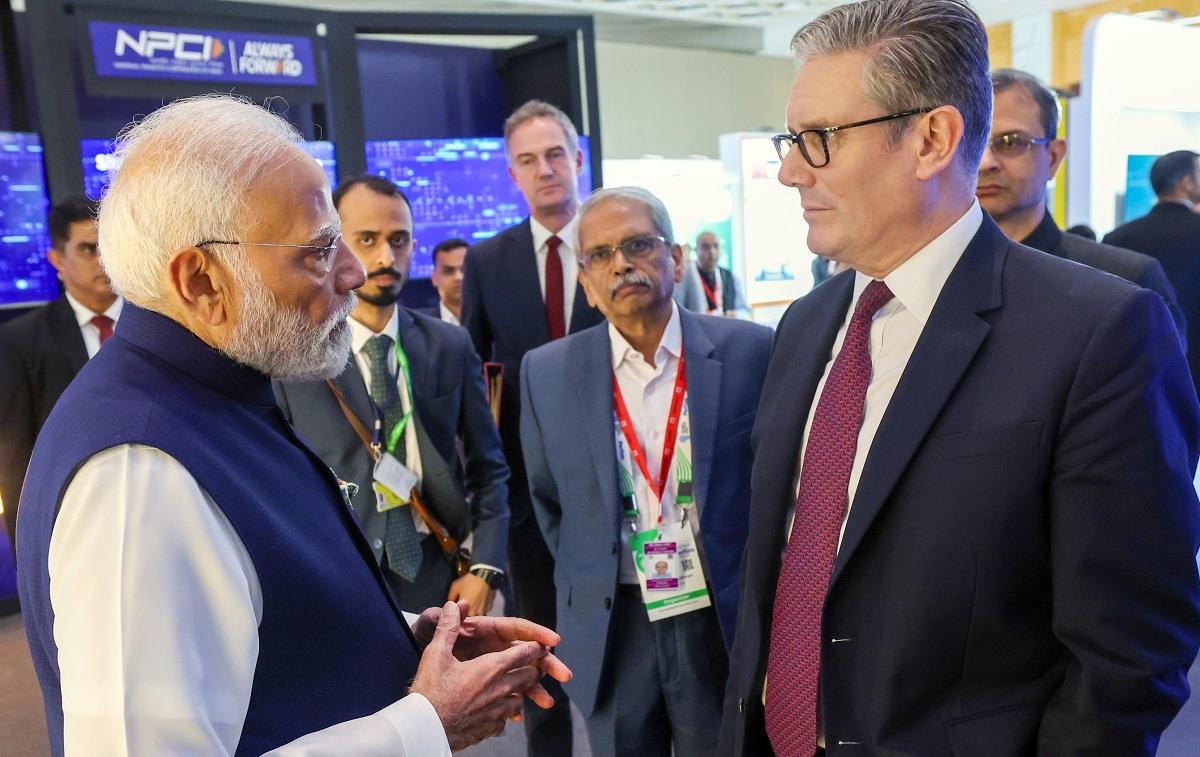
The new measures to expand the bilateral defence cooperation were announced following wide-ranging talks between Prime Minister Narendra Modi and his British counterpart Keir Starmer.
In his statement to the media, Modi also referred to the growing defence ties between the two countries.
"From defence and security to education and innovation, India and the UK are shaping new dimensions in their relationship," he said.
Britain's defence ministry said the $468 million (350 million pounds) contract on the LMM envisaged the delivery of air defence missiles and launchers, made by Thales at Belfast in Northern Ireland, to the Indian Army.
The deal will give a significant boost to the British defence industry and secure 700 jobs at a factory that currently makes the same weapons for Ukraine.
In a statement, the UK's defence ministry said the two countries signed an "implementing arrangement" to advance collaboration on electric-powered engines for naval ships, with the deal worth an initial 250 million pounds (USD 333 million).
A joint statement on Modi-Starmer talks listed the plan to supply lightweight multirole missile systems to the Indian military, besides an in-principle move to finalise an inter-governmental pact to jointly develop maritime electric propulsion systems for India's naval platforms.
A separate initiative was announced for Indian Air Force (IAF) instructors to be integrated with the Royal Air Force (RAF).
"In the context of cooperation on training, the two leaders welcomed progress on an arrangement that will see Indian Air Force qualified flying instructors integrated into UK Royal Air Force training, alongside an agreement that will facilitate our strong training and education relationship," the statement said.
It said both the prime ministers were pleased with the "intent to finalise an India-UK Inter-Governmental Agreement (IGA) on cooperation in developing maritime electric propulsion systems for Indian Naval platforms."
It said both leaders also announced the agreement to proceed via government to government route on an initial supply of LMM systems.
"This will further support India's air defence capabilities and, in the spirit of Atmanirbhar Bharat (self-reliant India), meet the current and future requirements of the Indian Ministry of Defence, and support a long-term collaboration on complex weapons between the two countries," it said.
Modi and Starmer also condemned in the "strongest terms" the Pahalgam terror attack and committed to strengthen co-operation to take "decisive and concerted" actions against globally proscribed terrorists, terror entities and their sponsors.
The two prime ministers "unequivocally and strongly condemned" terrorism and violent extremism in all its forms and manifestations and called for "zero tolerance" for terrorism and concerted international efforts to combat it in a comprehensive and sustained manner, the joint statement said.
"They agreed to counter radicalisation and violent extremism; combat financing of terrorism and the cross-border movement of terrorists; prevent exploitation of new and emerging technologies for terrorist purposes and tackle terrorist recruitment," it said.