
'Just as we cannot surrender the interests of our farmers and dairy industry, Trump is also looking for markets for the produce of the farmers in the Midwest, which are his support base.'
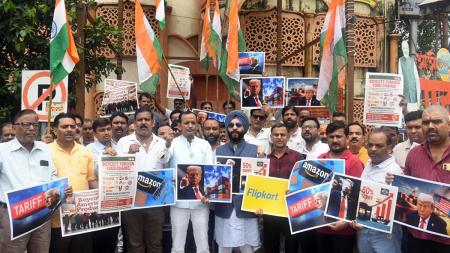
India could challenge US President Donald Trump's additional 25 per cent tariff in the US court of appeals for the federal circuit, or even put retaliatory tariffs.
But on Thursday, top government ministers and officials rejected these suggestions.
Instead, they said New Delhi should seek clarity on Trump's domestic compulsions to impose these tariffs and bide time till year-end, when America starts preparing for the House of Representatives elections, which is when the White House would be amenable to heed electors' ire over rising prices.
India should, in the interregnum, look for other markets for its products, they felt.
New Delhi will also keep an eye on the developments around the proposed meeting between Trump and Russian President Vladimir Putin.
On Thursday, National Security Adviser A K Doval was in Moscow to finalise dates for Putin's visit to India, but officials rejected speculation it could happen in August.
Modi is expected to visit China on August 31 to attend the Shanghai Cooperation Organisation and also have a bilateral meeting with Chinese President Xi Jinping.
The ministry of external affairs is yet to officially confirm the visit, but government sources were certain the visit was on.
Sources conceded that New Delhi needed to work harder to try to understand Trump's core elector base in Midwestern US.
"Just as we cannot surrender the interests of our farmers and dairy industry, Trump is also looking for markets for the produce of the farmers in the Midwest, which are his support base, and it is important for him in the context of the mid-term elections since the Republican majority in the House of Representatives is thin," a source said.
Secretary, Economic Relations, Ministry of External Affairs, Dammu Ravi, argued there is no logic or reason behind US' "unilateral" move to impose 50 per cent tariffs on India.
"Perhaps, this is a phase we have to overcome. The negotiations are still going on. So, we are confident that solutions will be found in the course of time in looking at mutually beneficial partnerships," Ravi said on the sidelines of the LIDE Brazil India Forum on Thursday.
The ministry of commerce is leading the negotiation from the Indian side, and some solutions were in sight when Trump moved in with the tariff hike, he said.
"We were very close to finding a solution, and I think that momentum has taken a temporary pause, but it will continue," he said.
India Eyes New Markets Amid US Tariff Heat
Abhijit Lele
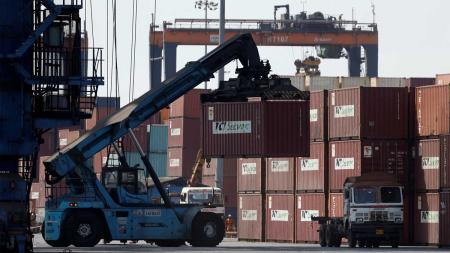
India is exploring new markets for its exports -- both goods and services -- as a diversification strategy amid the United States' decision to impose additional tariffs on Indian exports, said Dammu Ravi, Secretary (Economic Relations), ministry of external affairs.
Ravi called the US decision to levy high tariffs a unilateral move without logic, but expressed confidence that ongoing negotiations would yield mutually beneficial outcomes.
He was speaking to the media on the sidelines of a conference on India-Brazil relations in Mumbai.
US President Donald Trump on Wednesday announced an additional 25 per cent tariff on Indian goods exported to the US, citing India's import of Russian crude oil.
These are over and above the earlier 25 per cent duties, and will come into effect from 7 August 2025. The new duties will be enforced 21 days after the announcement.
Ravi said the higher tariffs do not significantly deter Indian industry.
"We are looking at opportunities, but also new markets. So, if the US becomes difficult to export to, then you will automatically look at other opportunities -- within our own region, in South Asia, Africa, the Middle East, and Latin America. These are potential areas.
"I think it's very natural for countries to look for alternatives," he said.
"It is a unilateral decision and I don't think there was any logical reason in the way it was done.
"The US and India are strong strategic partners. We have had a complementary relationship all this while."
Ravi added that leaders and businesses on both sides continue to explore opportunities and this may be a temporary phase.
"The negotiations are still going on, so we are confident that solutions will be found in the course of time," he said.
He confirmed that the ministry of commerce is leading the discussions.
"Those negotiations have not stopped. They will continue and are very close to finding a solution.
"The momentum had taken a temporary pause, but it will continue," Ravi said.
Responding to a question on India working with Brazil and other BRICS countries against the tariffs, Ravi noted that nations across the globe, including BRICS members, are affected.
"When you are hurt or affected by tariff walls in one part of the world, countries will naturally look for alternatives.
"This is a temporary aberration -- a problem that countries will face," he said.
"But in the course of time, we are confident that the world will find solutions.
"Like-minded countries will look for cooperation and economic engagement that will be mutually beneficial for all sides."
Feature Presentation: Ashish Narsale/Rediff
