The Human-rated LVM3 vehicle, the Crew Escape System and the Crew Module and Service Module are all in final stages of testing and integration.
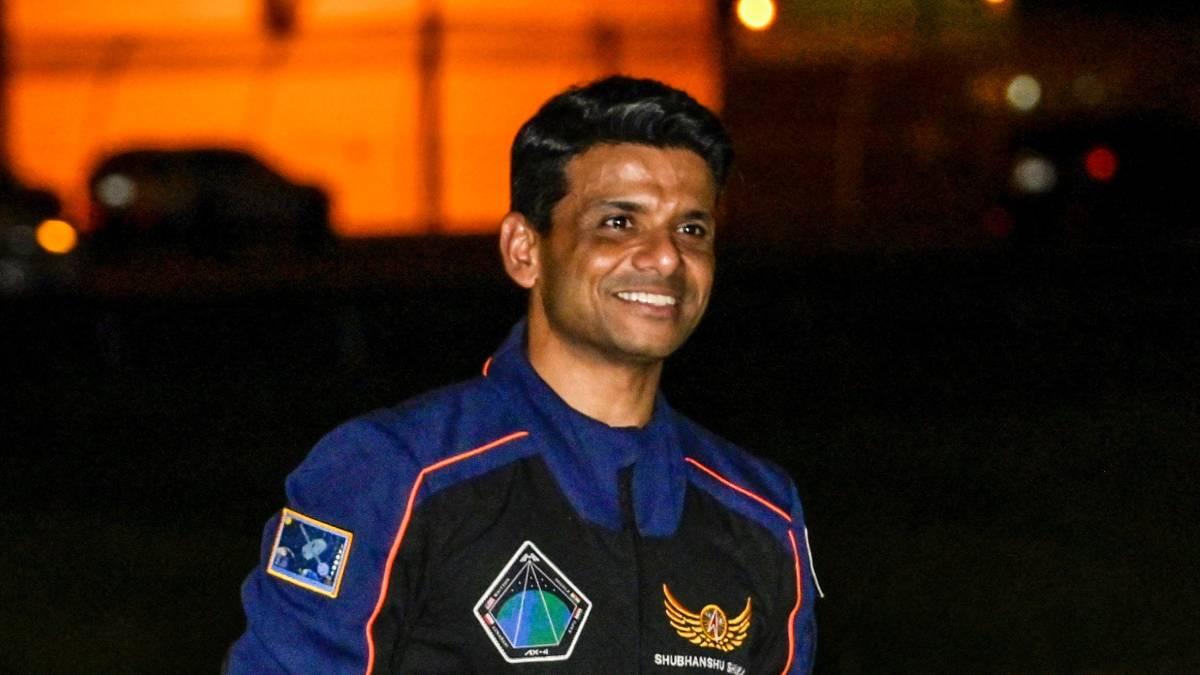
IMAGE: Axiom-4 Pilot Shubhanshu Shukla before flying to the International Space Station in Cape Canaveral, Florida, USA, June 24, 2025. Photograph: Steve Nesius/Reuters
Group Captain Shubhanshu Shukla's successful completion of Axiom Mission 4, along with his and the Gaganyaan crew's space-flight training in Russia, has validated India's crew-screening and selection process for its planned first human spaceflight mission, Assistant Chief of the Air Staff (Medical) Air Vice Marshal Anupam Agarwal revealed on Sunday, a day after the country celebrated the second National Space Day.
"There are numerous medical and physical parameters that must be considered when selecting the crew for a manned space flight," said Air Vice Marshal Agarwal, explaining that since Gaganyaan marked the Indian Space Research Organisation's maiden attempt, there was no pre-existing data or benchmarks to rely on.
"When the Gaganyaan programme was approved in December 2018 to undertake human spaceflight to Low Earth Orbit and establish the foundation for technologies required for an Indian human space-exploration programme, we had very little time to develop the procedure for crew selection and screening entirely from scratch," the air vice marshal explained.
"The Institute of Aerospace Medicine rendered yeoman service in this effort, as no country was willing to share the required information in this domain," he added.
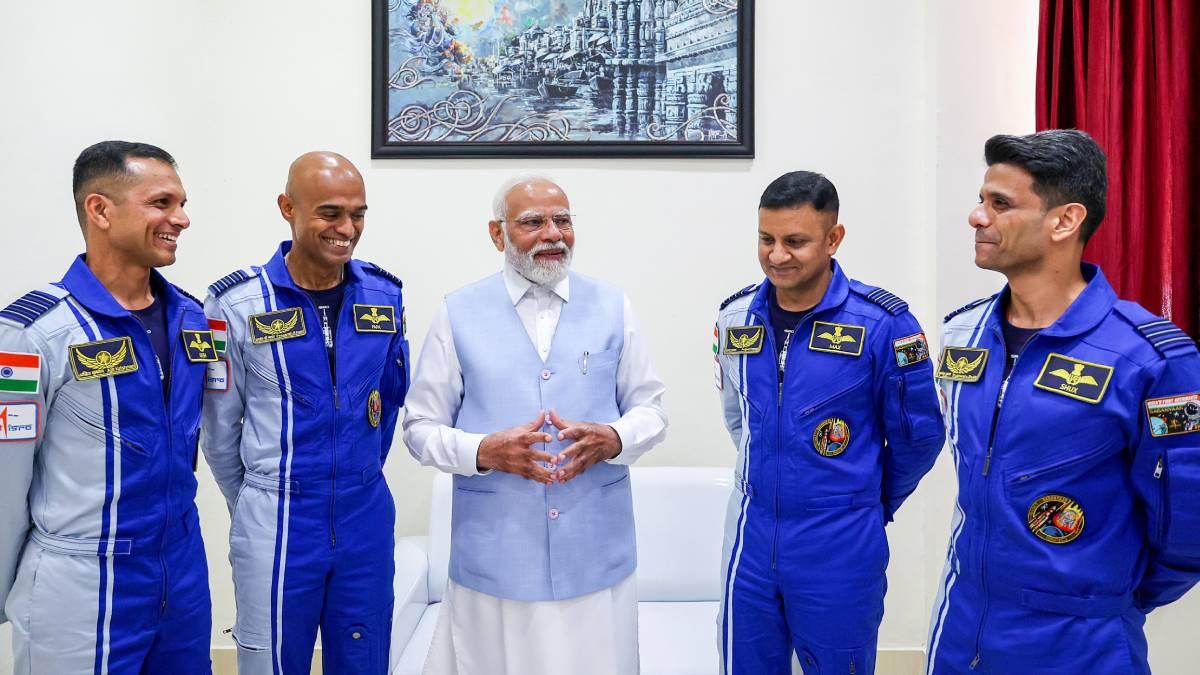
IMAGE: Prime Minister Narendra Modi tweeted this picture of his meeting with Indian astronauts-designate for the Gaganyaan mission. Photograph: ANI Photo
Highlighting that the four selected Gaganyatris -- Group Captains Shukla, Prasanth Balakrishnan Nair, Ajit Krishnan and Angad Pratap -- were also evaluated by the Russians before their training there, and that Group Captain Shukla underwent additional screening in the United States as part of the Axiom Mission 4, Air Vice-Marshal Agarwal explained that these multiple rounds of evaluation validated the selection procedure and processes independently established by India.
As part of the four-person Axiom-4 mission, Group Captain Shukla became the first Indian ever to set foot on the International Space Station (ISS) and only the second Indian to travel to space.
After successfully completing his 18-day mission aboard the ISS, he returned to earth on July 15.
Axiom-4, a commercial mission operated by the Houston-based private firm Axiom Space, was a collaboration between the US space agency, National Aeronautics and Space Administration (Nasa), Isro, the European Space Agency, and Elon Musk's SpaceX.
On Sunday, Defence Minister Rajnath Singh felicitated Group Captains Shukla, Nair, Krishnan and Pratap at an event in the national capital.
Speaking on the occasion, Singh praised the four Gaganyatris, describing them as 'gems of the country' and pioneers embodying the nation's aspirations.
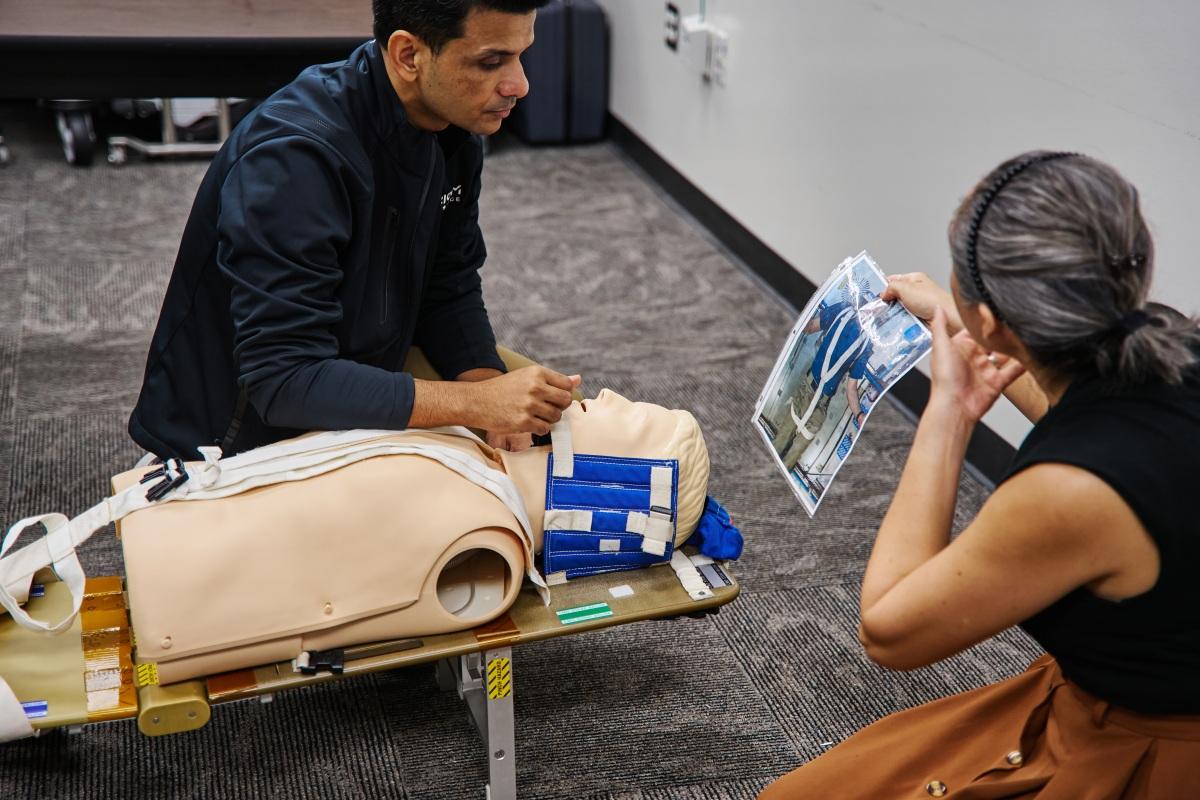
IMAGE: Group Captain Shubhanshu Shukla during medical emergency training in the USA. Photograph: Kind courtesy isro.gov.in
Highlighting the expanding presence of India in space, Singh added: "We do not see space only as a field of research, but as the future of tomorrow's economy, security, energy, and humanity.
"We are steadily advancing beyond the earth's surface into new frontiers of space.
"We have already marked our presence from the moon to Mars, and today, the nation stands fully prepared for missions like Gaganyaan."
Commending Group Captain Shukla for his successful space mission, Singh emphasised the officer's determination and courage, adding these qualities reflected the spirit of India.
"Completing two-and-a-half year's training in just two-and-a-half months, he showcased his personal dedication and the perseverance of the Indian people.
"His extraordinary feat is not just a technological achievement, but a message of faith and dedication.
"It is not just India's pride, it is proof of the progress of entire humanity," the defence minister said.
Calling Group Captain Shukla a symbol of "civil-military fusion", the defence minister added: "Though he wears the uniform of the Indian Air Force, his journey into space was not merely on behalf of the armed forces or India alone, but as a representative of all humanity.
"His contribution to the civil sector, through this historic mission, will forever be recorded in history."

IMAGE: Captain Prasanth Balakrishnan Nair during ISS emergency scenario training in the USA. Photograph: Kind courtesy isro.gov.in
The Gaganyaan programme has recently entered its final phase, with the first human spaceflight now scheduled for the first quarter of 2027.
The test mission schedule remains on track and will culminate in India's maiden human spaceflight, launching Indian Gaganyatris (astronauts) into orbit aboard an Indian rocket from Indian soil.
As of May, the Human-rated LVM3 vehicle, the Crew Escape System, and the Crew Module and Service Module were all in final stages of testing and integration.
Four IAF pilots, selected as Gaganyatri-designates, have completed training in Russia and are now undergoing further mission-specific training in India.
Their health, psychological fitness, and simulation-based operational readiness continue to be assessed at India's dedicated astronaut training facility.
The Gaganyaan Programme has a financial outlay of about Rs 20,193 crore (Rs 201.93 billion).
Prime Minister Narendra Modi has also outlined India's long-term ambitions in space, which include establishing the Bharatiya Antariksha Station by 2035 and sending the first Indian to the moon by 2040.
'If You Are Not A Team Player, You Are Not Fit For Spaceflight'
Undergoing survival tests in a simulated environment, learning photography to document space experiences and a team kayaking off the Mexican coast to foster camaraderie -- these were some of the activities that the crew of Axiom-4 had engaged in before setting off on the mission, astronaut Shubhanshu Shukla said.
During an event hosted by the Indian Air Force on Sunday, Group Captain Shukla, who goes by the callsign 'Shux', shared his experiences and challenges he faced while being part of the Axiom-4 mission to the International Space Station and the training he underwent prior to it.
After several postponements, the Dragon spacecraft carrying him and other three astronauts was launched from the Kennedy Space Center in the US on June 25.
"It was so powerful, it literally shakes every bone in your body.
"You are going from 0 km/hr to 28,500 km/hr in 8.5 minutes, and that speaks about the magnitude of it," Shukla recalled the intensity of the lift-off experience.
During the event, he also shared some anecdotes from his 20-day space sojourn as part of the mission that was preceded by several months of hard training.
"When you go to an ISS, you are essentially living in a new house.
"And, it has its own rules, its own set of terms and conditions, like how you would eat, how you would sleep.
"How would you go to a bathroom, actually that is the most challenging task, to go to a washroom in space," Shukla said, drawing mirth from the audience.
The astronaut, who will turn 40 this October 10, was commissioned into the IAF in 2006 and went on to become a decorated test pilot with over 2,000 hours of flying time on advanced fighter aircraft such as the Su-30 MKI, MiG-29, Jaguar, and Dornier-228.
His profile in the Axiom-4 mission was of a mission pilot, alongside commander Peggy Whitson of the US and mission specialists Slawosz Uznanski-Wisniewski of Poland and Tibor Kapu of Hungary.
"As a mission pilot you are supposed to interact with the displays, with the capsule itself.
"So, your training is slightly difficult as compared to the mission specialist," he said.
Recalling the training experience, including at NASA's Johnson Space CenteR in Houston, Shukla said the challenge in space is that help is not readily available, so one has to learn each and everything on ground.
And, for the past one year, this experience has been "nothing short of wonderful", he said.
"You have to be trained as a medical professional for (administering) first aid, you have to be trained as an engineer for maintenance, as a scientist for performing experiments, and at the same time you have to learn photography and videography, and also how to speak on camera, because everything you do, has to be done by you.
"There is nobody there who is going to come and assist you," the Indian astronaut said.
Shukla conducted seven India-led microgravity experiments across diverse domains of life sciences, agriculture, space biotechnology, and cognitive research.
"I think we had some 20-odd classes about photography and videography, because, when you go up there you would like to bring back memories and snapshots to be shared with people later. Hopefully, I have done a good job," he said.
During his address, Shukla also shared a few videos of his training regimen, and a small clip of the visuals of India as seen from space that he tried to capture on camera.
"And, India does look really beautiful.
"I'm not just saying it because all of us are Indians and we are sitting here, but I think that if you speak to any astronaut who is there on the station...
"The unique positioning and the shape, especially during night, if you pass over India, from the Indian Ocean, south to north, I think it is probably one of the most beautiful sights that you can ever see in your life," he said.
Shukla recalling the celestial experience said, from the orbit, the crew saw sunrise and sunset, 16 times a day, and "you never get bored of it".
Emphasising the diversity of the team, with each belonging to a different country and culture, he said, besides survival tests in a simulated environment for crew members, an exercise was also undertaken to foster camaraderie and team spirit among them.
So, a team kayaking was done off a beautiful coast in Mexico, and "I really enjoyed it," he said.
"You have to be a team player. If you are not a team player, you are not fit for spaceflight.
"Because, it doesn't work," Shukla underlined.
He emphasised that as in an IAF training, the majority of time in space training is what "would you do if something goes wrong".
Shukla grew up as a "shy and reserved" person, hearing stories of the 1984 spaceflight of Rakesh Sharma in his childhood days.
And, life, like his recent space sojourn in a spacecraft orbit, has indeed come full circle for him, as he signed autographs for school students and obliged the fellow air warriors queuing up to get clicked with him.
Asked how this transformation feels, he told PTI, "Oh, it feels wonderful to see the excitement among students for space and India's space programme."
Feature Presentation: Ashish Narsale/Rediff

