
By enabling real-time data sharing, the platform will help prevent scams and ensure secure transactions.

The finance ministry has raised concerns with the Reserve Bank of India over delays in rolling out the Digital Payments Intelligence Platform (DPIP), a flagship project designed to curb fraudulent digital transactions and enhance payment security, said a government official who did not wish to be named.
"In a communication, the finance ministry has urged the central bank to expedite the rollout, citing a rise in instances of online payment fraud and the urgent need for a coordinated, real-time monitoring system," said the official.
In June last year, the RBI had set up a committee, chaired by A P Hota, former managing director and chief executive officer of the National Payments Corporation of India (NPCI) to examine various aspects of establishing this digital public infrastructure.
Once operational, DPIP will collect and analyse data from various sources to identify potential threats and prevent fraudulent activities.
By enabling real-time data sharing, the platform will help prevent scams and ensure secure transactions.
The Reserve Bank Innovation Hub (RBIH) has been asked to build a prototype of DPIP in consultation with five to 10 banks.
It is going to leverage advanced technologies to curb payment-related fraud.
According to the annual report of the RBI, there has been a surge in cases of bank fraud, with the amount involved rising nearly three times to Rs 36,014 crore in 2024-2025 from Rs 12,230 crore the previous year.
Of this, as much as Rs 25,667 crore worth of cases of fraud were reported by public sector banks, against Rs 9,254 crore in FY24.
In terms of the number of fraud cases, the share of the digital payments (card/Internet) category has been the highest; in value terms, the loan portfolio (advances) has been the worst hit, it said.
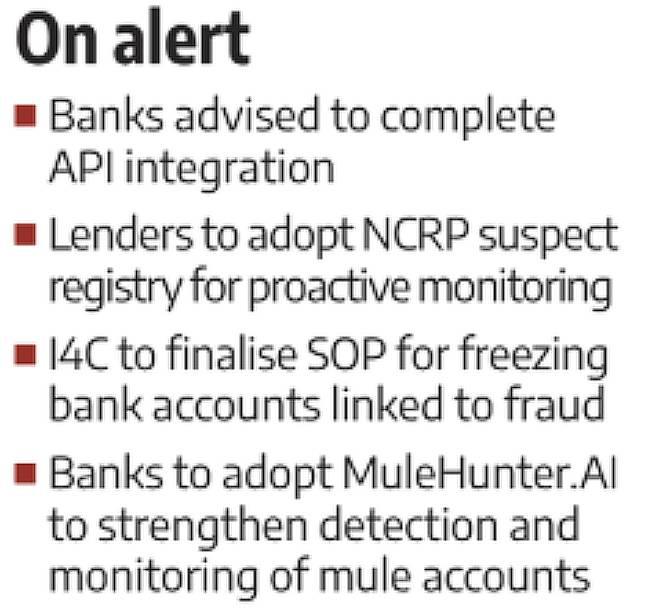
The official further added that the government was keeping a close watch on digital fraud and had advised banks to complete application programming interface (API) integration for better detection.
"Banks have been advised to adopt the National Cybercrime Reporting Portal (NCRP) Suspect Registry for proactive transaction monitoring," the official said.
"The Indian Cyber Crime Coordination Centre (I4C) will finalise the standard operating procedure for freezing bank accounts linked to fraud cases at the earliest.
"Additionally, banks have been asked to explore and implement the MuleHunter.AI tool to strengthen the detection and monitoring of mule accounts, which are often used by fraudsters to route illicit funds."
At least 15 more banks are set to implement the RBI-developed MuleHunter platform over the next two months to intensify efforts to identify accounts used for fraudulent transactions, said Suvendu Pati, an RBI chief general manager.
Mule accounts -- those created by fraudsters to receive, transfer or launder illicit funds collected from unsuspecting victims -- have been a big challenge for the banking system, as these accounts are generally opened using fraudulently obtained credentials.
MuleHunter complements banks' systems to tackle such activities, Pati said, claiming the RBI's platform was more efficient in detecting mule accounts.
Feature Presentation: Ashish Narsale/Rediff
