
'...as then it brings them closer to the complaints and grievances that the public faces.'
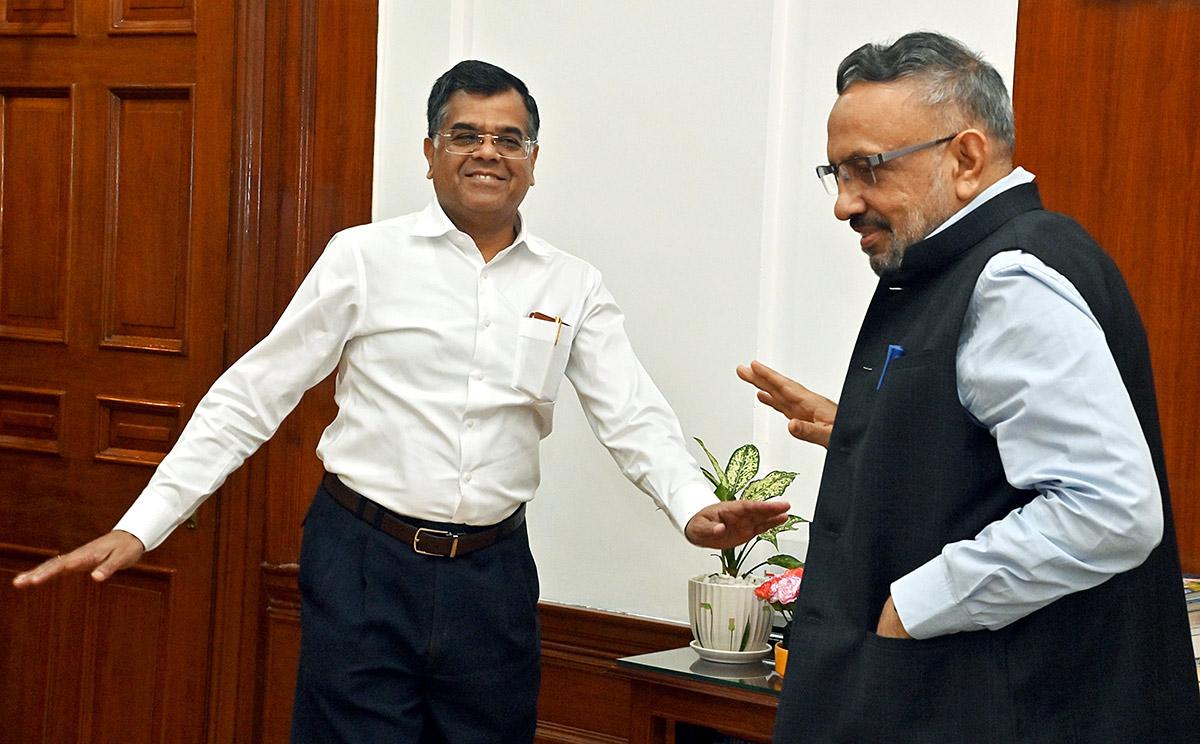
"Sir is not available", "Please try after a week", "We are not dealing with this issue": These are among the one-liners that private executives often hear from offices of senior bureaucrats while seeking appointments, according to a partner at one of the Big Four consulting firms.
He goes on to add that getting a meeting with secretaries is near impossible.
This trend is true across ministries barring some exceptions, another source in the private sector said.
Against this backdrop, a recent letter by Cabinet Secretary T V Somanathan, urging senior officers to meet non-officials from various backgrounds to understand ground realities and get valuable feedback, has sparked a debate.
Several former bureaucrats Business Standard spoke to seemed to suggest that not meeting people from external world was hardly a matter of choice in the government.
In any case, meetings and interactions have been a way of life in the government all along.
In fact, Somanathan, a 1987-batch IAS officer from Tamil Nadu cadre, sent out a circular to secretaries in the central government and all chief secretaries last year soon after taking charge as Cabinet secretary.
'As the existing practice, officers and others who wish to meet the Cabinet secretary may seek appointment by sending an email...' the circular dated October 18, 2024, said.
The circular, which came within two months of him taking charge as the top bureaucrat, also introduced an open house on trial basis.
While highlighting a 'perceived reluctance' on part of senior officials in holding such meetings, Somanathan's letter said: 'Meeting visitors can give insights into the actual state of affairs in the field, help detect or clarify miscommunications or misunderstandings about the government's policy or intentions, give access to new ideas, and provide an opportunity to rectify mistakes.'
Indeed, for a government that believes in 'minimum government and maximum governance', interactions with those outside of the system are critical for effective functioning, a former secretary said.
Former Cabinet secretary K M Chandrasekhar said it was possible that there was some fear among senior officers about meeting non-officials to steer clear of investigative agencies just in case of some controversies or allegations of wrongdoings.
"The Cabinet secretary did a good thing reassuring them. He is obviously rebuilding confidence, which is essential to achieve results," he pointed out.
A former secretary across key ministries echoed a similar challenge of how some officials might have avoided such meetings in the office so as not to leave a paper trail, fearing investigative scrutiny.
Wondering about the trigger for this circular, the ex-bureaucrat said: "Interaction with the public at large is an integral part of the functioning of field or operational officers, not secretariat officers."
However, many feel that the elusiveness of senior officers is less to do with any fear factor but more a reflection of policy-making becoming an increasingly data driven and scientific exercise, missing the human element.

Arun Maira, former member of the Planning Commission of India, said that most experts felt that people who come from the grassroots or are rooted to the ground don't understand anything about policy making.
"We all should recognise that there are many stakeholders in the system -- industry associations, big business houses, media, politicians etc," Maira, who was also chairman of the Boston Consulting Group, India, said. The common public and its grievances often get left out, he said.
Maira, who recently wrote a book Reimagining India's Economy: The Road to a More Equitable Society, pointed out that his main worry was that the missive on "increasing engagement" should not be hijacked by people who are influential and those with clout.
"Our ideology has become so top-down that people at the bottom are getting excluded from policy making and it is high time we bring them back," Maira said.
N C Saxena, ex-bureaucrat and former member of the Planning Commission, looks at it differently.
"Some bureaucrats resist meeting the public as then it brings them closer to the complaints and grievances that the public faces."
A currently serving senior bureaucrat who has been in various economic ministries said he has avoided meeting individual companies since there is no dispensation he could give them.
He therefore prefers to be approached by various industry chambers.
"Most of us do not meet one on one. It is a team meeting. They would come with supporting teams and I would have my director or deputy secretary with me," the official said.
A top bureaucrat, however, does not agree with this approach. He said that meeting an individual company might highlight a specific issue or complaint against a subordinate which could be valuable knowledge for the government.
"Even if no immediate action is taken, that information could be used while making future decisions," he said.
Chandrasekhar, who was Cabinet secretary during 2007-2011 when Dr Manmohan Singh was prime minister, recalls that there was no such reluctance to meet people in the past, except for a short period during Charan Singh's early days as PM.

Maira suggests that people complained of not being heard even in Planning Commission days, citing a civil society campaign called 'Waada Naa Todh Abhiyan (Don't break your promise)' to hold the government accountable to its national and international commitments.
"When we in the Planning Commission interacted with Waada Naa Todh people, their main grudge was that no one listened to them in the first place," Maira explained.
The house is divided on whether minutes of such meetings with non-officials should be maintained. Many officials feel that it could scare the private sector.
But some documentation could be done on a discretionary basis.
"I do ask for a letter in writing if something actionable is needed to be done. If they are not prepared to share it, I still make a mental note of it," a senior bureaucrat quoted earlier said.
"Organisations have rules on how to meet.... and meetings outside of the office have never been encouraged," a former secretary pointed out when asked about the latest Cabinet secretary's note on the need to meet in office rather than in clubs and restaurants.
On how to crack the code for getting these highly-sought after meetings, the Big Four executive seemed to have some idea.
"If we add keywords such as Make in India, Ease of Doing Business to our request, then chances of getting some face time do get better," he said.
Feature Presentation: Aslam Hunani/Rediff
