
The land pooling policy aims to kick-start a new wave of urbanisation in the predominantly rural state.

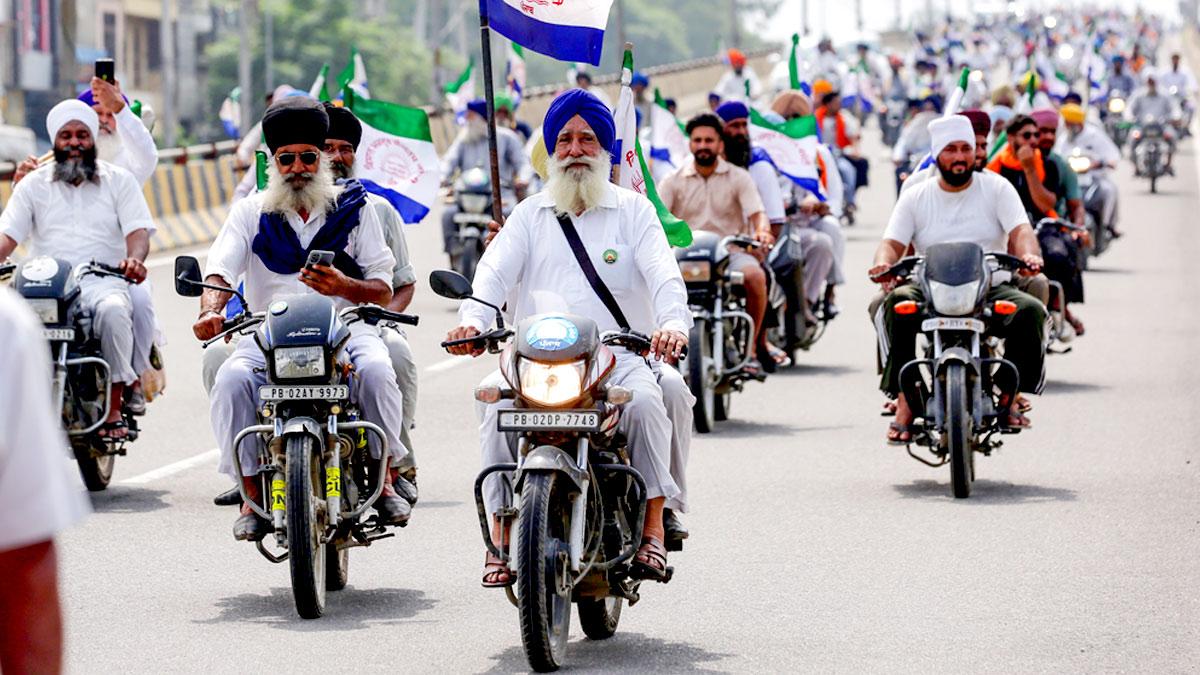
Punjab farmers are back on the streets. This time not against the Centre, but in protest against a controversial land pooling policy of the Bhagwant Mann-led Aam Aadmi Party government notified in June.
The policy aims to kick-start a new wave of urbanisation in the predominantly rural state.
Some experts say it was announced by using certain provisions of the Right to Fair Compensation and Transparency in Land Acquisition, Rehabilitation, and Resettlement Act of 2013, popularly known as LARR-2013.
According to them, the government's argument is that LARR, with its mandatory requirements such as social and environmental impact assessments and 70 per cent Gram Sabha consent, unduly delays the land acquisition process for urbanisation.
Hence, a new approach was needed to expedite it.
The land pooling policy is applicable to around 164 villages across Punjab, covering around 65,000 acres.
Of this, around 48,000 acres (roughly 74 per cent) is proposed to be acquired in and around the industrial city of Ludhiana.
In fact, land will be acquired around 27 major cities to set up urban clusters.
While the policy states that the submission of land by farmers for pooling is 'purely voluntary', critics argue that invoking Section 11 of the LARR implies that farmers lose the right to alter land use once it is pooled.
Policy details
According to experts, if a farmer contributes one acre of agricultural land for pooling in residential areas, he will receive 1,000 square yards of developed residential plots and 200 square yards of commercial plots (including parking) in return.
Similarly, there are different matrices for land to be returned if it is pooled for industrial, institutional, commercial, or mixed-use sectors.
In short, some experts said that broadly if a farmer gives one acre of land for pooling, only about 25 per cent will be returned to him as developed plots, while the rest will go for pooling.
Reports suggest around 45 per cent of landholdings in Punjab are less than five acres, though regions like Muktsar, Fazilka and Ludhiana in the state's south-west have larger holdings.
However, if large farmers -- those owning land parcels of 10 acres or more -- give their land for pooling to urban authorities such as the Punjab Urban Planning and Development Authority (PUDA), Greater Mohali Area Development Authority or Greater Ludhiana Area Development Authority, they must pay an external development charge or Rs 1 crore, whichever is higher.
In some cases, this development charge could go up to Rs 2 crore.
Compensation structure
Initially, the state government proposed an annual compensation of Rs 30,000 per acre to farmers, who opted to give their land for pooling, for three years from the date of possession or until the developed plots are handed over, whichever is earlier.
However, after protests, this compensation amount was raised to Rs 50,000 per acre per annum, which could go up to Rs 1 lakh.
Some experts said a new provision has now been introduced: If the delivery of developed plots is delayed beyond the stipulated timeline, the compensation will increase by 10 per cent annually until plots are handed over.
They point out that the Mann government's policy is on the lines of the one announced in 2013 by the then Akali Dal-Bharatiya Janata Party government -- except for a crucial difference: The earlier policy gave farmers the choice to either participate in pooling or accept compensation under the LARR.
"At that time, acquiring land wasn't much of an issue because most farmers took the compensation and moved on," said senior journalist Hamir Singh.
He pointed out that only about 22 to 25 per cent of people in each village actually own land. The rest are landless labourers, artisans, or non-farm workers whose livelihoods depend on that land.
"What happens to their livelihood when the land is taken away? The new policy does nothing to address their concerns," Singh said.
Farmers on the warpath
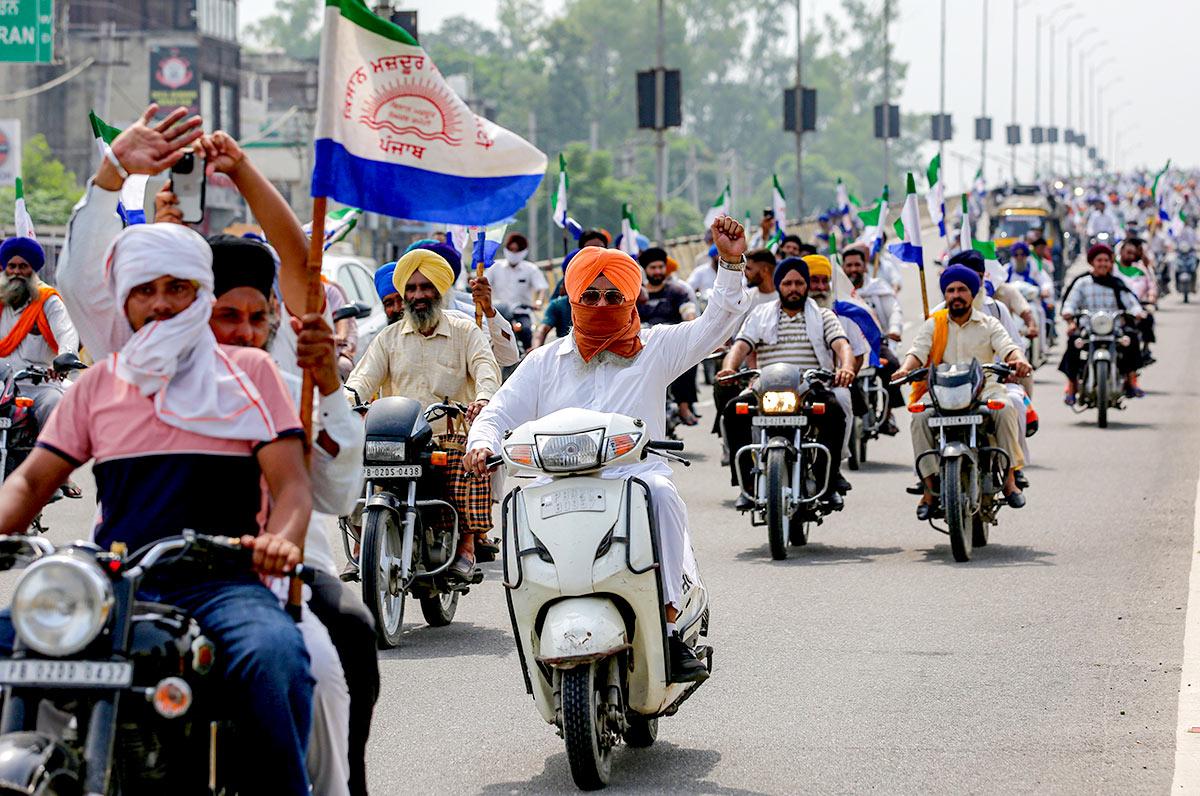
The policy, its inherent contradictions, and a deep mistrust of both state and central authorities have put farmers back on the warpath.
Tractor marches are being held in major cities, while the Samyukta Kisan Morcha has called for a statewide protest on August 24.
Farmers cite past experiences in which colonies promised under similar schemes were never built, and land acquired decades ago remains undeveloped.
With Punjab already reeling under debt, many fear the state may stop paying compensation after a few years, leaving them without land or return.
"Authorities like PUDA won't develop the land on their own but hand it over to a coloniser selected through bidding. What is the guarantee that the plots will be developed on time?" a senior farmer leader asked.
Ajay Vir Jakhar, chairman of the Bharat Krishak Samaj and former chair of the Punjab State Farmers and Farm Workers Commission, called the policy fundamentally flawed. "Punjab doesn't need more colonisation," he said.
Mann in a tight spot
Widespread opposition to the policy, and its political ramifications with farmers being the state's largest vote bank, has pushed Mann into a corner.
He has toured several villages to convince farmers, but critics say most visits have been to areas not directly affected by the policy.
The Opposition Congress, Shiromani Akali Dal and BJP have also strongly opposed the policy.
To address concerns, the government has announced multiple tweaks since the policy was first notified in June.
The latest change involves staggering its implementation, initially restricting it to larger cities such as Patiala, Ludhiana, and Mohali, with gradual expansion to smaller towns.
The government claims it has already acquired some land in Mohali and Ludhiana under the new policy. But farmers remain unconvinced.
"The Punjab government will have to withdraw this land pooling policy," said Ramandeep Mann, agricultural policy expert and farmers' rights activist.
"There was no consultation with farmers. The trust deficit is massive. In many cases, the financial burden for acquisition falls on the farmers themselves," he added.
Mann cited multiple past instances where land acquired for urbanisation in Punjab was never developed.
"Even when development happens," he said, "there's no guaranteed price realisation. All this makes the policy completely untenable for farmers."
Photographs curated by Manisha Kotian/Rediff
Feature Presentation: Aslam Hunani/Rediff
