The Rediff Special/B G Verghese
The politics of Bihar became so degenerate that for years it was
ruled by Ordinance Raj
 The politics of Bihar became so degenerate that for years it was
ruled by Ordinance Raj which underwent an extraordinary and wholly
unconstitutional refinement fully exposed by a Pune professor,
Dr Wadhva. This was the resort to re-promulgation of ordinance
several times over for years by governments afraid to face
the legislature. Complaisant governors abetted these thoroughly
dishonest transactions instead of bringing the defaulting governments
to heel. The Supreme Court was later to declare such re-promulgation
of ordinances a fraud on the Constitution.
The politics of Bihar became so degenerate that for years it was
ruled by Ordinance Raj which underwent an extraordinary and wholly
unconstitutional refinement fully exposed by a Pune professor,
Dr Wadhva. This was the resort to re-promulgation of ordinance
several times over for years by governments afraid to face
the legislature. Complaisant governors abetted these thoroughly
dishonest transactions instead of bringing the defaulting governments
to heel. The Supreme Court was later to declare such re-promulgation
of ordinances a fraud on the Constitution.
Despite the Chota Nagpur Land Tenancy Act, there has been widespread
alienation of tribal lands. The tribal population has received
a raw deal as its homelands have been taken over for mining, industry
and infrastructure without adequate thought or care for their
resettlement and rehabilitation. Small get-rich-quick mine owners
despoiled the countrywide which, even after coal nationalisation.
Small get-rick-quick mine owners despoiled the countryside which,
even after coal nationalisation, still looks grimy and speaks
of an environmental disaster.
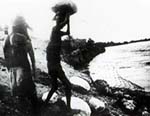
Depressed tribal communities have
resorted to felling their own forests to sustain 'head loading'
in order to eke out a livelihood. Tribal alienation through much
of middle India has created suspicion, animosities and an 'outsider'
syndrome manifest, in this particular instance, in the Jharkhand
movement. Here too one has seen the sorry spectacle of its leadership
being bought over and coopted.
Bihar's infrastructure is not the best. Apart from the arterial
transport corridor, large parts of south Bihar and Chota Nagpur
are not too well served by road or rail. My own experience in
travelling from Gaya to Patna and Ranchi to Patna, admittedly
some years ago, remains memorable. The Gaya-Patna run was bizarre,
with commuters literally dismantling the engine vacuum-hose near
their respective villages in order to enforce halts as long as
it took them to complete their errands.
The Ranchi-Patna night
run was in a sense hilarious as the train was invaded by ticketless
travellers. Upper class passengers bolted themselves in and one
embarrassed gentleman kept pleading to be let out to go to the
toilet while another insisted that to do so would be to risk death
and destruction! At station after station, the station master
was compelled to use the public address system to appeal to the
engine driver -- probably off for a cup of tea -- to return to his
cabin and start the train. Both incidents reflect the desperation
and indiscipline to which people have been driven.
Freight traffic moves through dense corridors by road and rail
across south Bihar but this is getting saturated. This applies
equally to the Grand Trunk Road. In North Bihar, consecutively,
as earlier mentioned, is poorer.
Until a decade after Independence, the Ganga and its tributaries
used to serve Bihar and link its northern and southern halves.
The waterway and the steamer services have both been killed by
neglect and railroad rivalry. Economic activity and traffic have
also moved away from the river. Now, with the declaration of the
Haldia-Allahabad stretch of the Ganga as National Waterway No.
1 and the promise of privatising inland water navigation, there
is need to devise a strategy to resuscitate inland water transport.
Infrastructure should be provided and incentives offered to locate
activity in specially-designated waterfront development areas.
The power situation is poor with the State Electricity Board in
acute disarray. Transmission and distribution losses are high
and the record of rural electrification disappointing. The hydro-thermal
mix is poor and objections to the proposed Koel Karo project have
not helped; nor the long standing discord - now hopefully ended
-- with Nepal whose hydro-potential could provide abundant power.
Tell us what you think of this article
|