
'...they always address problems superficially, never tackling root causes.'
'Currently, the policy response will focus on immediate relief -- getting people to safety, providing facilities, clearing debris.'
'This is necessary, but once immediate relief operations end, everything returns to 'normal' without addressing underlying vulnerabilities.'
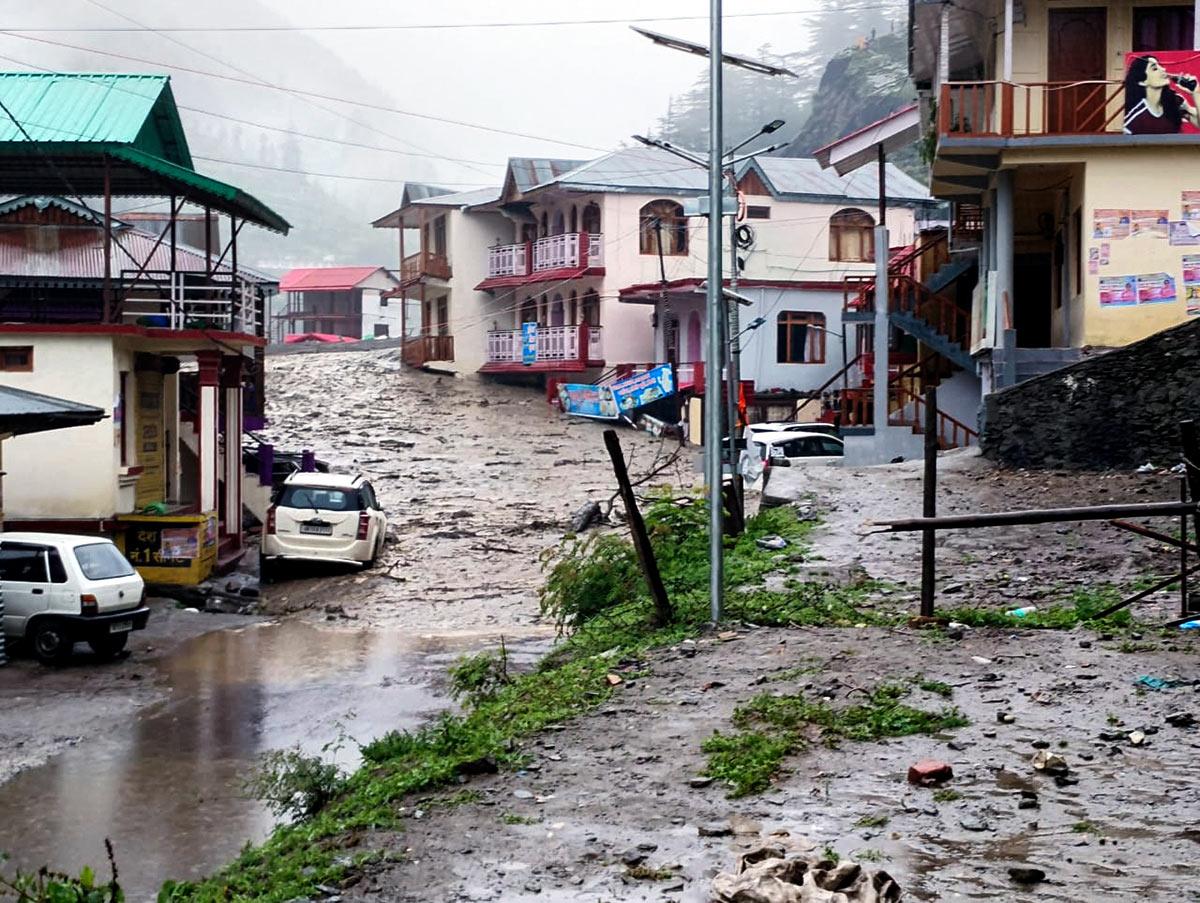
In the concluding segment of his two-part interview with Prasanna D Zore/Rediff, Dr Pradeep Srivastava, associate professor at IIT Roorkee, warns that flash floods will keep devastating the Himalayas unless India overhauls its priorities, infrastructure planning, and mountain-specific engineering.
In your 2021 interview, you mentioned these disasters are unstoppable. Do you feel we haven't learned adequate lessons in the four years since then?
I had emphasised that there's an urgent need to develop one Himalaya-centric institution by bringing together all Himalayan states. This institution should focus exclusively on Himalaya-related research, study mountain-specific engineering challenges, and develop appropriate engineering materials and design solutions.
Currently, we have 17-18 IITs, multiple NITs -- but the engineering education and knowledge we're creating is failing in mountain environments. It's simply not mountain-centric.
The Himalayan context -- in terms of its climate fragility, complex tectonics, unique landscape, and even cultural aspects -- is not being adequately addressed by conventional engineering solutions. We've been saying this continuously, but since our voice represents a small academic community, it often goes unheard.
What would this Himalaya-centric institution look like?
This should involve all Himalayan states -- irrespective of political party lines. Whether it's Himachal Pradesh, Kashmir, Ladakh, Sikkim, Arunachal Pradesh, or Assam -- they should collaborate to develop one comprehensive Himalayan research institution.
We shouldn't hesitate to bring in international experts, train our people extensively, send 10 to 20 people abroad for specialised training so they return and conduct Himalaya-centric research. This entire initiative needs to be heavily incentivised because mountain research is challenging and requires dedicated commitment.
What about major infrastructure projects like Char Dham Yatra roads and strategic connectivity with China?

Look, we have emotional attachments -- we have 150 crore people in India, so emotions are natural. But we need to be practical. This shouldn't be linked purely with patriotism or nationalism. This should be directly connected to scientific knowledge creation and evidence-based planning.
We need to first accept a hard truth: Our existing IITs and NITs -- whatever number we have -- have failed to provide adequate solutions for mountain engineering challenges. We must accept this reality before we can think fresh and develop new approaches.
The Char Dham Yatra roads that have been constructed, and roads built for strategic connectivity in case of conflicts -- for these projects, extensive mountain slope areas have been cleared of forests. You can see the environmental impact of such decisions.
How does this compare with what other countries are doing in similar mountain regions?
Our neighbour China is undertaking all kinds of development activities seemingly without much consideration for disaster implications. Disasters happen there too, but if we evaluate their infrastructure preparedness on a scale of one to ten compared to their infrastructure, we would rank below two.
My point is this: Whatever development is inevitable will happen. Where 100 people traditionally live, if 10,000 people are now traveling for pilgrimage or tourism, we absolutely have to develop supporting infrastructure. We are free citizens of a democratic country, and people have the right to travel and access these areas.
But our interventions need to be sustainable and scientifically planned. If trees are cut for development, how will carbon sequestration (Carbon sequestration stores carbon dioxide in trees, soil, or technology. Cutting trees reduces this, harming climate unless offset by alternatives) be maintained? What alternative environmental arrangements will be implemented? We need comprehensive planning for all these aspects.
Do you attribute incidents like flash floods in Dharali to accelerating climate change and increased frequency of extreme weather events?
Climate change is manifesting equally across the world. The question is: Why do these disasters disproportionately affect our region compared to developed nations?
The answer lies in what economists call the Global South phenomenon -- countries below the Brandt Line (the Brandt Line divides richer Global North from poorer Global South based on economic development levels) face significant challenges in information flow and knowledge translation.
Climate change is occurring in America, Canada, Australia, and China too. But if you examine disaster impact statistics, proportionally more devastating consequences occur in Global South countries.
This happens because Global North countries invest heavily in knowledge flow -- ensuring that knowledge generated by scientists, professors, and experts gets effectively translated to ground-level implementation. This translation process requires substantial financial investment.
In our case, knowledge is being generated, but we cannot afford the cost of translating it into practical, implementable solutions. This represents a fundamental political and economic challenge in knowledge flow systems.
Are you saying the knowledge exists but implementation is the problem?
Exactly. It's not a knowledge problem -- it's a knowledge flow problem. It's fundamentally about translating existing knowledge into actionable solutions.
Everyone with local education knows which side of a hill slope is safe for construction. Traditional communities have survived in these areas for centuries -- their settlements remain largely undamaged. But the modern infrastructure we've developed simply doesn't survive these natural events.
You'll afford proper implementation only when you assign equal value and equal weight to every human life. Simply distributing blankets and food after disasters, adopting a few children, or building schools -- while necessary -- won't solve the fundamental problem.
What infrastructure design and risk frameworks do you recommend for these extreme geological events?
I'm 55 years old, and honestly, our current generation's state of knowledge is perhaps insufficient for these challenges. The new students and coming generation are more capable with access to better technology and methodologies.
We need to present them with these complex problems and allow them the freedom to fail and innovate. But here's the current problem: When our students get admitted to BTech programmes, they fear only one thing -- getting low marks and missing out on a 50 lakh rupee job package.
This security-oriented mindset we've created has killed innovation completely. Students now focus entirely on job security rather than solving real-world problems.
How does this affect research and development in critical areas like studying the Himalayan topography, the reasons behind flash floods in Himalayas, the growing instances of landslides, etc?
We're stuck in a vicious cycle where everyone -- students, researchers, institutions -- only wants to make secure moves. Everyone's afraid of failing.
The government system reinforces this: If you fail once, your scholarship stops, you won't get admission next time. So we don't have intellectual freedom to think creatively and take risks.
This applies to researchers too. If you take a 2 crore rupee grant from the ministry of science and technology and your project fails, you won't get future funding. You have to predict expected outcomes in advance.
So scientists only pursue research they know will succeed. Earlier, there used to be exploration, then innovation and invention, followed by applied research. Now researchers aren't even doing genuine research -- only incremental knowledge addition.
This is the reality across India and most Global South countries.
What specific message does the Dharali incident send to decision makers and planners in India?
I'll be blunt. Our planners -- the IAS officers who execute policy -- receive training only in crisis management. When any crisis occurs, they're trained to manage it reactively.
They are not trained in sustainable development planning, and frankly, they are not expected to do long-term planning. The system trains them only to follow directives from political leadership.
When ministers or lawmakers visit disaster sites, they expect immediate visible action on the ground. So our administrative system is trained only to follow orders and implement quick fixes.
The fundamental problem with quick fixes is they always address problems superficially, never tackling root causes.
Currently, the policy response will focus on immediate relief -- getting people to safety, providing facilities, clearing debris.
This is necessary, but once immediate relief operations end and debris is cleared, everything returns to 'normal' without addressing underlying vulnerabilities.