
'If Washington has to balance Chinese power, she will have to turn to the third biggest power in the world which is India.'
'The United States and India will have to work together in order to keep Chinese ambitions in check.'
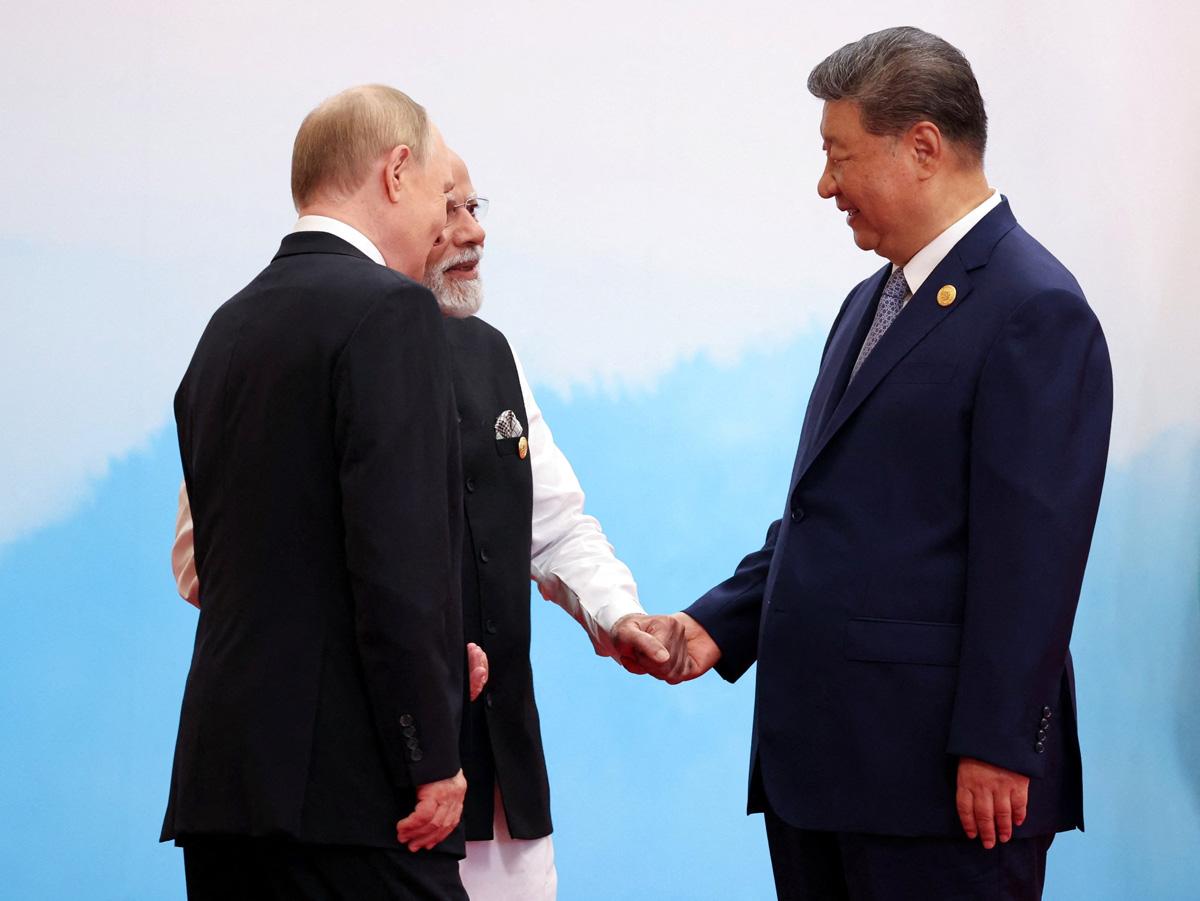
"The pictures coming out of Tianjin where Modi, Putin and Xi are seen smiling and even holding hands does not signal any strategic shift by New Delhi. This is not an embrace -- it is merely an attempt to get the train back on track," asserts Ambassador Gautam Bambawale, who served four tenures in China in his nearly 35 years in the Indian Foreign Service.
When Rediff last spoke to Ambassador Bambawale in January 2024, he had predicted that "China will have to untie the knot if the relationship has to improve", a diplomatic prophesy that hit the mark with Chinese Foreign Minister Wang Yi's visit to New Delhi on August 19 and Chinese President Xi Jinping's calibrated warmth when Prime Minister Narendra Modi made his first visit to China in seven years last week.
In that three-part January 2024 interview, Ambassador Bambawale -- who is only one of three Indians this century to have served as India's ambassador to both China and Pakistan; Ambassador Vijay Nambiar and Ambassador Shiv Shankar Menon being the others -- also indicated the difficulties of dealing with the Chinese communists when he revealed that "My understanding is that by the time President Xi Jinping came for the Chennai summit [2019], he had already instructed his army to undertake the action in Galwan in the summer of 2020."
A week after the Modi-Xi encounters on the rim of the Shanghai Cooperation Organisation summit in Tianjin, Ambassador Bambawale outlines to Nikhil Lakshman/Rediff the likely route map for the India-China relationship in the months ahead.
Many Indians were shocked by our going all out to embrace a new relationship with China after what happened in Ladakh these last 5 years and China's perfidious assistance to Pakistan during Operation Sindoor.
What, in your assessment, was the impetus for India's Beijing overture? Did trade concerns overwhelm strategic issues?
First of all, I think you have got it wrong. There is no all-out embrace of China by New Delhi. This is a tactical move to show Washington that India does have options in international politics.
If the United States is going to be so mercurial as well as near sighted, then India too has other avenues it can pursue. The pictures coming out of Tianjin where Modi, Putin and Xi are seen smiling and even holding hands does not signal any strategic shift by New Delhi.
However, if Washington is not going to be a dependable partner then India will look to others.
Commercial concerns may have driven the Indian narrative, but what was China's motivations for normalising the relationship?
Did Beijing see in the breakdown of the India-US relationship an opportunity to drive a wedge and make the India-US security relationship more difficult and its institutions like the Quad wobbly?
Beijing has always been uncomfortable with the India-US partnership and sees the current discomfiture in New Delhi as an opportunity to draw India into a closer embrace.
Over the past year, the Eastern Ladakh sector of the India-China Line of Actual Control (LAC) has quietened somewhat and that provided the space for PM Modi to meet Xi Jinping in Kazan last year and to attend the Tianjin Summit of the SCO just now.
This has also enabled some of the older exchanges uptil 2019 to be resumed. However, this is not an embrace -- it is merely an attempt to get the train back on track. You must see this clearly.
India had made the satisfactory outcome of the military standoff in Ladakh the cause on which it would resume the normalisation process. Was that 'satisfactory' outcome arrived at in October last year?
Military observers believe we at best struck a compromise -- rather a return to a status quo ante, we agreed to a status quo and buffer zones that don't ensure our troops return to positions pre-April 2020.
How do you see the situation in Ladakh from a diplomat's perspective? Was such a compromise necessary since the commanders' conferences were going nowhere?
How would such a compromise endanger our position on the LAC in this theatre, and the border talks in the long term?
As you rightly say, there is a long way to go even in Eastern Ladakh and the next step is to de-escalate troops so that they return to their normal peace time locations.
What has happened so far in Eastern Ladakh is that troops from both countries who were almost eyeball-to-eyeball or in close confrontation situations have now moved back slightly. In other words there has been disengagement of troops.
De-escalation of troops has not yet taken place. To put it differently, large numbers of troops of both sides continue to be present at those lofty heights in the Himalayas, they have not relocated to their peacetime stations.
India wants de-escalation to happen. Both governments have committed to work towards that. Let us see how it progresses.
As a result of talks between India and China at various levels, new arrangements for border management have come into existence.
I shall give you just one example. On the north bank of Pangong Tso, it has been agreed that Indian troops will stay behind Finger 4 while Chinese troops will stay behind Finger 8. Therefore, troops do not come face-to-face as happened earlier since both sides claim the area between Finger 4 and Finger 8. So, close proximity situations will be avoided.
Moreover, this arrangement does not compromise either side's position on where the boundary lies. This is not a bad arrangement for now.
Do we really want to go back to the status quo, where troops would confront each other and result in pushing, pulling and shoving by soldiers of each side?
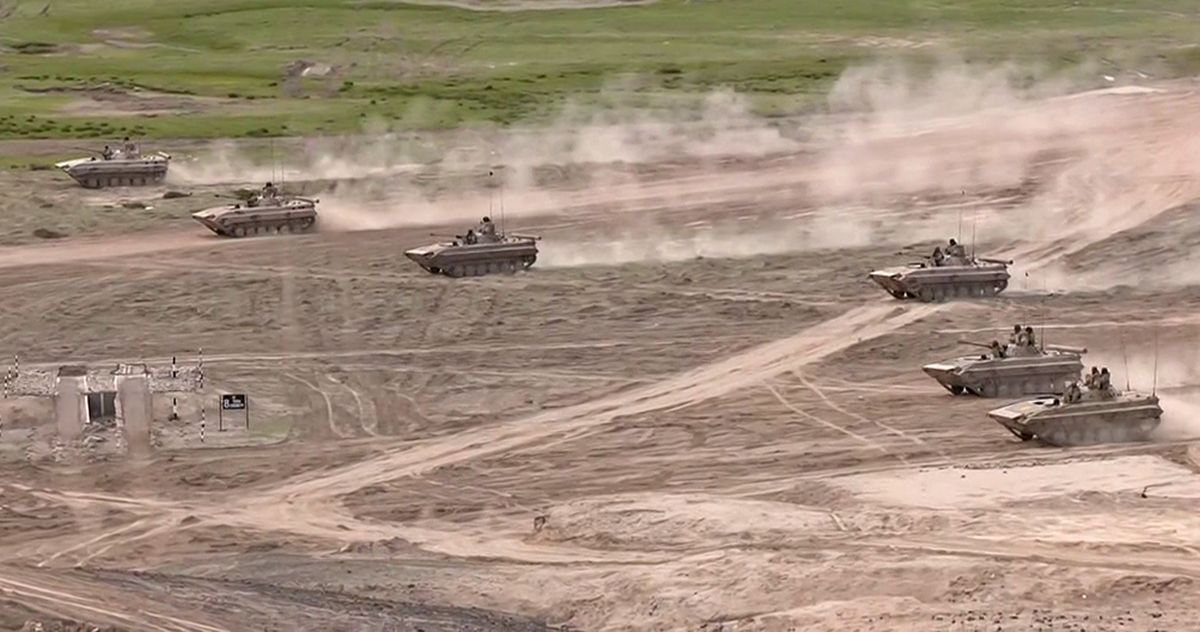
Do you think the Chinese learnt a lesson from the robust Indian military response after Galwan that any aggression would be paid back in unacceptable-to-the- PLA terms?
Would you say that the Indian military response after Galwan reset the military narrative with China, made the PLA generals realise that the Indian Defence forces were no pushover?
Is that why they have veered to a two front strategy to militarily engage India, boosting its cat's paw in Rawalpindi with weapons and intelligence?
Definitely. After initially being taken by surprise, Indian armed forces reacted magnificently to the Chinese attempt to change the status quo on the LAC in eastern Ladakh.
Indian armed forces showed their mettle and prevented China's PLA from achieving their military objectives. This has been a major reason for China to now push for a recalibration of India-China relations after a 5-year freeze in ties.
What is our best insurance against China? What can India do to ensure that China does not harm Indian interests in any way, like switching off, for instance, the flow of raw earth magnets?
How can we be resilient against future Chinese provocations of any kind?
Just as the Indian armed forces reacted and responded magnificently to the China military challenge in Eastern Ladakh, Indian industry must react and respond quickly and decisively to the Chinese industrial challenge.
We must make more critical elements of the supply chain within India or locate it elsewhere. We cannot be dependent on China for rare earth magnets or tunnel boring machines. Either we get them from other suppliers or else we make them in India.
It will take time but we have to move immediately. I do not see our Indian industry being serious about this weaponisation of critical parts of the supply chain and the necessity of making these items in India.
A year before Galwan occurred you had outlined some of the actions that find mention in the Wang Yi-S Jaishankar communique like greater people to people exchanges, enhancing tourism etc.
How will such actions enable a better India-China relationship? We don't see more Chinese tourists in say the US or the UK or Thailand improve Beijing's relationship with those countries.
As a diplomat, please do explain how such actions will improve the relationship.
The relationship between two nations cannot be one only between the governments. Businesses and ordinary people must also be involved to make it self-sufficient and self-generating.
So the current efforts to resume direct flights between India and China, make visas easier to obtain, encourage students to go to the other country are all efforts to get the India-China relationship back on track. These measures assist and aid the exchanges between governments.
Does the decision to establish an 'expert group' to explore an 'early harvest' on boundary delimitation signal a shift from India's earlier stance favouring a comprehensive resolution, or can this staged approach be seen as a pragmatic step toward building momentum for resolving broader, more complex issues?
The 'early harvest' proposal refers to the Sikkim Sector boundary which was delimited by an 1890 convention between British India and the Qing dynasty in China. Both independent India and communist China have broadly adhered to the line in Sikkim as depicted by the old convention.
The Chinese proposal is to lock that understanding in, while proceeding to negotiate on the Eastern Sector of the LAC (McMahon Line) and also in the Western Sector in Ladakh.
The difficult part of the Sikkim boundary will be the trijunctions between India-China-Nepal and India-China-Bhutan as they involve a third country.
The Expert Group set up for this purpose should be allowed to do its job.
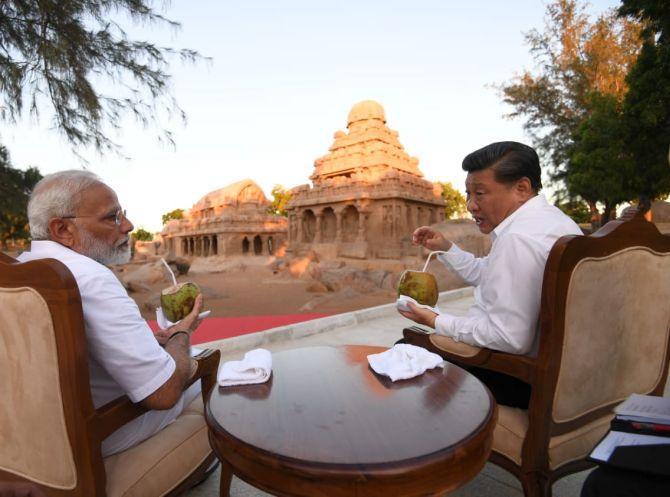
In his remarks at the meeting with Prime Minister Modi, Xi Jinping stressed that India and China should not let the border issue overwhelm the relationship. But what we have seen after Mr Modi became prime minister is Xi's constant encouragement to needle India on the border issue, be it Dokalam or Ladakh or in Arunachal.
So despite these typical Chinese clever-isms, how can we ever trust the Chinese?
What would be the defining signs from Beijing for India to trust Chinese intentions? Or would we be foolish to ever trust China?
This is a very important point on which India and China have diametrically opposite views. India has always argued that if there is no peace on the borders then the rest of the India-China bilateral relationship will be adversely affected. We saw this happen after Galwan.
On the contrary, Beijing argues that we should not permit hiccups on the border to upset the rest of the relationship. In other words, China wants the trade, commerce, people-to-people relationship to continue unimpeded by any actions of the PLA on the border. Beijing and New Delhi have a fundamental difference of opinion here.
President Trump appears to have lost interest in the American pivot in the Indo Pacific; it is unlikely he will attend the Quad Summit in New Delhi in November, possibly sending someone like Secretary of State Rubio that would also indicate the Quad's downsizing in America's strategic calculus.
America reached out to India 20 years ago in the expectation that we would be a counterpoint to China's ambitions; the India-US security relationship hinged largely on that.
How do all the current convulsions impact the China elements of the India-US strategic relationship? Do you see the US altering its view of India in the China prism?
International politics today is characterised by competition between the two major powers -- the US and China. This competition is likely to increase in intensity over the coming years. In fact, geopolitics over the next few decades will feature enhancing competition between the two countries. This is the reality.
If the United States cuts any kind of deal with China, it will imply that Washington acknowledges China as a peer competitor. This outcome is very, very unlikely.
If Washington has to balance Chinese power, she will have to turn to the third biggest power in the world which is India. The United States and India will have to work together in order to keep Chinese ambitions in check.
What one president or prime minister decides will not change these objective facts of global politics.
Foreign Secretary Vikram Misri said it was important to move ahead from a 'political and strategic direction' in this regard. As someone who has served as our ambassador in China and been an astute observer of India-China relations, what did the foreign secretary mean?
Does it mean that India focus on commerce and trade with China and keep complicated issues like the border on the back burner, knowing that it is unlikely to be resolved in our lifetime?
It means that both Beijing and New Delhi must keep the big picture in mind when evaluating India-China relations and deciding on future directions of ties.
The fact of the matter is that India has to focus inward over the next decade or two, strengthening itself both in terms of industry and manufacturing as well as in the realm of defence.
While exhibiting strategic patience, India must grow its economy as fast as it can maybe even at 8 or 9 per cent per annum over the next fifteen years.
Finally, what would be the signs that India-China relations are moving into a new phase, and how long will that take? What are the warning signs that we always need to watch out for when we deal with China?
That will happen as India strengthens herself domestically and internally, and when China shows respect and sensitivity towards New Delhi.