
'Famine in Gaza is not a failure of logistics or aid. What is to blame is deliberate starvation caused by a brutal war.'
'Any child dying in a war zone is a vote of no confidence against humanity.'
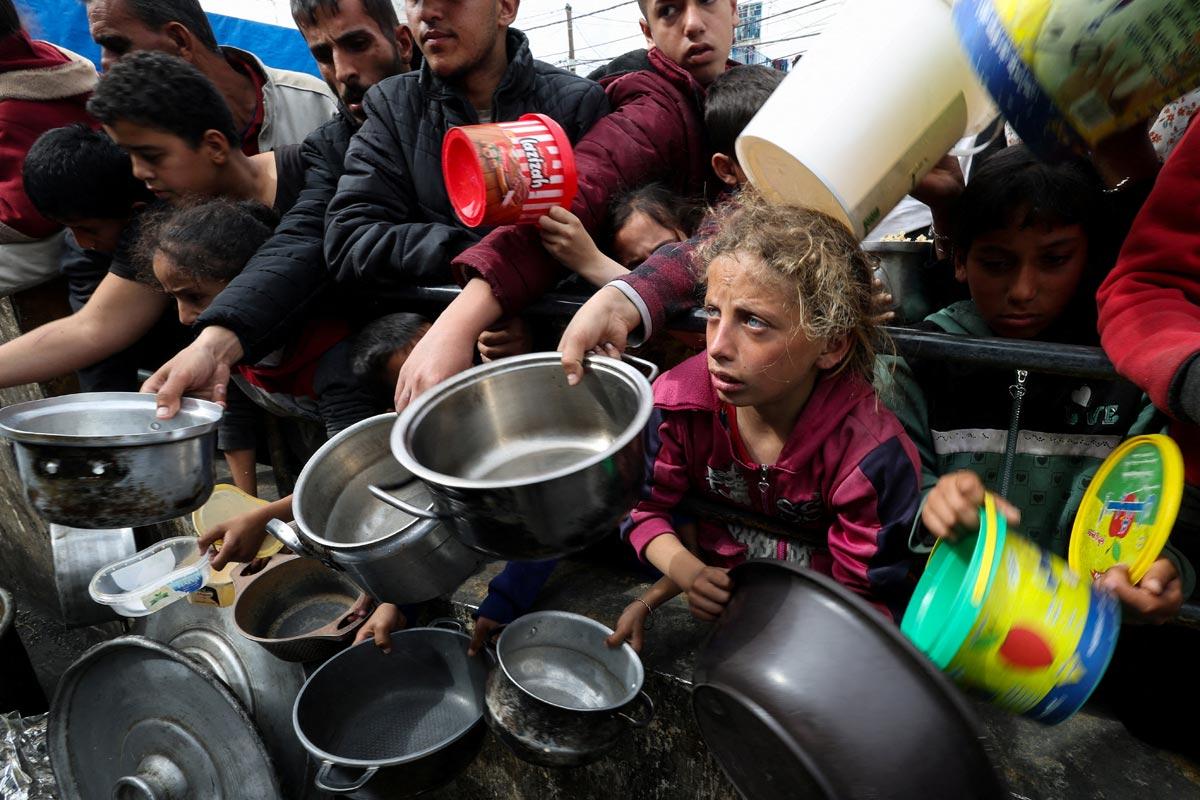
In a world where headlines about war and hunger blur into statistics, we are often forced to wonder why there is so much hatred and cruelty all around as innocents die every single day.
Many of them are children who have not even tasted the fruits of life. We go about our lives as if nothing has happened.
The war in Gaza has seen over 18,430 children dying due to missile attacks, bombing and systematic starvation.
As many as 62,895 Palestinians have been reportedly killed in Gaza, and 158,927 have been injured.
As these figures, which increase every day, haunt us, some voices remind us of the uselessness of war.
One of them is Dr Unni Krishnan, Global Humanitarian Director, Plan International, who has, for more than 25 years, worked on health and humanitarian issues on the frontlines of war, disasters, famine, hunger, and human rights violations on helpless populations.
Dr Unni Krishnan has walked through the rubble of Gaza, stood amid the ruins of Haiti's earthquakes, worked at the border town of Adre, where Sudanese refugee children arrive sick, hungry and traumatised, and witnessed the heartbreak of hungry orphans and children in Gaza and Ukraine.
His mission is not to just save lives, but to lend a quiet dignity and hope where it seems to have vanished.
As Dr Unni Krishnan moves from one conflict zone to another, steeling himself to encounter stark realities, he reveals a grim and terrifying account to Rediff Senior Contributor Ramesh Menon, saying that the man-made tragedy has to stop.
What are you now seeing in Gaza, which has seen unprecedented killings of helpless women and children, with starvation killing the rest?
We are seeing an entirely man-made, preventable tragedy that has left thousands dead and more than 2.2 million Palestinian people, including a million children, struggling to stay alive.
Famine and hunger are spreading as humanitarian workers are being targeted and killed.
We have seen how hundreds of trucks with food waited outside Gaza, as they are not being allowed in.
Israel is weaponising hunger by blocking aid.
The blockade of life-saving food and medicines will lead to families and children dying painfully and needlessly.
Famine in Gaza is not a failure of logistics or aid. What is to blame is deliberate starvation caused by a brutal war.
Any child dying in a war zone is a vote of no confidence against humanity.
When you see any conflict through the eyes of a child, you know what your priorities are. Children should always be the first priority in any humanitarian crisis.
Children with disabilities or those with sustained trauma should be at the top of our list.
A child under 18 would have seen six serious conflicts in Gaza if they had survived. Many did not.

Do you sometimes feel powerless and helpless while working in war zones?
A few months ago, I was talking to a doctor in Gaza. Doctors and hospitals in Gaza have been under bombardment, which is abnormal.
We wanted to make them feel that they were not alone in this crisis, and they were doing a great job. We wanted them to feel wanted and important.
While chatting with one such doctor, he told me that he did not have anaesthesia and was conducting surgery. This is abnormal, and I was at a loss for words.
Then, he said something chilling: he was going to operate on his own child. I just could not take it. What he said was haunting.
Later, when I was walking on a London street, I passed Boots, a medical shop. It was closed as it was late at night, but through the glass windows, I could see stacks of medicines on the shelves.
I stood there helplessly thinking of how, at one point, when there were thousands of trucks full of medicines and food waiting outside Gaza, they were not being allowed to enter so that they could not be distributed to the sick and injured.

It is heartbreaking to see children die of starvation...
In Canberra, a 24-hour vigil was held in July where several relief workers and human rights advocates participated. Some Australian MPs also joined us.
It was a very cold afternoon, and it was raining. But they stayed to read the names of 17,000 children, some of whom were not even a year old.
What crimes had they committed? This is deliberate warfare deployed on children that the world has never seen.
They are being starved. For a child, starvation unfolds in three stages. The first is when they start skipping meals as food is in short supply.
The second is when the body sucks energy from stored fat. In the final stage, it turns fatal when all stored fats have been depleted and the body turns to bone and muscle for energy, making it difficult for a child to walk, talk, and even breathe.
Gradually, their immune systems weaken. Their organs will slow down and slowly grind to a halt. It is such a painful way to die.

It is not just Gaza... Armed conflicts in Sudan over political power and ethnic divisions have caused famine and mass displacement, affecting women and children. Ongoing violence has resulted in high rates of sexual violence against women and the recruitment of children into militias.
In Sudan, sexual violence was used in war. Systematic rape and sexual violence were used as a weapon against young girls. The UN has reported this.
5 million children have been forcefully displaced. They are hungry and malnourished. Especially in Darfur. Approximately half of Sudan's population -- 25 million people -- is facing extreme levels of hunger.
Children are being maimed and disabled all over in Gaza, Ukraine and Sudan. There are more than 123 million people who have been forcefully displaced worldwide, with wars, disasters and hunger driving these figures.

A large part of the world today is in conflict. There is war, civil unrest, ethnic tensions, terrorism and hate campaigns. What devastating impacts are you seeing during your travel to these areas?
We are seeing humanity at its worst.
Acts of brutality in most of the war-torn areas show utter disrespect for the International Humanitarian Law. Schools, hospitals, and aid workers are being deliberately targeted.
The world seems to be moving ahead, but what about civilisation?
Why are some people so cruel to defenceless children? Our silence will amplify the violence and killing.
Suffering is unprecedented on multiple levels, never seen before because of deliberate strategies of those who are at war.
The stark truth is that in recent history, war and human suffering have been at their highest. It is dangerously unique as these deaths and suffering are human-made and preventable.
Children are being killed because of disrespect for human values such as compassion and internationally binding norms such as the International Humanitarian Law.
Armed conflicts have risen by 175 per cent since 2010. In 2023, alone, 78 countries were involved in war beyond their borders, according to the Australian Economic Institute.
Overall, funding cuts by the United States and other donors have made it worse, accelerating suffering in conflict areas.
On the other hand, ordinary poor people in low-income countries like Bangladesh are hosting Rohingya refugees. Chad is hosting Sudanese refugees.
Iran, Turkey, Germany, Colombia and Uganda are some of the countries that host refugees.
I will never forget what I witnessed in the communities where Plan International works -- how a simple act of kindness, a shared meal, or a warm welcome from local families, or a place for children to play and learn gave refugee children not just comfort, but hope, dignity, and the courage to begin again.

What is the price that women and children are paying?
In Sudan and Gaza, mothers are figuring out which child to feed.
During a humanitarian mission in Somalia, when I was travelling with my team from Plan International in the central region, we received a message that a new group of displaced people had arrived in a neighbouring village, and they were in a very bad shape.
It was very hot. I went there with Javier Espinosa, a legendary Spanish journalist.
I saw a mother cooking who had five children lying on the floor waiting for the food.
When we went closer, we found that it was just water she was boiling, just to give the children hope that food would come soon, and as they waited, they would fall asleep.
Children in such places do not even have the energy to smile back at you.
Children have simple needs. They want food. They want to hold hands with their friends. They want to go to school.
They want to fly kites or play football. And, here they were all lying on the floor waiting for food.
Children never start wars, yet they suffer the most. In every war zone I have worked, I have witnessed how, with even the smallest support, children find the strength to hope again and the courage to begin anew.
Feature Presentation: Aslam Hunani/Rediff