
'They are totally disconnected with farm activities which their families have been involved in for years.'

While large farms are the norm in the developed countries where farming is a commercial activity, in developing countries like India, farming is mostly done on small farms, by small farmers as a means for their livelihood.
It is generally believed that bigger farms yield more than large farms.
But a study conducted by by researchers at IIT Bombay and the University of Hyderabad analysing the data from 1975 to 2014, created by the International Crops Research Institute for the Semi-Arid Tropics (ICRISAT), found that there has been a change in farm size and land productivity relationship.
The smaller farms that were more productive than large farms in terms of yield per acre in earlier decades have lost their productivity advantage, and productivity in India's semi-arid tropics in recent decades is depending less on farm size and more on access to inputs, credit, and markets.
The study is significant in the context of the shrinking farm size in India.
Professor Sarthak Gaurav from the Shailesh J Mehta School of Management, IIT Bombay and the co-author of the study, throws light on the study.
Professor Gaurav's areas of specialisation are agriculture, behavioural economics, development economics and risk and insurance. He is also the co-author of the book Accidental Gamblers: Risk and Vulnerability of Vidarbha Cotton that examines the role of historical factors and contemporary developments in influencing lives and livelihoods of the cotton farmers of Vidarbha region in Maharashtra.
"Since manufacturing sector growth has stalled in India except perhaps in Maharashtra or Tamil Nadu, the labour that is released from agriculture is not getting absorbed by the market... Unless the industrial output goes up, this is going to be a major problem for the economy in terms of employment generation," Professor Gaurav tells Rediff's Shobha Warrier.
Your study looks at data spanning over four decades which makes it quite exhaustive. What prompted you to conduct such a study?
The relationship between farm size and farm productivity in the developing world has been debated for several decades.
The question, whether small farms are indeed more productive, has been an area of enquiry for me for over a decade.
My research with Professor Srijit Mishra as my supervisor (who is now a professor at the University of Hyderabad) was largely about understanding the farming crisis and agrarian crisis in the Vidarbha region.
As agrarian distress dragged on in semi-arid regions of India, the productivity advantage small farms had in the 1960s and 1970s, faded in the later years (2009 to 2014).
It was in that context that we started examining the classic debate on the farm size and productivity relationship.
Studies since the 1960s have shown that smaller farms are generally more productive than large farms in terms of yield per acre.
This trend ran contrary to the industrial logic and puzzled researchers and policymakers.
In a study that was published in the journal, Oxford Development Studies in 2015, we used data that were available at the National Sample Survey for year 2002-2003, and found that small farmers are more productive than larger farmers in terms of output per an acre of land or a hectare of land.
But we raised concerns about sustainability of small holder farming given the low absolute levels of earnings from cultivation and associated risk factors.
That study and the work of my PhD student, Dr Rahul Kumar Singh, prompted us to re-examine the relationship with data for a longer period of time to understand if there has been any change in the relationship between farm size and productivity.
Our study found that this inverse farm size-productivity relationship, where the productivity decreases as the farm size increases, is more pronounced in the rain-fed semi-arid regions which constitutes two thirds of India's farm production which is large parts of most states, from Gujarat to Andhra, Madhya Pradesh, Maharashtra, etc.

If the small farmers produce more, why do they remain poor?
Small farms were more productive in India, especially in the early years (1975 to 1984).
Even if they were more productive, it did not translate into sustainability and over the years.
A lot of studies were done over the last three, four decades including those by Nobel Laureate Professor Amartya Sen, and found that many factors were involved in sustainable production like, whether it is an irrigated area or unirrigated area, or an arid area.
Because the small farmers were poor, they could not hire labour like the large farmers, so they were using family labour more intensively. So, their concerns were not just about sustainability but feeding the family.
Still, the smallholders matter greatly for food security and rural stability, but they are increasingly vulnerable due to monocropping and high input costs.
We believe that the way forward is to strengthen the capacity of smallholders by improving their access to appropriate technologies, affordable credit, and reliable extension services.
Also, collective farming like the co-operative model is important for small farmers.
You said small farms were more productive in the early years. You mean, soon after the Green Revolution?
Yes, small farms were indeed more productive, especially in the early years but there were several debates on aspects of how land and productivity were measured, and the relationships estimated.
Our period of study in the paper published in the journal Agricultural Economics in 2025 was from 1975 to 2014 which was almost 40 years of data.
It shows three waves in farming revolution.
We found that in the First Wave (1975 to 1984), the time Green Revolution had more or less kicked in and irrigation was intensifying, crop diversity was happening and small farmers were getting access to mechanisation.
The small farmers tend to put in far more intensive family labour, and add more fertilisers per unit of land compared to larger landholders that has implications on farm mechanisation as well as increased reliance on highly intensive systems of production.
When you look at the value of output per acre and net profit per acre, even during those early years, the productivity scale was not as tilted towards small farms as was previously thought.
This suggests that what matters is not just the size of the land but how effectively land is cultivated.
When you go to the Second Wave (2001 to 2008), we saw that the relationship between farm size and productivity had weakened significantly.
It meant, in the three decades, a structural change was happening in rural India. And the advantage small farmers had over large farmers vanished.
We saw no productivity advantage to small farms.
In the Third Wave (2009 to 2014), we found that there was no difference between a small and large farmer at all. The advantage a small farm had over large farm totally vanished by now.
We also looked at how farmers converted inputs into output to gauge efficiency. We found that small farmers were less efficient than large farmers.
Also, diversification has decreased in the third wave, and they followed more of mono-cropping. The cash crop model had picked up. So, farmers were more vulnerable to fluctuations in the prices.
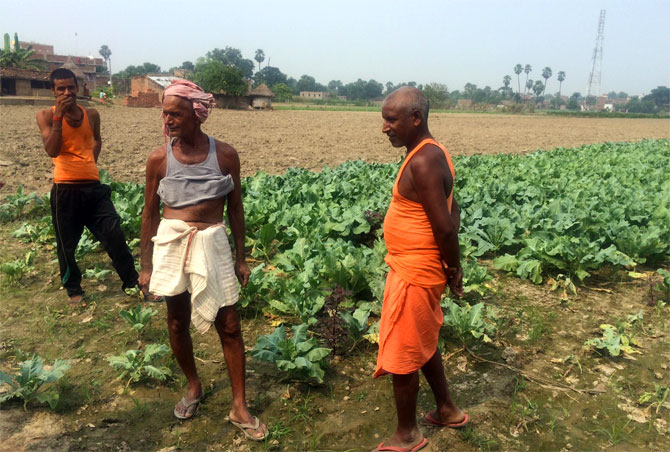
The general perception is that only large farms are viable and small farms are not. And as per your study, India also has reached that position today.
Now the problem is, India has reached a position in its growth story where 90% of the farmers are still small and marginal.
They operate on less than 2 hectares of land, and are at a disadvantage when you take farm output.
But you still have the same policies which you had formulated in the 1970s, 1980s and 1990s when small farms yielded more than the large farms.
It is time the policy framers look at the vulnerability of small farmers. For example, if you look at the three farm laws, you will see that they are tilted towards large farmers, and they do not help the small and medium farmers.
The question is, how can the small farmers go up the value chain?
Also, while framing the farm policies, you cannot ignore the demographic changes that are taking place in rural India.

You mean the case of young people not engaging in farming and moving to urban areas for jobs?
Yes, the Gen Zs are not interested in farming as is evident from our fieldwork in different parts of the country. They are totally disconnected with farm activities which their families have been involved in for years.
Since the manufacturing sector growth has stalled in India in the context of its structural transformation except perhaps in states like Maharashtra or Tamil Nadu, the labour that is released from agriculture is not getting absorbed by the market.
This creates the need to think about industrial policy and skilling programmes seriously.
Unless the industrial output goes up, this is going to be a major problem for the economy in terms of employment generation.
We cannot look at various sectors in isolation.

Do you see small farmers disappearing soon?
The number of farmers itself fell between the 2001 and 2011 Census.
Depending on whether we consider agricultural households or operational holdings, the absolute number of small and marginal farmers in India is very large.
But we see that the average small farm size is falling as confirmed by the Agricultural Census 2021-2022 also.
The average farm land holding per family unit is going down.
It means there is a lot of non-farm land is coming up that is evident from the changing land use and land patterns across the country.
What we see is, since the workforce participation in agriculture and allied activities is gradually falling, the percentage contribution from agriculture is going to fall.
But in absolute numbers, it is not falling as one would have anticipated because of the population growth.
 IMAGE: Professor Sarthak Gaurav
You said after the third wave, small farms were no longer viable. Is that the major reason for the agrarian crisis India is facing today?
What we have understood based on our studies is there is a need to visit the agrarian systems before devising an agriculture development strategy for the next 20 to 25 years.
Ecological sustainability and balance has been affected in many areas.
We need to look at agriculture more holistically.
Many of the challenges we observed were not just about farm size but from the weak linkages in the input and output markets, and limited access to knowledge and infrastructure.
Helping smallholders organise into collectives or producer groups can enable them to pool resources, adopt agroecological practices, and negotiate better prices.
The development strategies need to be based on contextual realities, and policy paradigms have to be of strategic importance.
How long will it take for India to catch up with some other developing nations?
If you take the case of China which opened up its economy in 1978 and how it has grown, there is a 20-year gap to catch up!
Feature Presentation: Aslam Hunani/Rediff