
'This type of comprehensive legislation has never been introduced before in Parliament's history.'
'A bill that simultaneously affects ministers, chief ministers, and the prime minister represents completely uncharted Constitutional territory.'
'Throughout our nation's legislative history, the established policy has consistently held that public office holders should face punishment only after receiving conviction from a competent court of law. Without this safeguard, we risk systematic destabilisation, and our federal structure would face complete collapse.'
'Any central government could potentially deploy this legislation against state governments they oppose politically. This represents the most frightening prospect and dangerous possibility that these bills create.'
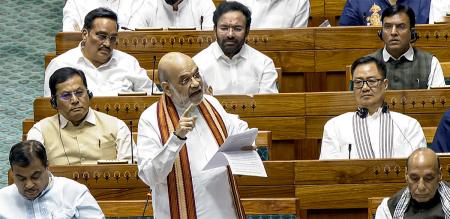
Constitutional expert and former secretary general of the Lok Sabha P D T Achary warns the new accountability bills could weaponise arrests to destabilise governments, calling the prime minister's inclusion a "mockery."
Mr Achary raises grave Constitutional concerns about Union Home Minister Amit Shah's accountability bills targeting prime ministers, chief ministers, and Cabinet ministers.
In an interview with Prasanna D Zore/Rediff, Mr Achary warns that these unprecedented legislative measures could become dangerous "weapons" to destabilise governments and could potentially lead to collapse India's federal structure.
The distinguished Constitutional expert emphasised that these bills, classified as the 130th Constitutional Amendment, must mandatorily pass with a special majority under Article 368, requiring two-thirds of members present and voting in both Houses of Parliament. He categorically states that the Speaker possesses no authority to reclassify these Constitutional amendments as ordinary legislation requiring simple majority.
Do the new bills introduced by Home Minister Amit Shah, particularly those enabling the arrest or removal of prime ministers, chief inisters and Cabinet ministers, require a two-thirds majority since they alter the balance of Constitutional offices, or can they be passed with a simple majority?
No, they absolutely cannot be passed with a simple majority.
These bills must be passed through special majority procedures. The special majority requirement means securing the majority of the total membership of each House, along with two-thirds of the members present and voting during the session.
So this requires only a special majority. Should one half of the state legislatures also vote for this?
I don't believe that requirement applies in this case, though I would need to verify this point. My initial assessment is that state legislature ratification is not required for these particular bills.
So for these three bills, a two-thirds majority of both the Lok Sabha and Rajya Sabha members present and voting is required?
If I understand the Constitutional framework correctly, yes, that is precisely the requirement.
Under what Constitutional provision is the two-thirds majority required for the passage of these bills?
This requirement is explicitly provided under Article 368 of the Constitution, which is the fundamental provision governing Constitutional amendments. Any Constitutional article that requires amendment must satisfy this special majority requirement.
So Article 368 of the Constitution mandates this procedure?
Correct, Article 368 establishes this mandatory framework.
Can the Speaker of the Lok Sabha classify these bills on disqualification and arrest of PMs and CMs as ordinary legislation requiring only a simple majority, or must they be treated as Constitutional amendments?
The Speaker possesses absolutely no authority to reclassify these bills. The classification is already definitively established.
If you examine the bill documentation, you'll find it clearly designated as the 130th Amendment to the Constitution. The enacting formula and the long title explicitly state 'An Act to amend the Constitution of India'.
This Constitutional nature is unambiguously stated throughout the bill's structure.
The Speaker's jurisdiction extends only to determining whether legislation constitutes a money bill, nothing beyond that scope. The Speaker has no power whatsoever to reclassify or re-characterise any legislative measure.
Would provisions in these bills, if they directly affect federalism, executive accountability and separation of powers, come under the Basic Structure doctrine, thereby mandating Constitutional amendment procedures rather than ordinary legislative processes?
If these provisions impact the Basic Structure of the Constitution -- and the elements you mentioned certainly constitute basic structural components -- then any legal challenge would invoke the Basic Structure doctrine.
Should anyone approach the courts challenging these bills as an assault on the fundamental structures embedded in the Constitution, the judiciary would naturally undertake a comprehensive examination.
The courts would be obligated to scrutinise whether these measures actually violate the foundational principles of our Constitutional framework.
Has Parliament in the past passed any bills as sweeping as the current set of disqualification and accountability bills with a simple majority despite their Constitutional implications? Are there any precedents?
This type of comprehensive legislation has never been introduced before in Parliament's history.
A bill that simultaneously affects ministers, chief ministers, and the prime minister represents completely uncharted Constitutional territory. This legislative approach is entirely unprecedented in our parliamentary experience.
Since these bills directly affect chief ministers and fundamentally alter the relationships between the Union and states' executive, do they require ratification by half the states as mandated for certain federal amendments?
Based on my preliminary assessment, I believe such state ratification is not required for these specific bills. However, I would need to conduct a thorough Constitutional review to provide a definitive answer on this particular procedural requirement.
If the government attempts to push through these accountability bills with only a simple majority, what would constitute the immediate legal grounds for challenging such action in the Supreme Court?
First and foremost, the government cannot possibly pursue these as ordinary legislation because they have been definitively categorised as Constitutional amendments.
There exists absolutely no Constitutional possibility for either House of Parliament to pass these measures as simple legislation requiring only a basic majority. The Constitutional framework simply does not permit such procedural deviation.
In your expert opinion, if these new accountability bills targeting prime ministers, chief ministers and Cabinet ministers were somehow passed without following the special majority route, how would this affect parliamentary democracy and the separation of powers between states and the Union?
Your hypothetical scenario cannot materialise within our Constitutional system. Such a situation simply cannot arise in either House of Parliament.
Under absolutely no Constitutional circumstances can these bills be passed through simple majority procedures. The Constitutional amendment process is inviolable.
When these bills were first introduced, what was your immediate assessment?
On the surface, people might initially consider such legislation necessary, reasoning that ministers, chief ministers, or prime ministers should not continue in office while facing imprisonment. However, I find the inclusion of the prime minister within this bill's scope to be a Constitutional mockery. This inclusion might serve purposes of legal equity or address certain jurisprudential challenges related to equality before law principles.
The fundamental concern arises when considering the practical implications.
If ministers face imprisonment, they would automatically lose their positions after 30 days under these provisions.
Our country operates under various penal statutes that permit arrest and detention for extended periods -- 90 days, 100 days, or even 60 days -- particularly under draconian legislation like the Prevention of Money Laundering Act (PMLA) and the Unlawful Activities Prevention Act (UAPA
The dangerous potential emerges when considering that any individual could fabricate charges against a chief minister. Such a person could file a false complaint with the Enforcement Directorate, or the Central Bureau of Investigation which would then investigate, arrest the chief minister, and after 30 days of detention, that chief minister would automatically lose office. This scenario would trigger the complete collapse of the state government.
This mechanism could be weaponised as a tool for destabilisation by any Union government -- and I emphasise this applies to any future Union government, not specifically the current administration.
Any central government could potentially deploy this legislation against state governments they oppose politically. This represents the most frightening prospect and dangerous possibility that these bills create.
Throughout our nation's legislative history, the established policy has consistently held that public office holders should face punishment only after receiving conviction from a competent court of law. Without this safeguard, we risk systematic destabilisation, and our federal structure would face complete collapse.
Consider extending this logic to members of Parliament. If we establish laws stipulating that merely filing allegations or cases against MPs results in their imprisonment and subsequent disqualification with loss of membership, this mechanism could theoretically target all 543 Lok Sabha members.
Imagine the catastrophic impact on our country and political system if such weaponisation occurred.
This is precisely why seasoned lawmakers exercise extreme caution regarding legislation affecting political office holders. We're not discussing junior ministers here -- we're addressing chief ministers who govern entire states. These officials could be targeted under any of these draconian laws and imprisoned for 30 days or longer.
If political opponents desire a particular chief minister's removal, this legislation provides the most expedient method available. This constitutes the primary danger.
Our legislative tradition has always maintained that only after an individual receives conviction from a competent court of law should they forfeit their political position.
These three new bills completely override and obliterate this fundamental Constitutional safeguard, representing a dangerous departure from established democratic principles.