
'If the INDIA bloc ever forms the government, they will be more than tempted to use such provisions to bring about regime change in BJP-ruled states.'
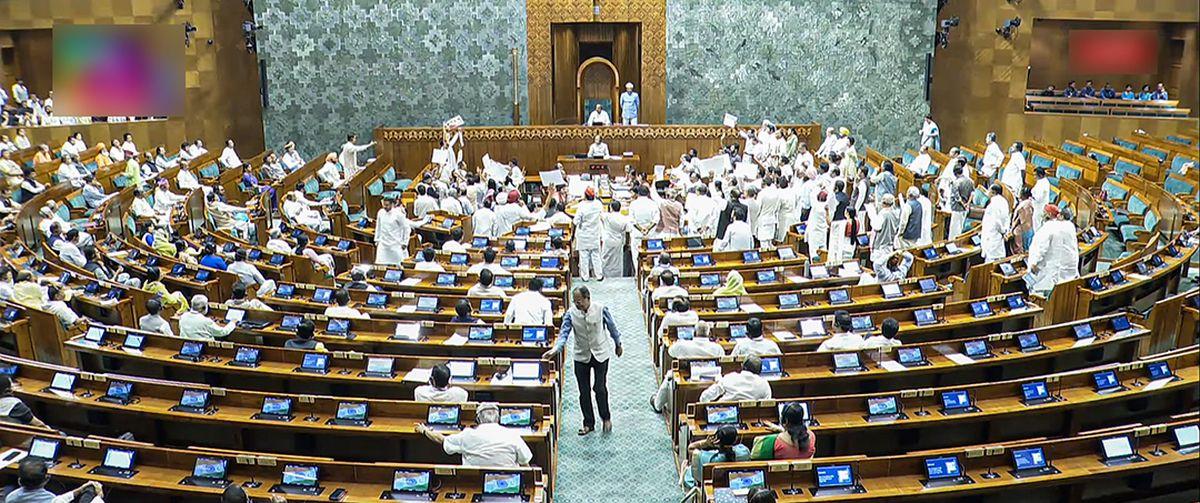
The 130th Constitutional Amendment Bill has driven a deeper wedge between the government and Opposition, already at daggers drawn.
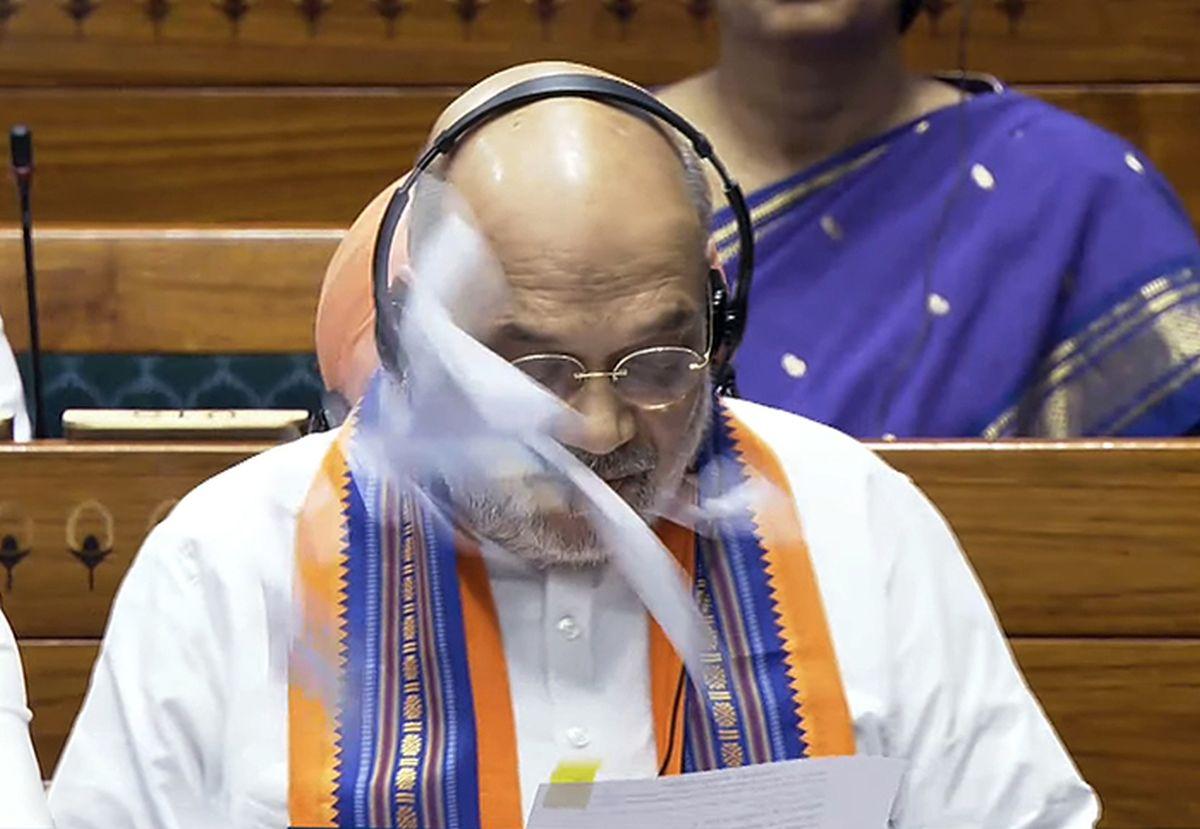
'Assault on democracy', 'Dictatorship begins', 'More than a super-Emergency' was how the Opposition parties characterised the bill, moved in the Lok Sabha on Wednesday by Home Minister Amit Shah and promptly sent to a joint parliamentary committee.
The government defended the bill saying it was an attempt to elevate the declining moral standards and maintain integrity in politics, but it failed to cut ice with the Opposition parties as well as the commentariat.
Political analyst and Editor At Large of the Darjeeling Chronicle news portal, Upendra M Pradhan is among who believe the legislation is a step in the wrong direction.
"This is not 'Gestapo-like authoritarianism', rather this is at best 'colossal stupidity', and at worse 'not so well thought plan to impose morality in politics'," Mr Pradhan tells Syed Firdaus Ashraf/Rediff in the concluding segment of the interview.
Amit Shah himself resigned as Gujarat's home minister before his arrest and refrained from taking office until he was discharged by the court, as he said in Parliament. Shouldn't such conduct be the norm?
As I've said earlier, that used to be the standard convention till Arvind Kejriwal broke it. But a sweeping law, that's borderline draconian, cannot be an answer for that. We need to find other ways for inducing 'moral suasion'.
Would this bill mark the end of democracy, since a chief minister could be forced to step down before a court verdict?
It does not mark the end of democracy, but it risks being such.
Like I have said earlier, this amendment has a very high potential or chance of being misused.
We have a saying in Darjeeling, 'मलाई खाने बाघले, तँलाई पनि खान्छ (the tiger that is eating me up today, will gobble you up tomorrow)'. The BJP should be extremely wary of this amendment.
If the INDIA bloc ever forms the government, they will be more than tempted to use such provisions to bring about regime change in BJP-ruled states.
Can the President give assent to the prime minister's arrest?
Article 74 of the Constitution mandates the existence of the council of ministers with the prime minister as its head, to aid and advise the President in the exercise of her/his functions.
Article 77 of the Constitution states that, 'All executive action of the Government of India shall be expressed to be taken in the name of the President.'
In our Constitution, Article 361 grants the President immunity from arrest or prosecution during their term. However, such provisions do not exist for the PM. The President's power to grant prosecution sanction against the PM is discretionary, and she/he is not required to consult the PM.
Critics say this move is comparable to the Gestapo-like authoritarianism of 1930s Nazi Germany.
I say the critics are wrong. I don't understand this strange fascination to compare everything the Opposition doesn't like with Nazism.
This Amendment, while has the potential to be misused, provides equal opportunity for every party, and I say this with intended sarcasm (since sarcasm deficient people abound).
If this law exists, someday in the future those in Opposition today could be in power tomorrow, and they could potentially misuse it.
This is not 'Gestapo-like authoritarianism', rather this is at best 'colossal stupidity', and at worse 'not so well thought plan to impose morality in politics'.
Since Arvind Kejriwal did not resign on moral grounds, setting a precedent for others, doesn't the 130th Amendment seem necessary?
As I have said before, you cannot forcefully introduce morality in politics. We need a bottom-up, not a top-down law aimed at imposing it.
You cannot introduce a provision in the Constitution like how the USA imposes 'Freedom and Democracy' in every country where oil is found, and this too I say with intended sarcasm.
Would such a bill effectively dilute the fundamental principle of 'innocent till proven guilty'?
It does, absolutely. 'Innocent until proven guilty, beyond a reasonable doubt, in a court of law' is one of the fundamental tenants of Indian jurisprudence.
Arrest and detention, and even judicial custody, are pre-trial measures under the Code of Criminal Procedure, 1973. These DO NOT IMPLY GUILT.
Automatic removal of a PM/CM/ministers merely based on allegations and arrest will be punishing them without due process. I feel, this will be violating two fundamental rights -- Articles 14 (equality before law) and Article 21 (right to life and personal liberty).
More importantly, it paints every politician as being morally corrupt individuals who will behave like Arvind Kejriwal.
Shouldn't naitikta (morality) in politics be upheld, like when L K Advani resigned as Leader of the Opposition after being an accused in the Jain diary case?
That is what I have been saying. Morality in politics and political life has been the cornerstone of Indian democracy. Amit Shahji resigned as home minister when he was chargesheeted by the CBI. He rejoined after his name was cleared. This is how you exemplify and encourage morality.
You cannot impose 'naitikta-morality' by the force of law. It needs to be inculcated from early childhood.
Could the real motive behind this amendment be to keep allies Nitish Kumar and Chandrababu Naidu in line?
This has got more to do with the way Arvind Kejriwal behaved, shaming the entire nation, than forcing Nitish Kumar or Chandababu Naidu.
Considering that 28 ministers in the Modi Cabinet face charges, with 19 of them being serious, doesn't this raise questions about double standards?
No, it doesn't. If any of these ministers are arrested for over 30 days, even they will be removed, so how is it double standards?
Moreover, in India, fake cases abound. One needs to be extremely diplomatic not to have fake cases filed against you if you are in politics.
Look at West Bengal, for instance. Almost all Opposition politicians have multiple cases filed against them, some real, while some are absurd.
The provision of 30 days' time for an accused leader to get relief -- isn't that a reasonable and fair time period?
Depends on what's reasonable. Ask AAP leader Satyendar Jain if 30 days would have been enough to get relief.