'The largest listenership for Vividh Bharati outside the country is in Spain.'
'The labourers who go there for the tomato-picking season feel cut off from their country and listen to Vividh Bharati to overcome their loneliness.'
Neelesh Kulkarni, who along with Vikrant Pande has authored Akashvani, Hundred Years of Stories from All India Radio wears many hats.
"I first went behind a mic at All India Radio by featuring in a children's programme 60, 62 years ago," he recalls.
"I owe to the training I got then, all my achievements in the fields of public speaking, voice-overs, cricket commentary, theatre, etc. The book is a humble attempt at saying, 'Thank you!'."
A management graduate and entrepreneur who quit the corporate world after a seven year stint, Kulkarni has run his own business for the last 39 years.
His first book In the Footsteps of Rama, Travels with the Ramayana (Harper Collins) is in its second edition. It has been translated into Hindi, Marathi and Gujarati and made into a six-part OTT series. The Hindi translation was declared the best nonfiction book for 2023-2024 by FICCI.
He was also part of the best-selling anthology, Where the Gods Dwell, Thirteen Temples and Their (Hi)Stories (Westland Books), which is also in its second edition.
His Open Sesame, Magic Tricks for Kids was published by Red Panda in March 2024.
Uprising, The Liberation of Dadra and Nagar Haveli, the first book on the only successful people-led armed struggle in the history of the Indian freedom movement, was published by Westland Books last year. It is being translated into Marathi and Gujarati and is also being made into an OTT series.
He is currently working on a children's book, an anecdotal history of Delhi University and a book on the Varkaree tradition.
"Where else can you get such stupendous reach? How can a medium with such massive reach and a committed listener base be an underdog?", Neelesh Kulkarni tells Sunil Gatade about why he embarked on a book on AIR.
After In the Footsteps of Rama and the one on the freedom struggle for Dadra and Nagar Haveli, what prompted you to take an unconventional topic like All India Radio?
I owe a debt of gratitude to All India Radio on two counts.
My father worked at All India Radio his entire working life, and I was brought up on the salary he earned from there.
I first went behind a microphone at the age of 7 on All India Radio's children's programme and was a regular on it for almost six years, which was a massive learning experience for me.
In my various activities, such as performing on stage, recording voiceovers, providing cricket commentary, or serving as a public speaking coach, it is the training I received from All India Radio that has shaped me into who I am.
The book is therefore an attempt to repay the debt of gratitude I owe the organisation. The choice was therefore not a surprise but a natural extension of my writing.
What was the biggest revelation while researching the book on the national broadcaster?
Whenever I speak about my book, people presume it is a nostalgia trip, and when I began writing the book, I assumed it would be just that -- a paean to a golden past, concluding with a sorry farewell, kind of an ending.
What came as a revelation was that not only is All India Radio on the move, but it is poised for a quantum leap with the use of technology.
I also learnt that All India Radio has a captive audience that does not move from it, regardless of the temptation of private FM channels. Both, needless to say, were heartening.
Despite AIR being all pervasive, there is a perception in the changed scenario that it has become an underdog amid the glitz and glamour of the private radio channels. Do you agree?
Not at all. It still has the most extensive listenership and the most loyal fan base.
It is now heard all over the world in stereophonic sound through the 'NEWS-ON-AIR' mobile app.
Expats can listen to the radio stations of their hometowns through the app and stay connected to their roots, regardless of their location.
For example, the largest listenership for Vividh Bharati outside the country is in Spain.
The labourers who go there for the tomato-picking season feel isolated and cut off from their country and listen to Vividh Bharati to overcome their loneliness.
Similarly, a soldier from Kerala posted in Siachen can listen to his favourite programmes from his local radio station on his mobile.
Also, people in remote hamlets, where there is not even mobile connectivity, listen to and receive radio through the Free Dish.
Where else can you get such stupendous reach? How can a medium with such massive reach and a committed listener base be an underdog?
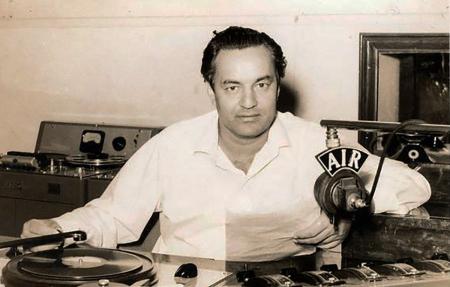
Why do you think AIR has not been able to become the BBC, which often criticises its own government?
What percentage of private radio and television channels criticise the government? Why blame All India Radio alone? Additionally, it's a public broadcaster, and it has to highlight the achievements of the government.
Notwithstanding this, programmes critiquing the government have been made in the past, though I cannot predict whether they will be in the future.
Any suggestions to AIR for wider reach and greater interaction with its audience?
Better marketing of their tech initiatives so that things like the NEWS on AIR app and the free dish get wider attention and become more popular.
With that, AIR will take a quantum leap in not only its reach but also its revenue.
****
Photographs curated by Manisha Kotian/Rediff
Feature Presentation: Rajesh Alva/Rediff