
'Visualise those 15 to 18 seconds: Fully loaded aircraft, pilot manually controlling with both hands (no autopilot immediately after takeoff), looking forward while switches are behind.'
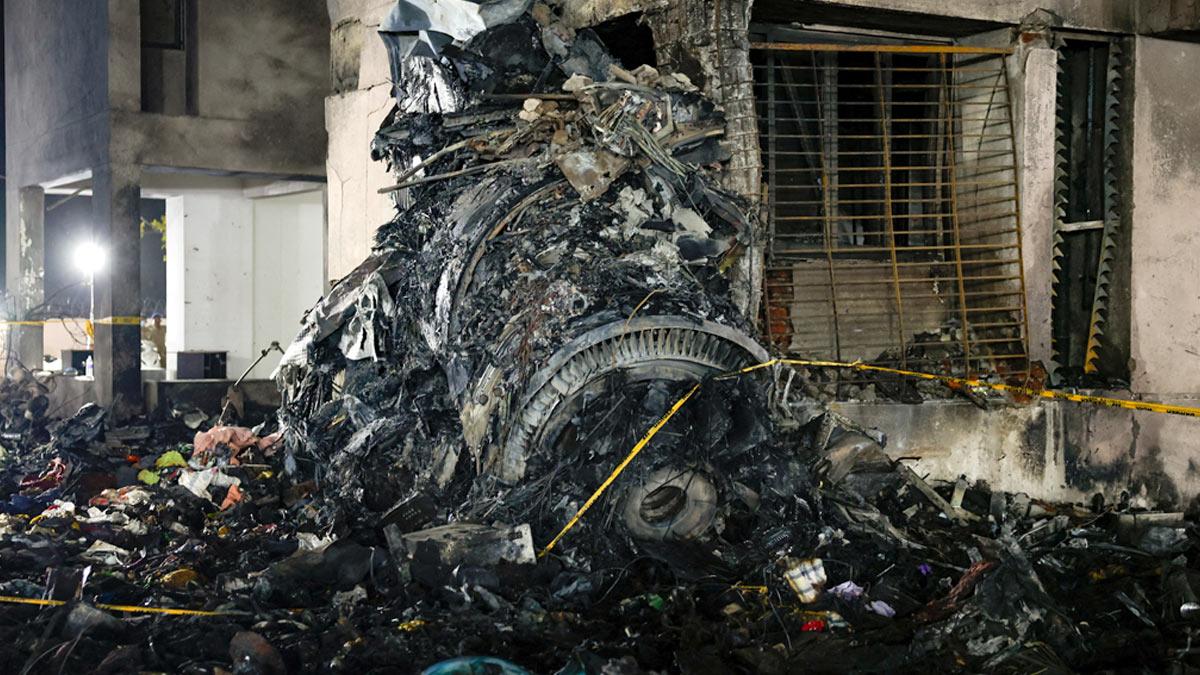
In the concluding part of his candid interview with Prasanna D Zore/Rediff, Air Marshal Sanjeev Kapoor (retd) urges caution in judging the cockpit conversation that captured one pilot asking, 'Why did you cut off?' and the other replying, 'I did not.'
"Isolating one statement from an entire conversation is absolutely incorrect," he insists, pointing out how vital it is to understand the complete context of these few tense seconds.
The air marshal then explains why, given the aircraft's extreme weight, scorching ambient temperatures, and the impossibility of sustaining flight with both engines rolling back so soon after takeoff, no pilot action could realistically have changed the tragic outcome.
India's DGCA didn't proactively enforce inspections after the FAA's SAIB advisory. Should local oversight agencies like the DGCA err on the side of safety with international advisories?
This is what the AAIB Preliminary Report Says: The FAA issued Special Airworthiness Information Bulletin (SAIB) No. NM-18-33 on December 17, 2018, regarding the potential disengagement of the fuel control switch locking feature.
This SAIB was issued based on reports from operators of Model 737 airplanes that the fuel control switches were installed with the locking feature disengaged.
The airworthiness concern was not considered an unsafe condition that would warrant airworthiness directive (AD) by the FAA.
The fuel control switch design, including the locking feature, is similar on various Boeing airplane models including part number 4TL837-3D which is fitted in B787-8 aircraft VT-ANB.
As per the information from Air India, the suggested inspections were not carried out as the SAIB was advisory and not mandatory.
The scrutiny of maintenance records revealed that the throttle control module was replaced on VT-ANB in 2019 and 2023.
However, the reason for the replacement was not linked to the fuel control switch.
There has been no defect reported pertaining to the fuel control switch since 2023 on VT-ANB.
Absolutely correct. DGCA should be more proactive in ensuring that advisories that are serious in nature or have serious ramifications should be implemented.
We need more aviation professionals in DGCA decision-making positions. Currently, there's no pilot or air crew in top decision-making roles.
These are technical matters that only professionals can fully comprehend. Aviation is a technical matter and it requires technical leadership to achieve expected outcomes.
Could earlier resolution of the fuel switch locking issue have prevented this crash?
(This hypothesis is) difficult to determine. Thousands of Boeing 787s operate globally. This advisory was issued seven years ago for the entire fleet, and there have been no 787 accidents related to this issue.
Secondly, simultaneous failure of both engines is extremely rare. One engine alone can maintain flight -- these are the most powerful engines GE manufactures for the 787. Even with single-engine failure, the aircraft can continue safely.
Dual engine failure is so improbable that while pilots practice such scenarios in simulators, it's typically simulated during cruise flight over volcanic ash or similar conditions.
The redundancy makes it virtually unthinkable that both engines would fail immediately after takeoff.
With the aircraft at 213 tons, operating in hot weather with landing gear extended and both engines rolling back, was any pilot action realistically possible?
You're operating at extreme performance limits. Globally, 75% to 80% of accidents occur during takeoff and landing phases because aircraft operate at their limits.
The aircraft becomes airborne at speeds very close to stalling speed (the minimum speed at which the wings can generate enough lift to keep flying; below this, the aircraft loses lift and starts to descend).
This fully loaded aircraft, departing for a 10-hour flight with maximum fuel and passengers, operated in afternoon heat. While ambient temperature was 38-39°C, tarmac temperatures would have reached 40-45°C at 1.30-2 pm in Ahmedabad. The aircraft was at absolute performance limits (during the takeoff).
Under better conditions -- cooler weather, lighter load -- recovery probability might have increased. But here, airspeed was just 180 knots with extremely high nose attitude (In aviation, attitude specifically refers to the orientation of the aircraft's nose relative to the horizon -- meaning its pitch (nose up or down), roll (tilt left or right), and yaw (rotation left or right)), approaching stall speed. The aircraft stalled and impacted the ground.
Should the AAIB have been more explicit about how unrecoverable this situation was?
The final report may address this. Officials have stated this is merely a preliminary report -- the final report will comprehensively cover all aspects and may take months. They have adhered to ICAO's 30-day preliminary report requirement. The accident occurred on June 12, 2025, so they met the deadline. More detailed analysis should emerge in the final report.
How long for the final report?
Not sure at this stage whereas the previous AI accidents at Kozhikode and Mangalore accident took three to four years for the final report to come. I expect minimum six to eight months for anything concrete (the final report explaining the reasons behind the AI 171 crash) to be tabled.
The CVR captured one pilot asking 'Why did you cut off?' and the other responding 'I did not.' Should investigators exercise additional caution before attributing this to pilot error?

Isolating one statement from an entire conversation is absolutely incorrect. We're conversing now -- if you extracted one statement without context, implication, or my response, it would be meaningless.
What was the complete exchange? What was the subsequent response?
This appears to show pilots were taken by surprise. The crew never expected dual engine failure.
One pilot asked the other about fuel cut-off, received a negative response -- this absolutely indicates they were surprised. The loss of thrust caused the aircraft to descend.
Under what circumstances do pilots shut off fuel switches?
Various engine malfunction scenarios require fuel shut-off operation. However, this is typically done at higher altitudes because height is crucial for aircraft recovery -- height converts to speed, which is essential.
The RAT (Ram Air Turbine) is a small emergency device on aircraft that looks like a mini propeller. Think of it like children running with pinwheels or triangular paper toys that spin in the wind -- the faster you run, the faster it turns.
Similarly, when an aircraft loses its main hydraulic or electrical power, the RAT automatically deploys into the airflow outside the plane.
As the aircraft continues moving forward, air rushes over the RAT's blades, causing them to spin purely from the force of that airflow (without needing any engine power).
This rotation generates enough hydraulic pressure and electricity to keep essential flight systems running, helping pilots maintain basic control and instruments until they can safely land.
What caution should investigators exercise regarding cockpit conversations before attributing incidents to pilot error?
This represents normal pilot communication. It highlights their surprise at power loss.
Should airlines adopt clearer SOPs or additional briefings about accidental fuel switch activation?
The premise of accidental activation is completely far-fetched and out of question.
No pilot in normal mental state would operate switches as suggested. The pilot likely attempted engine restart upon recognising power loss -- the required action.
Visualise those 15 to 18 seconds: Fully loaded aircraft, pilot manually controlling with both hands (no autopilot immediately after takeoff), looking forward while switches are behind.
It must have been hellish in the cockpit.
What policy signals should the final report send to global regulatory bodies?
All agencies will closely monitor this accident due to its global implications.
Findings will inform orders from Boeing, GE, and advisories to regulatory bodies worldwide.
Every accident globally provides lessons for operators. Every SOP and emergency procedure pilots practice represents accumulated knowledge from previous incidents.
If something new emerges, it becomes part of future training. After this accident, Boeing and 787 operators will likely simulate immediate post-takeoff dual engine failure scenarios in training.
For passengers trying to understand this tragedy, what does this preliminary report reveal about modern aviation's safety net?
Air travel remains one of the safest transportation modes. Accident rates relative to flying hours continue declining. Compare train, bus and road accidents -- aviation accidents are significantly fewer. Nothing should deter people from flying.
These unfortunate accidents occur, but thousands of aircraft fly daily clocking millions of flight hours globally. Suggesting flying is unsafe is absolutely incorrect.
Flying inherently becomes safer through technology and improved devices. However, basic flying skills are declining as we increasingly rely on technology.
We've reached near-total technological dependence, which should ideally blend conventional flying with technological assistance.