
'Anyone they don't like can be potentially arrested and thrown in jail for 30 days to induce regime change.'
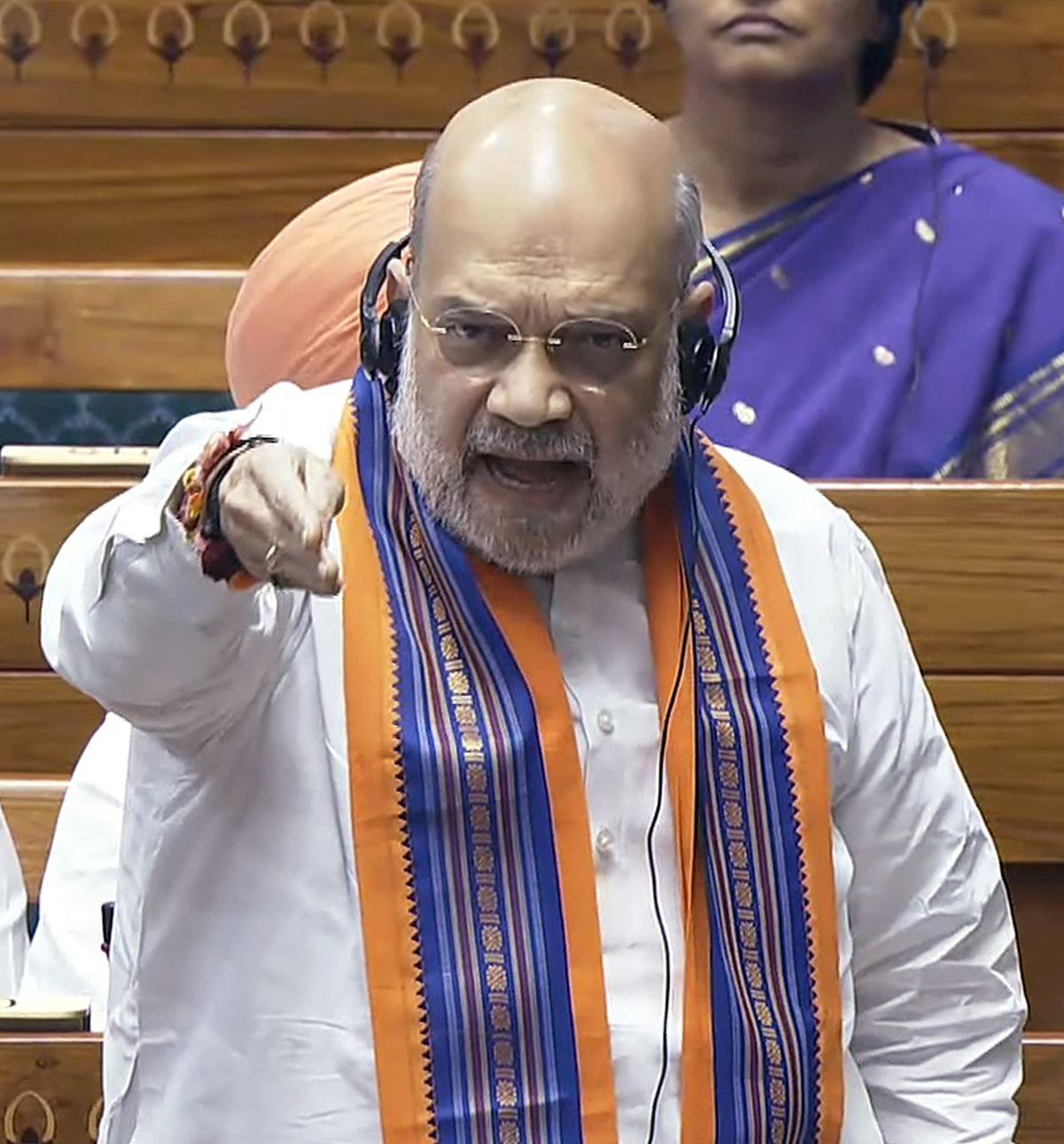
As Parliament erupted over the sudden introduction of the controversial 130th Constitution Amendment Bill, which allows for unseating a prime minister, chief ministers and ministers after 30 days of detention in a criminal case, a growing chorus of concern has emerged outside as well -- not only from Opposition benches but also from legal experts, civil society, and independent political observers.
At the heart of the debate lies a fundamental question: Can morality in public life be legislated without endangering the principles of democracy, due process, and individual liberty?
To explore this complex question, Syed Firdaus Ashraf/Rediff spoke with Upendra M Pradhan, Darjeeling-based political analyst and Editor-at-Large at the Darjeeling Chronicle news portal.
In this wide-ranging conversation, Pradhan recalls history -- from the misuse of Section 66A of the IT Act to authoritarian legacy of the 39th Amendment under Indira Gandhi -- to argue that the 130th Constitutional Amendment risks becoming a tool for regime change rather than a mechanism for accountability.
He cautions against undermining the foundational legal principle of "innocent until proven guilty," warning that morality enforced by law often masks a deeper political intent.
Part one of a two-part interview.
What is your objection to the 130th Constitution Amendment Bill?
I don't have objections per se. But knowing India and Indian politics the way I do, I am fearful such laws could be misused, if not today, then definitely in the future some day.
It's like having a new car sitting in the garage -- even if the owner doesn't feel like driving it today, someone else may be tempted to drive it.
Section 66A of the IT Act came into effect in 2009. Before it was struck down in 2015, around 681 cases were filed under it. Even after the scrapping, 1,307 more cases were registered illegally until recent years.
If a law exists, the government of the day will be tempted to impose it, and that is what worries me.
Although jurisprudence dictates 'innocent till proven guilty', don't you think the political leadership, like Caesar's wife, must be held to higher moral standards?
See, we expect those in public life to be amenable to higher levels of probity. However, in Indian politics, it is known for higher-ups and even agencies/higher bureaucracy to file fake cases against those they don't like.
What's the guarantee that all the accused are guilty, and if one is not proven guilty, why should they be sidelined?
Why do you think the government has suddenly brought up this bill out of the blue?
One name stands out -- Arvind Kejriwal.
India is governed as much by conventions as the Constitution. It has been a convention that anyone accused of major crime will resign to allow for a fair probe.
Lalu Prasad Yadav resigned as Bihar CM so did Amit Shah when he was Gujarat home minister. But Kejriwal continued to run the CM's office, which set a very bad precedent and also was against all norms of decency.
Since a Constitution Amendment Bill requires a two-thirds majority, which the government currently lacks, do you think this bill can actually be passed?
India is a democratic country where the votes inside Parliament reflect the will of the people outside too.
In a world super-connected through social media, it is very easy for the people to perceive anyone opposing the bill as being 'corrupt' or 'trying to shield the corrupt'.
Hence, if it comes to voting on such a bill, majority of the political parties will be keeping their ears close to the ground.
If public opinion is leaning towards supporting the bill, they will vote for it.
If the people are in a 'we don't care' mode, almost all political parties including NDA members, may actually end up not voting for it.
The real question is, can the government generate enough public opinion in favour of the bill?
With morality in politics largely ignored today, doesn't this bill go some distance in restoring it by holding political leaders accountable for their actions?
India is known to resist anything that's imposed. The Emergency of 1975 is an example.
You cannot impose morality by the force of law. It has to be inculcated through education -- right from pre-nursery levels, and through positive role models.
When Prime Minister Modi said 'na khaunga, na khane dunga' people were hopeful the much needed era of change is here. It's been 11 years, actual, on the ground change is yet to come.
The 39th Amendment initiated by Indira Gandhi's government gave the prime minister immunity. How does this compare to the 130th Amendment?
If the 39th Amendment was about protect the actions of the executive against judicial scrutiny, the 130th Amendment has the risk of being a 'rule by remand' tool.
Both the amendments go against the fundamentals of 'rule of law' -- everyone is equal in the eyes of law, and no one is above the law.
The 130th Constitutional Amendment risks placing power in the hands of the PM/CM/bureaucracy, through agencies like ED/CBI/CID/state police.
Anyone they don't like can be potentially arrested and thrown in jail for 30 days to induce regime change.