
'No respite from economic pain is worth the loss of dignity and self-respect,' asserts former foreign secretary Shyam Saran.
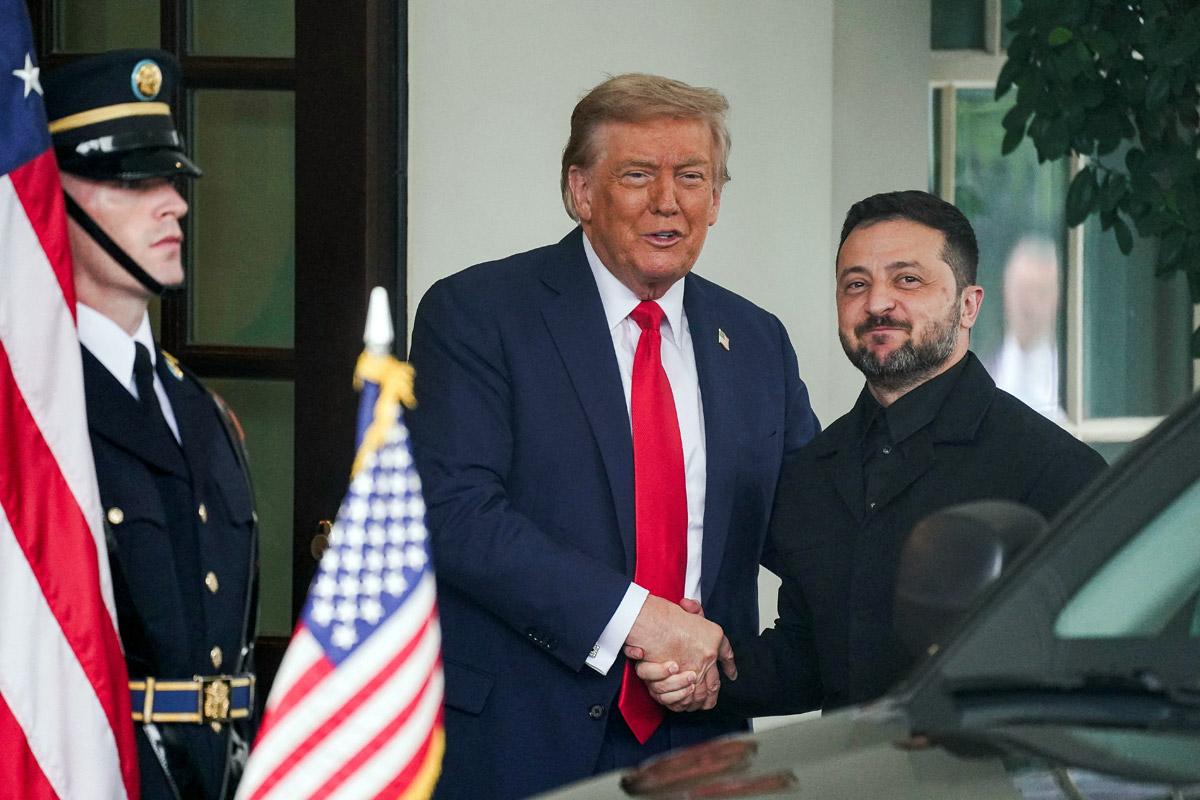
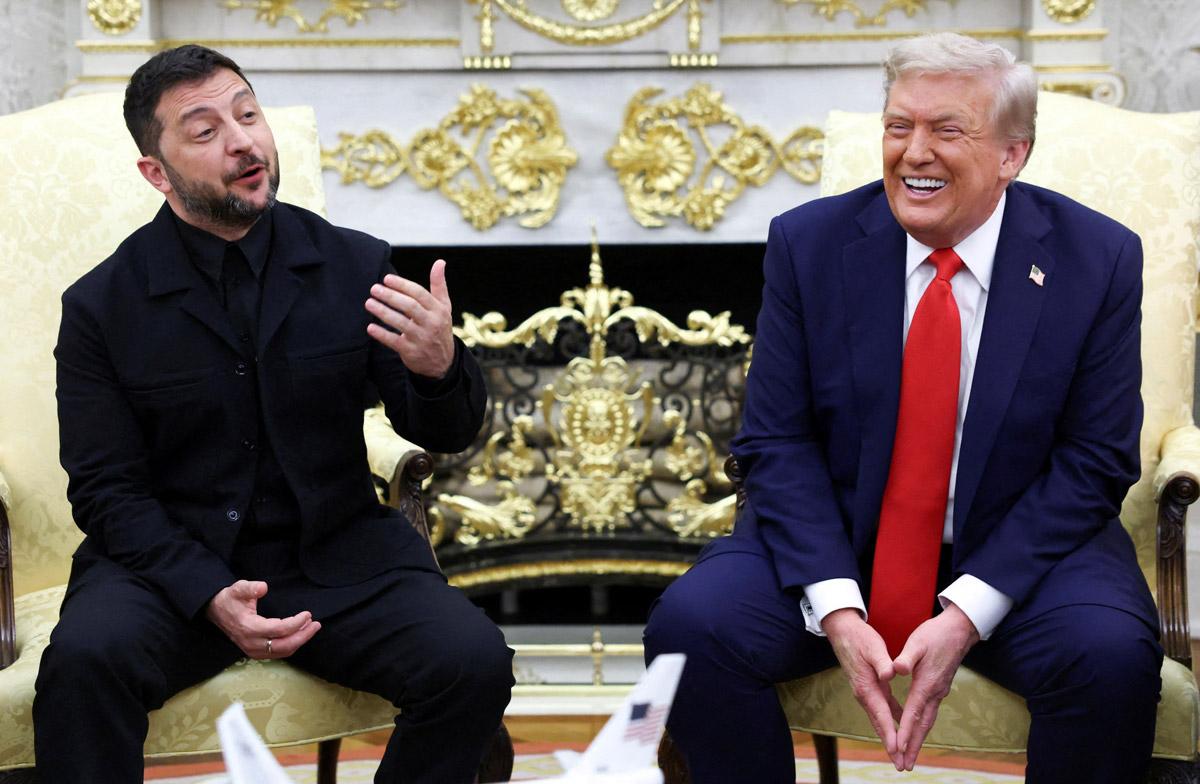
For an outside observer, it was painful to watch the orchestrated obsequiousness of some of the world's most powerful nations in front of US President Donald Trump at the meeting on Ukraine in Washington, DC on August 18, 2025.
President Volodymyr Zelenskyy of Ukraine joined the seven key European leaders -- Emmanuel Macron of France, Keir Starmer of the United Kingdom, Friedrich Merz of Germany, Giorgia Meloni of Italy, Alexander Stubb of Finland, Ursula von der Leyen, President of the European Union, and Mark Rutte, secretary general of the North Atlantic Treaty Organization.
They competed for Mr Trump's approbation by lauding him as a peacemaker, as a leader invested in 'stopping the killing' and for being generous and solicitous to his friends.
One may argue, as some European commentators have done, that this public display of abject fealty was a small price to pay for keeping the world's most powerful nation on their side.
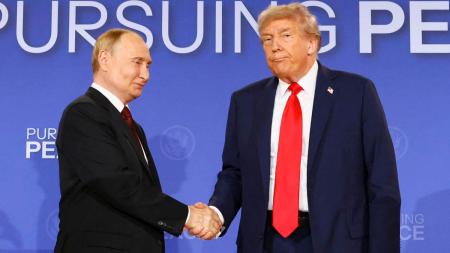
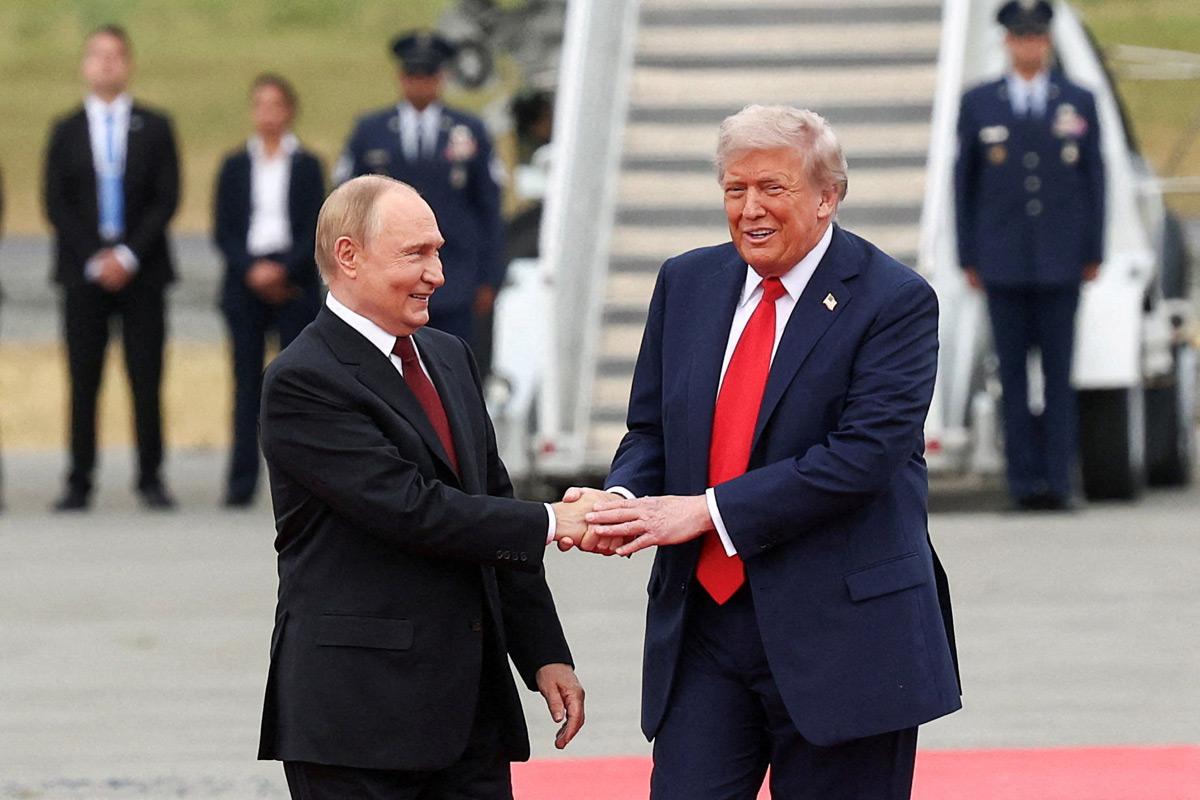
They had to keep up with the measured but very successful use of flattery by President Vladimir Putin of Russia in Alaska.
Mr Putin had succeeded in deflecting Mr Trump from his the earlier insistence on an immediate ceasefire and in persuading him to accept the Russian position of pursuing peace by addressing the 'root causes'.
What many commentators have failed to note is that Mr Trump has openly declared that Ukraine must accept 'territorial swaps' as the price for peace.
This is a huge win for Russia. In his meeting with Mr Zelenskyy at the White House, a map was unrolled for the visitor, presumably detailing the loss of land he must swallow.
The European leaders seemed to have studiously avoided this thorny subject in their comments, though it lies at the crux of the crisis.
President Macron and Chancellor Merz did raise the issue of a ceasefire, which would postpone the land question.
President Trump dismissed it out of hand. Much is being made of Russia's willingness, conveyed in Alaska, to consider appropriate security guarantees for Ukraine if a peace deal were to be reached. But President Trump's Special Envoy Steve Witkopf suggested that among these guarantees, Russia had talked of measures that could be enshrined in Russian domestic legislation! This is laughable.
The Russian official statement on the Washington meeting categorically rejects any deployment of peacekeeping forces from Nato countries on Ukrainian soil.
On earlier occasions, Russia has vaguely hinted that China could join as a 'guarantor' of a peace deal.
Mr Trump has only committed the US to support a European role in establishing such guarantees, but not to actively participate.
Despite these glaring ambiguities and contradictions, 'security guarantees' to Ukraine were touted as the big success of the meeting.
This helped deflect attention away from the hitherto intractable issue of territory. Ukraine has been consistent in demanding that all the territories occupied by Russia since 2014, including Crimea, must be returned.
Mr Witkopf, and later the European leaders, spoke of 'Nato Article 5 like guarantees'. Article 5 commits each Nato member country to the collective defence of another member in case it is the victim of aggression. There are no ifs and buts.
Anything short of such a commitment may not be worth very much. One must recall the utter failure of the Budapest Memorandum of 1994 wherein Ukraine, Belarus, and Kazakhstan agreed to transfer their inherited nuclear weapons to Russia in exchange for security assurances from the US, the UK, and Russia.
The memorandum pledged to respect the signatories' independence, sovereignty, and existing borders, and not to use or threaten to use force against them.
Specifically, it committed the signatories to seek immediate UN Security Council action to assist Ukraine if it became a victim of an act of aggression or of a threat of aggression involving nuclear weapons.
Russia violated its own solemn commitments under the memorandum with utter impunity. It may have been subjected to sanctions and political isolation but there has been no military pushback.
If 'kissing the ring' was designed to bring Mr Trump towards a more supportive position on Ukraine, it failed.
There may be a trilateral meeting among Trump, Putin and Zelenskyy following Washington. It is unlikely that Mr Putin will agree to such a meeting without a clear indication that he may keep the Ukrainian lands he has occupied already, as well as additional territory he claims.
Mr Trump has already conceded the Russian insistence on land for peace. The question now is whether Mr Putin would be ready to scale down his demands or whether he believes there is a chance of getting all of what he wants.
If one compares the atmospherics of Mr Putin's Alaska visit with that of the Washington get-together of Western allies, it is difficult to avoid the conclusion that Mr Trump's affinity with Putin has a different, almost reverential quality.
It took just one meeting with Mr Putin for Mr Trump to drop his consistent insistence on a ceasefire. He had threatened more painful sanctions on Russia and on those who trade with Russia if the latter refused to stop the war.
At a reception for the visiting leaders in Washington, Mr Trump was heard saying to a visitor that Putin really wanted to end the war and 'he wants to give me a deal'.
What could India take away from Alaska and Washington? One, pandering to an egotistical leader is self-defeating. It opens the path to serial humiliation.
Two, any notion that a pause on additional sanctions on Russia, would relieve India from the additional 25 per cent tariff for buying Russian oil must be put aside. These penal tariffs have more to do with India than Russia.
Three, India must brace itself for an extended period of US hostility. One hopes that the temptation to repeat the European display of abject subservience will be avoided.
No respite from economic pain is worth the loss of dignity and self-respect. Our reactions must continue to be measured.
We must remain open to concluding a trade deal with the US that preserves our equities even while opening the door to US capital and technology.
Four, India must be alive to the real possibility of Mr Trump seeking a 'grand bargain' with another strongman, China's Xi Jinping.
From a geopolitical sweet spot, India is being pushed to the periphery with diminished agency.
This requires an attitude of prudence, patience, and the pursuit of a series of small gains rather than aiming for big-ticket initiatives. The storm will pass.
Feature Presentation: Rajesh Alva/Rediff
