
AIADMK leader Edappadi K Palaniswami is under pressure from his party as his unclear stand on the BJP alliance has brought back fears among party workers that the AIADMK may lose its identity, be forced into an unwanted coalition, and be taken over by the BJP later, observes N Sathiya Moorthy.

Under pressure from rival Dravida Munnetra Kazhagam's daily taunts, All India Anna DMK boss and former Tamil Nadu chief minister Edappadi K Palaniswami may have already wrecked the party's revived alliance with the Bharatiya Janata Party.
EPS' public statement that he was not a 'fool' to share power with the BJP if their alliance came to power in next year's assembly polls in the state has left more than a bad taste for their common well-wishers who want the ruling DMK to go, whatever the cost.
Yes, EPS was responding to DMK voices that had increased in numbers and frequency after he launched his early campaign for the assembly polls.
The campaign tour was mainly aimed at reassuring AIADMK cadres, for them to work together with the BJP at the grassroots level.
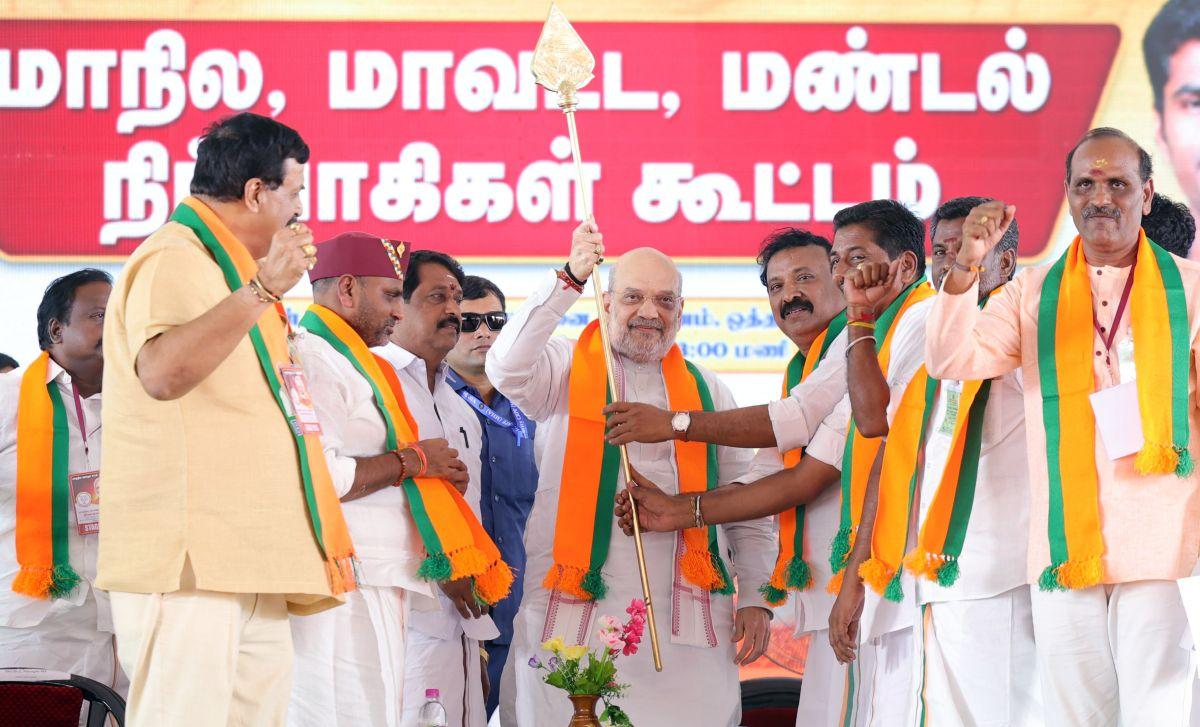
These cadres were yet to come to terms with EPS' sudden acceptance of the BJP's chief national strategist Amit Shah's 'alliance announcement' in April after having unilaterally broken the ties ahead of last year's Lok Sabha polls.
Their reasons only doubled after the 'forced' revival of the alliance. Earlier, it was only the BJP's Hindutva agenda, which the AIADMK cadres were convinced was behind their successive electoral defeats in 2019 (Lok Sabha) and 2021 (assembly).
They do not want to reckon with the reality that even when they had broken off with the BJP, both parties lost very badly to the ruling DMK combine in last year's Lok Sabha polls.
Clearly, they were driven by the belief that the Dravidian voter was not as yet convinced that the EPS leadership would not patch up with the BJP, post-poll, especially if some ministerial berths at the Centre were on offer.
The second and more immediate concern is Amit Shah's repeated reiteration from day one that if they came to power they would form a coalition government, but with EPS/AIADMK at the helm.
As a concept 'coalition governments' are an anathema for the two Dravidian majors. They believe and seemed to have made the Tamil voter believe in their belief. Their cadres definitely believe in it.
Hence, the more state BJP leaders talk about a coalition dispensation post-poll, more agitated have the AIADMK cadres become.
They are not sure if EPS would stay his ground first in seat-sharing talks for the polls and later in denying a share in power for the BJP if their party had an absolute majority.
It had always been the case under party founder MGR and his political heir Jayalalithaa, and in the parent DMK, both under founder C N Annadurai and his successor, M Karunanidhi.
Today, no DMK ally, including the Congress leader of the national INDIA bloc is overly confident that they could seek and obtain a share in power if the alliance returned to power.
Hence also why no DMK leader is talking about a non-existent situation even when some of their allies are making an occasional noise in this regard.

In private, it is also here AIADMK cadres seem to draw the line. They are not sure that party leaders under EPS are steadfast in defending their legacy position on Hindutva issues.
They cite Jayalalithaa's victorious slogan from Prime Minister Narendra Modi's first national poll outing in 2014.
For the cadres, Jayalalithaa's war-cry at the time, 'Modi-ya, indha Lady-ya?' said it all. That non-equivocal position alone helped her stall the Modi wave in Tamil Nadu.
Today, EPS' vacillation, purportedly over threats of imminent ED, IT and CBI raids have made the difference, according to these cadres.
In context, they also whisper about the way one-time AIADMK leader and later DMK Minister Senthil Balaji was prepared to stay in prison for 400-odd days pending his repeated bail applications.
They want their second-line leaders to repeat the example, but they are all especially afraid of the Enforcement Directorate is their reckoning.
Against this background, his second-line leaders' studied silence on the alliance, either way, has forced EPS' hands.
The fear that the BJP has been in direct touch with some of them, again through the ED/IT route, is not to the liking of the cadres, and more so of EPS.
The only one who may have escaped suspicion is one-time Jaya confidant and EPS' political guru, K A Sengottiyan.
It was argued the EPS' acquiescence in Amit Shah's near-unilateral April announcement on alliance revival had more to do with his colleagues and confidants from his chief ministerial days may pull the rug from under his feet as had happened to other estranged allies of the BJP in other states.
It is here that AIADMK cadres have reason to fear the BJP's endearments on an electoral alliance with an eye on a coalition government.
They are convinced that if the DMK were to lose power next year, the BJP-led Centre would arm-twist EPS and/or the AIADMK second-line to fall in line, share power, and obtain key ministerial positions, too.
In their eyes, again, it would only be a first step towards the BJP hijacking the alliance, government and the chief minister's job, overnight, as had happened in Karnataka, Maharashtra and many North Eastern states through the ten-plus years of Narendra Modi's dispensation.
In context, they point to the way the BJP had caused faction feuds within the AIADMK and also the PMK since the days after Jayalalithaa's hospitalisation.

In context, AIADMK cadres do not buy the argument that their 20-per cent stand-alone vote share in last year's Lok Sabha poll was too close for comfort, and the BJP-NDA's 18.5 per cent was the clincher for the rival DMK alliance.
They instead point out that the BJP's 18.5 per cent in 2024 and earlier in 2014 was actually the NDA vote-share, and it comprised many regional allies.
The BJP PR bandwagon, including those in the national and social media, have made even the AIADMK second-line to believe that it was not the case, and all those votes were for the BJP.
The AIADMK cadres readily concede that like with Atal Bihari Vajpayee in 1998 and 1999, there is also a 'Modi vote' in the state for the prime minister. But when it came to the assembly elections, the BJP obtained only the traditional three per cent vote-share.
Hence, according to them, the AIADMK and EPS need not have to fear that the BJP-NDA would pool in all the 18.5 per cent from the Lok Sabha polls. Instead, they point to the recent, ready acceptance of EPS' leadership by estranged AIADMK leaders like T T V Dhinakaran and sections of the OPS faction. There was also the PMK with its steady five per cent vote-share in the NDA at the time.
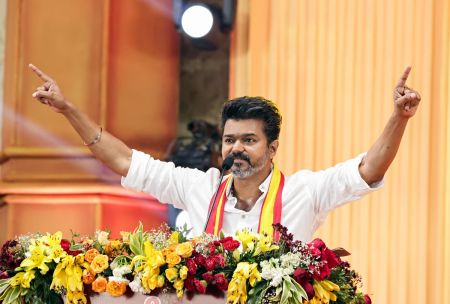
They argue that much of the NDA's vote-share last year came from these allies, and not from or for the BJP. Hence, even now it might not be too late for the AIADMK to form a new alliance with the rest of them all, now that actor-politician Vijay's TVK has pronounced him its chief ministerial candidate.
The TVK has also asserted that they would not work under another chief minister or chief minister candidate.
What does it all mean for the AIADMK-BJP alliance?
Even while repeatedly reiterating that the alliance would remain for the assembly polls during his road shows, EPS has also declared himself against a coalition government.
This is seen as his need to convince his cadres that he would not yield to the BJP post-poll, or during seat-sharing talks pre-poll.
It is here both sides see a hide-and-seek game during seat-sharing talks. The BJP would want to claim high numbers for Team NDA if only to ensure that the AIADMK did not have enough seats in its pocket to be able to record an independent victory.
EPS would want it otherwise.
Indications are that unlike in the past, he may not trust his very trusted allies; to handle initial negotiations. This could mean tough-talking from the beginning with little room for back-tracking without losing face.
There are two occasions from the past that Dravidian poll strategists recall, to buttress their argument.
The first one dates back to the 1980 assembly polls after Indira Gandhi, returning to power in the post-Janata Party era, dismissed the MGR-led AIADMK regime along with eight other non-Congress state governments.
Desperate to ensure a repeat of their Lok Sabha poll performance earlier in the year, the DMK's Karunanidhi was too generous to the Congress ally, and offered 114 of the total 234 seats, retaining only 112 for his party. Together they also supported eight others, six of them from the IUML.
If they won, a coalition was implied in the structure of seat-sharing. However, they lost badly, 162-69.
The general belief was that the sympathy wave in MGR's favour did the trick after he went to the voters, demanding 'justice' against the unwarranted sacking of his government.
However, the truth was that the DMK and Congress cadres worked at cross-purposes, the former to ensure lesser dependence on the latter to form a government, and the latter to achieve exactly the reverse. In the end, their cross-voting, if it could be called so, did them in.
Independent of the Tamil voter's purported revulsion to coalition governments, from 1980 on, the two Dravidian majors were convinced that leadership acceptance did not work at the grassroots level.
This is also the logic behind EPS' concern -- though he has been reduced to convince his cadres that he is not afraid of Amit Shah and the BJP.
The second example is that of elections 2011, when Jayalalithaa fastened a strong alliance with late actor-politician Vijayakanth's DMDK and others. The AIADMK won 150 of 160 seats contested, a hit-rate of 93.75 per cent.
Against this, in the rival DMK-led alliance, the Congress partner from UPA-II ruling the Centre, scooped out 63 seats and the Vanniar-strong PMK, 30.
With the magic figure standing at 118, the DMK had only 119 seats to contest.
Though the defeat was attributed to the 2-G scam, it was clear from the start that alliance partners, especially frustrated DMK cadres, would work against the allies, particularly the Congress. Together, they lost.
This is again a lesson that not only AIADMK cadres now, but even DMK second-line leaders recall when the talk inside the respective alliance is for a post-poll coalition dispensation.
There is a section of AIADMK electoral opinion that the party could well go it alone still, hoping for some of the DMK's anti-BJP allies to cross the floor and give a psychological jolt to the ruling party, without the AIADMK having to tie-up with the ruling party at the Centre.
However, opinion is divided about the outcome if the TVK joins hands with the BJP if the latter accepts Vijay as its chief minister candidate.
To this, internal AIADMK opinion still is that Vijay would lose credibility after projecting his party as both anti-BJP and anti-DMK, not necessarily in that order.
It is thus argued that as long as the TVK goes alone with some minor allies, sliced away from the other three existing partnerships, the DMK might end up returning to power, but it would not mean the end of the road for the AIADMK.
It is pointed out how after the unprecedented election debacles, the DMK (1991, 22 per cent) and the AIADMK (1996, 21 per cent) bounced back to being what they are still today.
The argument thus is not for the leaderships of the two parties to fall for motivated statistics-driven arguments against going it alone, and especially to create an image that the AIADMK's entire future depended now on the BJP alliance.
In a way, yes, it is argued, if the AIADMK-NDA won next year, the former can forget its future.
Whether sharing power or not, the BJP leader of the NDA would ensure that the party hurriedly strengthened itself at the cost of the AIADMK, especially in time for facing the Lok Sabha polls in 2029.
Or, that is what has happened elsewhere, it is pointed out.
N Sathiya Moorthy, veteran journalist and author, is a Chennai-based policy analyst and political commentator.
Feature Presentation: Rajesh Alva/Rediff