
One must wonder whether Mr Modi's efforts to wine and dine the Big Two of today's world were seen as a sign of weakness rather than a proffered arm of friendship, points out R Jagannathan.
For a country that is soon to overtake Japan to become the world's fourth-largest economy, and possibly the third before the end of the decade, India punches below its weight in terms of diplomacy.
While Prime Minister Narendra Modi is routinely seen as a rising global leader, he has to get more done through active diplomacy.
A visible personal rapport with global leaders is not a solid enough basis for conducting the kind of hard-nosed diplomacy that delivers net gains for the country.
We saw this recently when, despite a seemingly close relationship with Donald Trump, he managed to deeply embarrass India by claiming that the United States had mediated a ceasefire between India and Pakistan after Operation Sindoor.
Worse, we are now stuck with 25 per cent tariffs on exports to the US, and have been warned of a further 25 per cent tariffs over our ties with long-time friend Russia.
Earlier, after Mr Modi personally hosted China's Xi Jinping in Gujarat and Tamil Nadu, we ended up with the Galwan clashes and the remilitarisation of the India-China border.
Worse, during Operation Sindoor, China fully supported Pakistan in targeting Indian air and other assets with its weapons and intelligence.
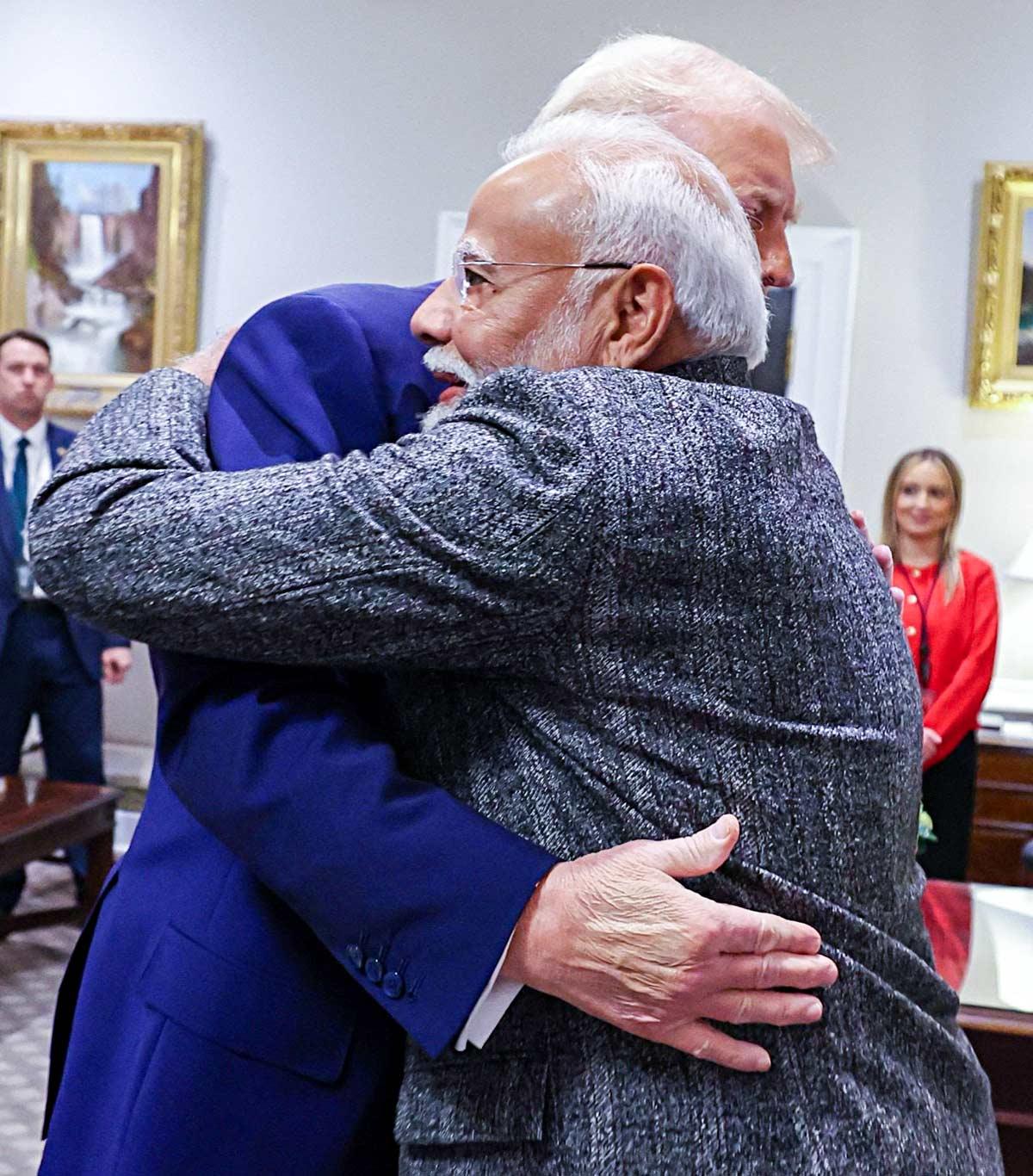
In fact, one must wonder whether Mr Modi's efforts to wine and dine the Big Two of today's world were seen as a sign of weakness rather than a proffered arm of friendship.
His trademark hugs may have played well with an Indian audience, but it's unclear how world leaders interpreted them.
We need to move from demonstrative style to hard substance, both in diplomacy and action.
Reducing our dependence on foreign military supplies by focusing on indigenous supply chains and technology is a no-brainer.
What we must ponder is whether our diplomacy so far has been more reactive than proactive.
We can't just be responding to the wars and growing instability around us with mere statements.
We have to make things happen and mitigate the threats, both to ourselves and the world.
Our diplomacy needs an activist role, even if it is behind the scenes.

To list just some of the challenges, there is pressure building up for us to reduce our economic and military ties to Russia.
In West Asia, as Israel gets more and more isolated from Western opinion due to its actions in Gaza (France and some European Union members have recognised Palestine, and the United Kingdom may follow suit), India will be under pressure to do something about Palestine.
It will be difficult to maintain our close strategic partnerships with Israel, especially if domestic Muslim opinion -- never very comfortable with the Modi government -- starts piling on the pressure through Opposition parties.
It is not in India's interest to let either Russia or Israel be undermined too much or go down in flames.
While the US will probably stand by Israel, domestic opinion in the US and Europe -- especially on the political Left -- is rapidly turning anti-Israel.
And most of Europe and the US would not mind Russia's effective demise as a major power.
In our own neighbourhood, we already have a Pakistan-China axis to contend with, but may soon have to add Bangladesh to the list of potential hostile powers.
The fact that India has not been able to protect Hindus in Bangladesh or even seal its borders against infiltrators says a lot.
One of Mr Modi's statements that did not age well is that 'This is not the era of war'.
Soon after he said this in the context of the Ukraine-Russia conflict, we ended up with another West Asian war that is still ongoing, and our own mini-war with Pakistan.
Even in Southeast Asia, two Asean members, Cambodia and Thailand, were recently involved in a deadly border skirmish.
One may not want war, but this doesn't quite look like an age of peace either, with every country now seeking to boost its defence capabilities.
The fact that our own defence exports are booming should tell us that the scent of war is rising everywhere -- after the collapse of the old world order, and the rise of China.
India needs to do more to help end wars while making sure that our own strategic interests are protected.
It is not in our interest to see Russia diminished, for that would push it deeper into China's hands and worsen our own strategic interests.
We must take an active part in defusing the Ukraine war by using people like National Security Advisor Ajit Doval (and some others, who can remain unnamed) to discuss possible ways to end the war.
This cannot happen without the EU and Russia coming to some sort of agreement on how Ukraine is to be divided or governed in future.
Russia is a European power, and Europe should not have to think of it as a perpetual enemy, especially when Russia is one of the world's biggest sources of energy and critical minerals.
We must ask whether Ukraine should become a neutral, non-EU/non-Nato state -- as Finland was during the Cold War.
Can Russia be allowed to keep troops in the Donbas region of Ukraine, which it has already annexed, as part of a diplomatic solution?
In West Asia, world opinion is moving towards a two-state solution, but that will not work.
A fully-independent Gaza could quite easily fall into the arms of Hamas and, as a legitimate state, will be able to build up its own independent military might in addition to hosting terror assets.
Solutions short of independence may have to be considered.
Should Gaza be a protectorate of Israel along with one neighbouring power (Jordan?), with independence in most areas barring foreign policy and defence?
The India-Bhutan relationship offers one kind of solution.
India must think beyond just defence capabilities, weaving in diplomacy that enables new alliances to emerge.
India could facilitate -- without being overconfident of its ability to influence this shift -- a slow detente between Russia and Germany (and, indirectly, the EU) to make it possible for the former to reduce its dependence on China.
If Pakistan could facilitate a US-China rapprochement in the 1970s, why can't India do the same between Europe and Russia?
Today, Germany and Japan are not led by men like Hitler and Hideki Tojo.
If anything, that Axis of Potential Evil is led by China's Xi Jinping, Iran's ayatollahs, Pakistan's military generals, and Turkey's Recep Tayyip Erdogan, who is dreaming of heading the next Islamic caliphate.
Threats to world peace usually come from powers that want big changes in the status quo, and this does not include other rising powers like India, Indonesia, Brazil, or South Africa.
None of these countries have overambitious territorial claims or a grab-what-you-can attitude.
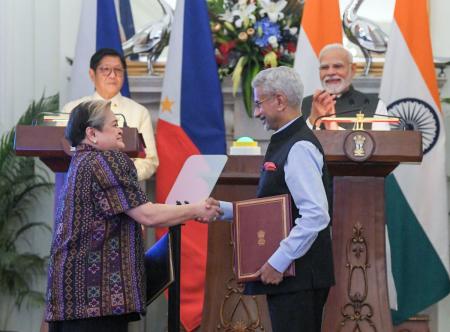
India must raise its diplomatic game to one from passive to active, both to create a new power balance and to protect its own strategic interests.
Feature Presentation: Aslam Hunani/Rediff
