
The Maoists in Bastar went from one village to another with kits providing badly needed medical intervention. The medical help was one key reason why the tribals were attracted to the Maoists, points out M R Narayan Swamy.
Now that vast sections of the media are celebrating the imminent decimation of the Maoist movement in India, it becomes pertinent to ask what led the Naxalites to take such deep roots in Bastar, a sprawling region where immeasurable mineral rich always co-existed with terrible poverty.
As any security official would affirm, armed groups do not operate for long, long periods in total vacuum.
The Maoists in Bastar could not have lasted for decades but for what they did and, more important, for what the Indian state did not do.
For sure, the Naxalites or Maoists did many things which were brazenly wrong and which sparked revulsion even in the minds of those whose cause they claimed to uphold.
But that is only a part of their blood-soaked saga which now shows clear signs of coming to an end.
Unlike those who sowed the seeds of Naxalism in 1967 in West Bengal and later turned a so-called revolutionary movement into one of mindless violence before drowning under internal rifts and State terror, their successors in Bastar lived and fought amid the tribals, one of the most impoverished and exploited sections of the Indian society.
The Bastar rebels too committed blunders but they were different from their predecessors in more ways than one.
Journalists who forayed frequently into Bastar, at times spending weeks and months in the thick forested terrain, could observe close ties between the tribal villagers as well as the men and women who called themselves Maoists and were well-armed to take on the security forces.
When the Maoists made their entry into Bastar in the 1980s, well-connected contractors and businessmen used to strip the forests bare.
The Maoists ended this endemic loot. There was a time when tribals were paid a pathetic Rs 3 for a packet of tendu leaf; within years of the Maoist era, the price shot up to Rs 154.
Ironical it may sound, it was only because of the need to take on the Maoists that the authorities started to lay roads and expand electricity connection in the rural interiors.
There was a time when police stations in remote areas were alone served by electricity.
For decades, there was no attempt by successive governments to provide healthcare in the tribal-populated areas.
The Maoists went from one village to another with kits providing badly needed medical intervention. The medical help was one key reason why the tribals were attracted to the Maoists.
The rebels also put an end to the age old practice of human sacrifice. Over a period of time, petty crimes, murder and prostitution came to a halt because of diktats from the Naxalites.
The fear of Maoist violence also virtually ended the varied forms of assault on tribal life.
Many of the Naxalites from undivided Andhra Pradesh who made Bastar their home and operational base learnt local dialects.
They lived with the villagers, bathed in the rivers, washed their own uniform and were not haughty unlike the city-based contractors and forest officials the tribal folks had always encountered.
All these -- and more -- helped the Maoists to adapt to Bastar like fish to water.
The more the government tried to overcome the rebels, the more the security forces suffered, helping the Naxalites to run a state within a state.
But all this was too good to last. And this is why the government is now confident of finally overcoming the Maoists in Bastar, where the Naxalites have reigned supreme since the 1980s.

The Maoists may have splintered and regrouped but they did not evolve with the times.
They continued to live in Mao's world and thought that his bygone tactics of seizing rural areas and encircling cities would help them win the revolutionary war. This was just a pipe dream.
True, they were better armed than Mao's forces before his victory in 1948. On the other hand, the Indian State was incredibly more powerful than the foes Mao ever encountered -- and this is being acknowledged only now by some of the surrendered Maoists.
In any case, in a country where people do not really view China as a friend, an ideology based on Mao's teachings is unlikely to win too many friends.
This is why the Maoists remained holed up for decades in Bastar and some other regions; they lost territory one by one and they could not grow beyond the economically backward zones where they found shelter.
The sweeping economic reforms India unleashed in 1991 too weaned away youths from rebel politics although its significance was not realized then.
Over the past many years, recruitment into Maoist ranks virtually ended; fear was not the determining factor for this.
After innumerable setbacks, the State too reinvented itself. It changed tactics.
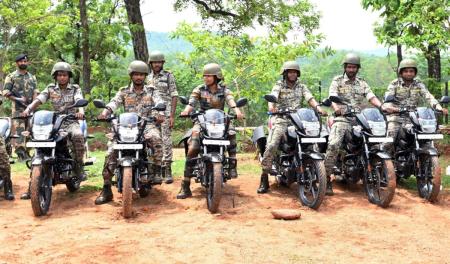
Outright brutalities did not end but focussed commando operations began to play a major role. Both human and technical intelligence contributed majorly to dent Maoist defences.
Roads were extended right up to the interiors, helping the administration while more and more villagers could travel to nearest towns -- opening their eyes to a world many had not known earlier.
In states like Chhattisgarh and undivided Andhra Pradesh, police posts opened in previously unpatrolled areas.
Security forces set up medical facilities in rural camps where villagers were wooed and provided healthcare, using a tactic the Maoists had mastered earlier.
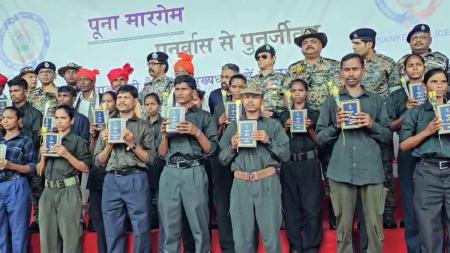
State governments also announced attractive surrender schemes, enabling those who had lived in the forests for long years to come over-ground in a bid to start life anew.
The more surrendered Maoists succeeded in the real world, more of their comrades got emboldened to give up the life of fugitives.
Many Maoist actions contributed to their undoing. This included severe punishment meted out to cadres even for petty misdemeanours and brutal killings of so-called class enemies.
Those who thus suffered within and outside the rebel ranks ended up becoming the eyes and ears of the security forces.
Abductions of rich people for money -- this happened more outside Bastar -- also tarnished the image of the Maoist movement, leading to disillusionment.

In the final analysis, despite all talk of 'Urban Naxalites', the Maoists were mostly holed up in forested interiors, with no major support base or sympathy in towns and cities.
They had to depend on ideologically uninspired men to fetch medicines and other vital necessities against cash payment.
Finally, with a central government determined to wipe out Maoism and with state governments falling in line, the situation turned from difficult to precarious for Naxalites.
Parts of Bastar are no more hospitable territory to the Maoists, triggering further internal contradictions.
But irrespective of whether the Naxalites are physically suppressed or not before March 2026, a deadline set by Home Minister Amit Shah, the seeds that birthed Naxalism would need to be tackled and urgently: Grinding poverty, lack of development, and undisguised exploitation of the poorest of the poor.
That, if the past is any guide, appears to be a tall order!