
'I disagree with much of Modi's politics, but it cannot be denied that in these years in office, he has carved more than a niche for himself in history,' points out Nilanjan Mukhopadhyay, author, Narendra Modi: The Man, The Times.
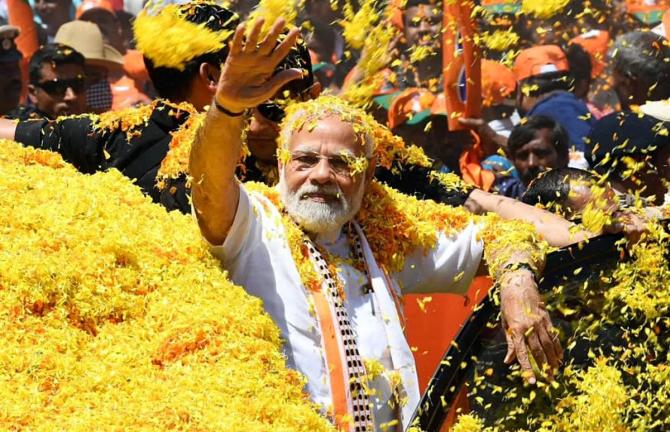
On October 7, Prime Minister Narendra Modi entered the 25th year of serving as head of a government. The unprecedented innings in power began on this day in 2001.
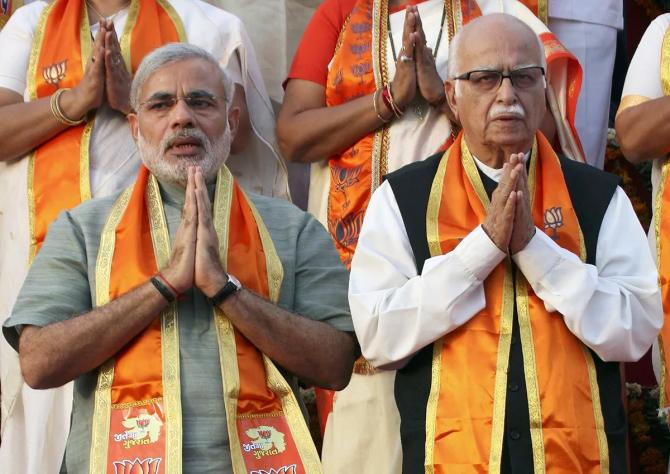
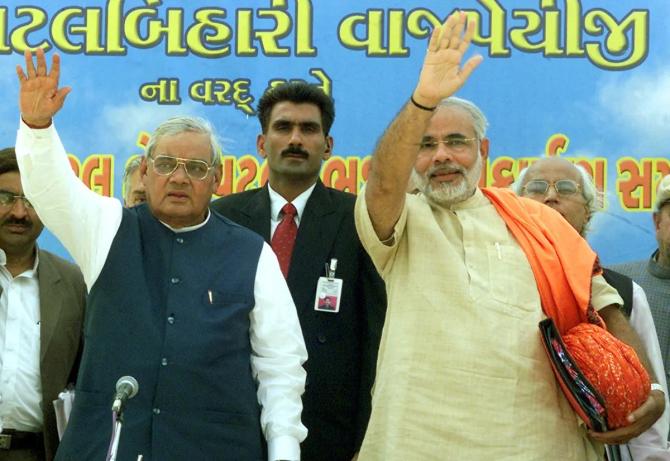
Days prior to this, the Bharatiya Janata Party's top brass -- then power duo, Atal Bihari Vajpayee and Lal Krishna Advani -- decided that only Modi, onetime Rashtriya Swayamsevak Sangh pracharak, could resurrect the BJP in Gujarat.
Despite wielding a near two-third majority in the state assembly, the party's popularity was plummeting. Its prospects for the next elections, due in February-March 2003, were bleak.
This situational paradox stemmed from then chief minister Keshubhai Patel's abject failure to provide speedy relief measures and initiate rehabilitation projects for the earthquake affected.
Memories of the calamitous tremor that ended lives of thousands besides reducing homes and business to rubble across Gujarat, but mainly in Kutch, have not yet faded from memory.
Besides other tasks looming ahead, a large part of Gujarat required rebuilding. The state government's assistance was required to get back lakhs of people on their feet. The BJP required a fresh hand at the helm.
Previously, Modi never held any office, elective or administrative. But Vajpayee and Advani knew that the 51-year-old onetime pracharak could devise strategies and resolve problems on the work floor.
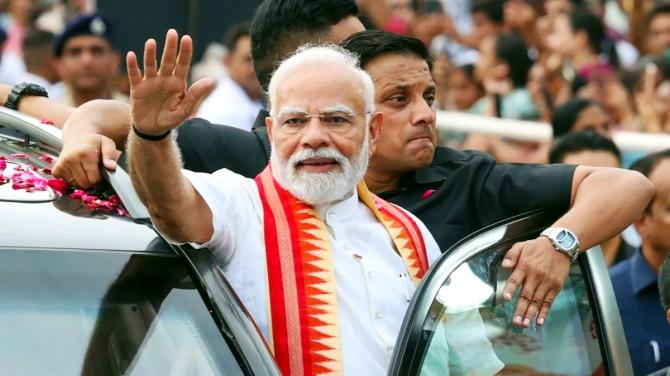
While researching his biography in 2012, I had asked how he overnight adapted to the CM's job. Modi explained that the Sangh was a workshop that trained swayamsevak/s for multifarious tasks, including finding the "right person for every job".
He may have exaggerated the RSS' role in his life and career in that conversation. But even recently in this year's Independence Day speech Modi referred to the organisation training swayamsevaks to 'dedicate their lives to the welfare of the motherland. Service, dedication, organisation, and unmatched discipline -- these have been its hallmarks.'
Even before embarking to facing challenges, Modi showed his propensity towards staging events and fostering his persona as a cultic figure.
His oath-taking ceremony was described by this website as an extravagant function that was unparalleled for its scale and ostentation.
The curtain-raiser for the celebrations next year when Modi will complete a quarter of a century in the chief ministerial and prime ministerial offices underscored that he remains an event manager par excellence.
Congratulations were heaped on Modi in an orchestrated manner and he responded with expected verbiage: He said it has been his 'constant endeavour to improve the lives of people and contribute to the progress of the nation'.
Thereafter, he expressed satisfaction for first making 'Gujarat a powerhouse of good governance' and continuing in the same vein from the Centre.
I disagree with much of Modi's politics and find strategies he uses to further his persona extremely problematic. But it cannot be denied that in these years in office, he has carved more than a niche for himself in history.
Throughout this period, starting October 2001, Modi has unabashedly stood his ground as a political Hindu and given courage to supporters to wear their majoritarian stance on the sleeves.
Recognising the power of communication early in his career, Modi consciously honed his inborn eloquence.
He realised that people's perceptions mattered and thereby went about foisting the view that his governance style was unique and unprecedented in Gujarat.
In time, he publicised and marketed the idea of ushering in the notional 'Gujarat Model' in the rest of India.
He transited from Gandhinagar to Delhi by also peddling numerous dreams, all packaged as Achhe Din or good times.
For the 2014 campaign, Modi projected himself in a way that every section of Indians found a facet of his persona which promised fulfillment of their long-standing aspirations.
Immediately after assuming power, he committed to Antyodaya or upliftment of the last person, euphemism for the most marginalised and impoverished sections of society.
Over the past eleven years, his promise has not wavered and has been backed by schemes, which still roll-out, directly handing over cash or material goods to those at the bottom rungs of the economic ladder. These however, barely ensure their survival and a life of dignity and comfort eludes the majority.
Modi's policies however, also ensured that those on the higher echelons went further up and the gap widened with those below.
At least from 1991-1992, when he anchored Murli Manohar Joshi's Ekta Yatra, Modi harnessed the power of technology. He continued to do so as prime minister.
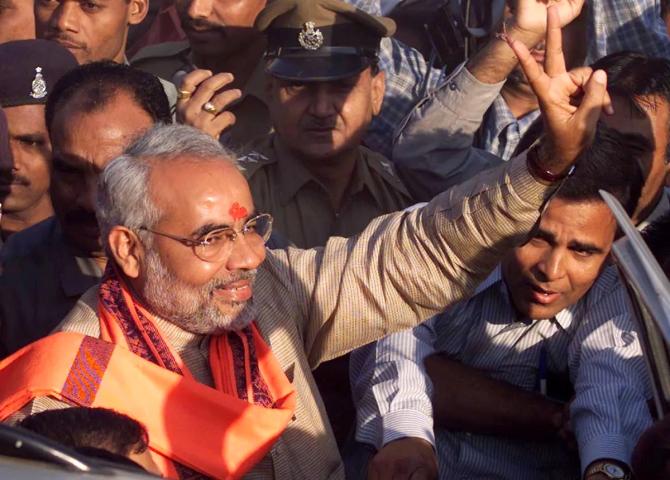
Digitised financial inclusion became his catchphrase early in his tenure and remains so, notwithstanding the fact that sceptics and critics continue flagging empty coffers in banks, in names of millions of citizens.
Yet, that tools and apps providing spine to India's financial digitised inclusion are finding global embrace, is testimony to Modi's foresight regarding capacities of technology in vesting a sense of 'power' at the fingertips of all.
Despite his constant lip-service to valuing the Constitution as his 'constant guide', Modi has made himself synonymous with the Indian nation and thereby any criticism of his policies is projected by his party humungous 'slander machinery' as an 'anti-national' act.
It is not just that the cult of Modi has merely made him larger than life, but almost all State institutions, constitutionally mandated to function autonomously, have become little but lackeys of the Executive, which too is reduced to promoting just one persona.
Inaugurations of any significance, or which further make-belief narratives, are choreographed events to ensure his signature, even on institutions on which the Constitution does not mandate Modi's writ.
For instance, although Parliament as an institution has no place for the prime minister in its running, Modi personally performed every Hindu ritual, related to the construction and opening of the new Parliament building.
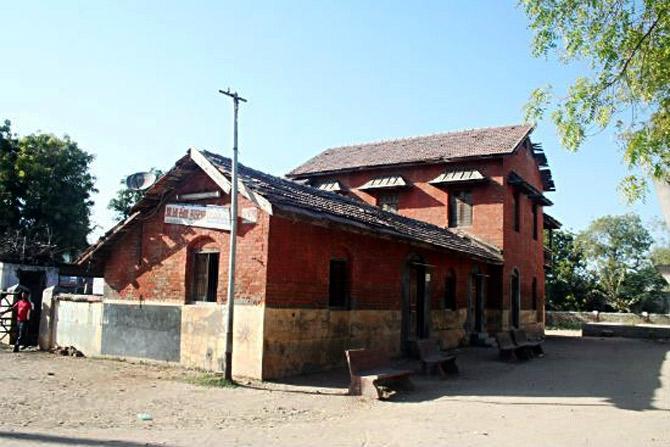
Modi has entered this watershed year in his career in the midst of assembly elections in Bihar. The polls in this state are being conducted in the backdrop of the Election Commission of India's questionable decision to conduct a Special Intensive Revision of the electoral rolls.
Even BJP supporters have been circumspect about the urgency displayed by the poll body. Many of them have concluded that while the rolls required examination to check for duplication and removal of names of the deceased, this was hardly the way to do it.
The entire episode surrounding the SIR underscores how the impartiality of Constitutional bodies has been eroded since 2014.
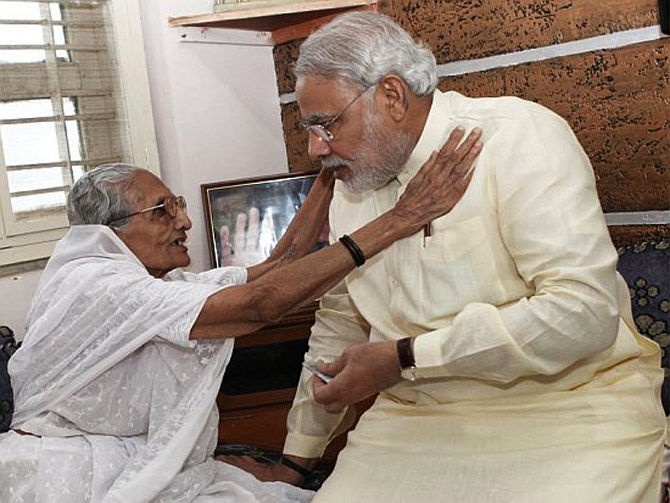
Over the past 24 years, Modi has presided over administrative apparatuses which have not just got steadily communalised, but also pursued policies that polarised society.
The discourse championed by Modi and his party are more often than not based on falsities -- for instance the latest push, started by Modi from the Red Fort, to raise fears over 'infiltrators'.
This has led to widespread insecurity among religious minorities. The fears of being disenfranchised have been raised following years of societal campaigns, and even backed by some BJP leaders in government, to economically boycott minorities, especially Muslims.
In contrast to Modi's 'success' on these issues which have ensured his electoral stranglehold is his failure on the basic promises made on employment, economic growth and reducing disparity in society.
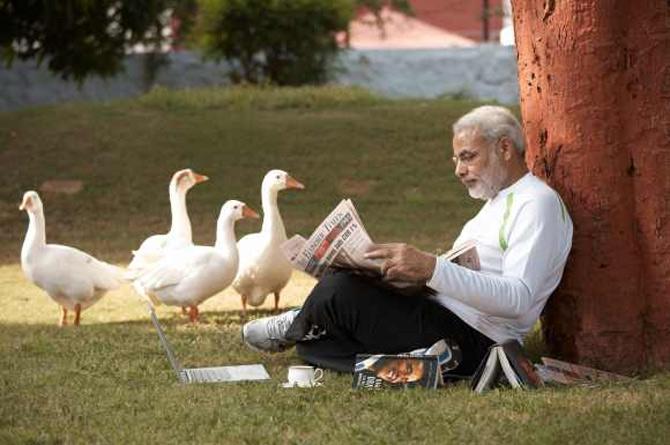
In the 2024 Lok Sabha elections, the Modi-led cavalcade received a jolt and failed to secure majority in Parliament, making it dependent on alliance partners.
It is difficult to assess what will prevail over the months till October 2026: Will the issues that resulted in the reduced mandate for Modi in 2024 gain greater further momentum among the people? Or will the politics of cult-building and communal polarisation prevail?
The answer to these questions shall determine the nature of celebrations next year when Modi expects to actually complete 25 years in public offices.
Nilanjan Mukhopadhyay's latest book is The Demolition, The Verdict and The Temple: The Definitive Book on the Ram Mandir Project.
Feature Presentation: Rajesh Alva/Rediff






 © 2025