A deep dive into Trump's new policy and what it means for Indian professionals and companies.
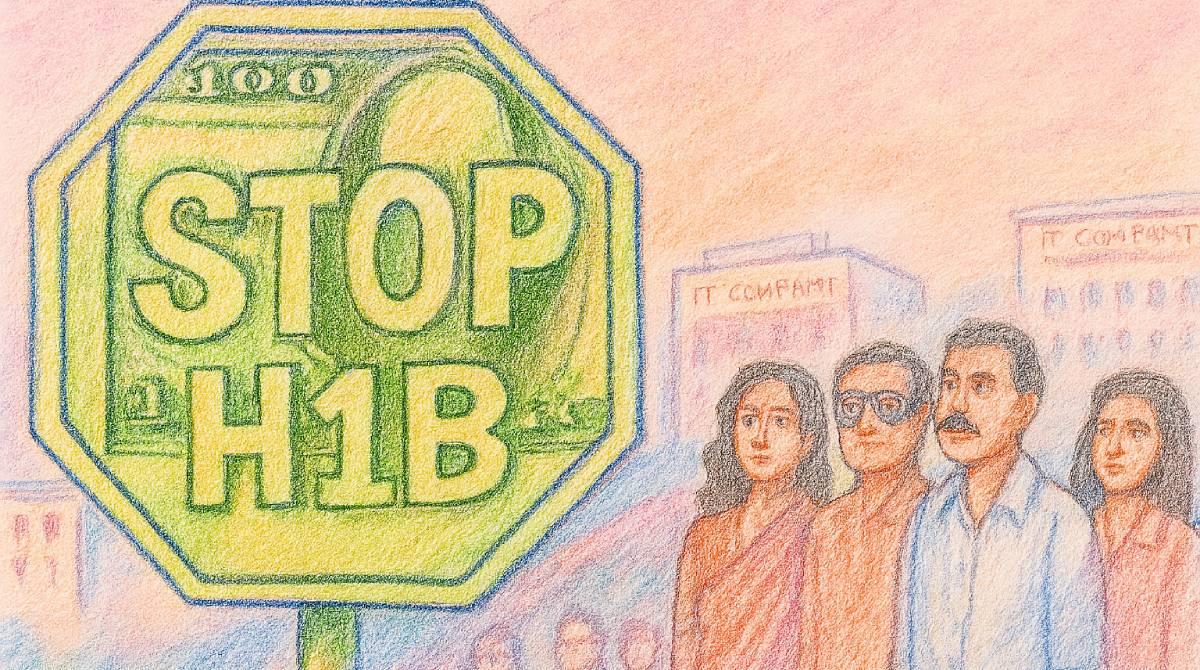
This FAQ reads like the fine print, breaking down the Trump administration's $100,000 H1B visa fee -- the biggest shift in America's skilled immigration programme in decades. It explains who pays, when, and what it means for Indian professionals, students, and IT companies that dominate the H1B landscape.
Providing context is Rajiv Dabhadkar, founder of the National Organisation for Software and Technology Professionals (NOSTOPS), an advocacy body for knowledge workers.
Dabhadkar has long worked on issues of wage discrimination and guest worker rights, and here he clarifies how this new policy reshapes migration economics for Indian H1B visa aspirants.
The Trump administration's Presidential Proclamation 'Restriction on Entry of Certain Nonimmigrant Workers,' signed on September 19, 2025, imposes a $100,000 fee on new H1B visa petitions -- representing the most significant overhaul of America's skilled worker immigration programme in decades. This dramatic fee increase, effective from September 21, 2025, aims to curb programme abuses and protect American workers whilst fundamentally reshaping how foreign talent enters the US tech sector.
The policy particularly impacts Indian professionals and IT companies, who comprise the majority of H1B visa holders and applicants.
Understanding the Presidential Proclamation
What exactly does this new Presidential Proclamation on H1B visas say?
The Presidential Proclamation states that the H1B nonimmigrant visa programme 'was created to bring temporary workers into the United States to perform additive, high-skilled functions, but it has been deliberately exploited to replace, rather than supplement, American workers with lower-paid, lower-skilled labour'.
The core objective is to address systemic abuse where 'some employers, using practices now widely adopted by entire sectors, have abused the H1B statute and its regulations to artificially suppress wages'.
There's confusion about the $100,000 fee. Does everyone have to pay it, or just new applicants?
The $100,000 payment must accompany 'any new H1B visa petitions submitted after 12.01 am eastern daylight time on September 21, 2025. This includes the 2026 lottery, and any other H1B petitions submitted after 12.01 am eastern daylight time on September 21, 2025'.
The fee applies only to new visas and is not an annual payment. It does not apply to renewals or current visa holders.
Does this fee apply only to new petitions, or could it extend to renewals later?
The Proclamation 'does not change any payments or fees required to be submitted in connection with any H1B renewals. The fee is a one-time fee on submission of a new H1B petition'.
However, additional reforms are under consideration, including 'a rulemaking by the Department of Labour to revise and raise the prevailing wage levels' and 'a rulemaking by the Department of Homeland Security to prioritise high-skilled, high-paid aliens in the H1B lottery'.
Is this fee a one-time payment per petition, or could it recur at each stage?
It is a one-time fee that applies only to new petition submissions. This replaces the previous fee structure which included multiple smaller fees.
Which authority has the legal power to implement and enforce this Presidential Proclamation?
The Proclamation is issued 'by the authority vested in me as President by the Constitution and the laws of the United States of America' under 'sections 212(f) and 215(a) of the Immigration and Nationality Act'. Implementation involves:
If USCIS says current H1B holders aren't impacted, can that interpretation change later?
Whilst the Proclamation 'does not prevent any holder of a current H1B visa from travelling in and out of the United States', interpretations could potentially change. However, the restriction expires '12 months after the effective date of this proclamation' unless extended, requiring future action for continuation.
Who bears the financial burden -- employers, employees, or both?
Employers must make the payment, as stated: 'Employers shall, prior to filing an H1B petition on behalf of an alien outside the United States, obtain and retain documentation showing that the payment described in section 1 of this proclamation has been made'.
Can industry bodies or companies challenge this Presidential Proclamation in US courts?
Immigration law experts have raised 'numerous questions' about the new fee, and legal challenges are expected. However, the Proclamation states it 'is not intended to, and does not, create any right or benefit, substantive or procedural, enforceable at law or in equity by any party against the United States'.
Business groups and tech industries are likely to oppose the policy, arguing that it will stifle innovation, increase operational costs, and disproportionately affect small and medium-sized businesses. The tech industry has already expressed strong opposition to the policy, warning that it will harm innovation and competitiveness.
The litigation process could take months or even years to resolve, and the implementation of the executive action may be delayed pending court rulings.
Impact on Employees and Families
For Indian employees already in the US on H1B visas, what changes should they expect for renewals?
The Proclamation does not apply 'to any previously issued H1B visas' and 'does not change any payments or fees required to be submitted in connection with any H1B renewals'. Current holders can continue their employment and travel without additional fees.
What about dependents (H4 spouses and children) -- will they face higher fees or restrictions?
The $100,000 fee applies specifically to H1B petitions and does not directly impact H4 dependent visa applications. However, future immigration policy changes could affect dependent visa programmes.
How does this affect Indian students on OPT hoping to transition into H1B jobs?
Students on Optional Practical Training seeking H1B sponsorship will face the new reality that employers must pay $100,000 for new H1B petitions. This may significantly reduce employer willingness to sponsor visas, particularly among smaller companies and startups.
For those whose H1B renewal is due soon, should they prepare to pay, explore alternatives, or wait for clarifications?
Those seeking renewals are exempt from the new fee, as the Proclamation 'does not change any payments or fees required to be submitted in connection with any H1B renewals'. Only new H1B petitions require the $100,000 payment.
Impact on Employers and Indian IT Companies
How will this steep fee impact Indian IT service companies that file thousands of H1B visas annually?
The $100,000 fee will significantly impact Indian IT companies' cost structures and business models. Companies filing hundreds or thousands of H1B petitions annually will face substantial additional costs, potentially totalling millions of dollars annually.
Will the increased cost directly impact their profitability, or will they pass it on to employees and clients?
Companies will likely adopt mixed strategies: absorbing some costs to remain competitive whilst passing others to clients through contract renegotiations. The industry-wide nature of the fee increase may facilitate client acceptance of cost pass-throughs.
Could this accelerate the trend of Indian IT firms hiring more locals in the US instead of sending employees onsite?
Yes, the substantial fee increase will likely accelerate local hiring strategies and offshore delivery models, reducing dependence on H1B visa holders for onsite client engagement.
How badly could Indian IT stocks and the IT index be hit in the short term?
Initial market reactions showed significant declines, but long-term impacts will depend on companies' adaptation strategies and ability to maintain profitability through alternative delivery models.
In the medium term, will this reduce India's services exports and remittances from the US?
The policy may slow growth in India's IT services exports and potentially reduce remittance flows as fewer Indian professionals work in the US. However, increased offshoring could partially offset these effects.
Strategic and Long-Term Implications
Is this move about raising revenue for the US, or part of a broader attempt to discourage foreign workers?
The Proclamation explicitly states it addresses 'the large-scale replacement of American workers through systemic abuse of the programme' which 'has undermined both our economic and national security'. Revenue generation appears secondary to workforce protection objectives.
What are India's diplomatic or trade options to push back against such high visa costs?
India may pursue diplomatic engagement through bilateral discussions, trade negotiations, and potentially reciprocal measures. However, the Proclamation is issued under presidential authority citing national security concerns, which may limit negotiation scope.
Do you foresee this leading to return migration from the US back to India if costs keep rising?
Current visa holders are not affected and can continue travelling, so immediate return migration is unlikely. However, reduced new visa approvals may decrease future Indian professional migration to the US.
Historically, how does this fee compare to past increases in scale and intent?
Previous H1B fees were typically in the hundreds or low thousands of dollars. The $100,000 fee represents an unprecedented increase -- potentially 20-50 times higher than previous rates -- marking the most dramatic policy change in the programme's history.
Guidance for Affected Indians
What practical steps should Indian professionals currently in the US take to safeguard their status and jobs?
Current H1B holders should:
For aspirants in India preparing for H1B, is it still worth applying or should they reconsider?
The $100,000 fee fundamentally changes H1B economics. Prospective applicants should:
If this Presidential Proclamation faces legal or political pushback in the US, what's the realistic timeline before it becomes binding?
The Proclamation is already effective as of September 21, 2025. Legal challenges may seek injunctions or stays, but the policy is currently binding for new H1B petitions.
Advice -- both financial and professional -- for Indians to navigate this situation with minimum disruption?
Financial Planning:
Professional Development:
Strategic Planning:
Note: This FAQ is based on official US government sources including the White House Presidential Proclamation and USCIS guidance. Immigration policies are subject to change, and individuals should consult qualified immigration attorneys for personalised advice.