|
| Help | |
| You are here: Rediff Home » India » News » Report |
| Advertisement | |||||||||||||||||||||||
| |||||||||||||||||||||||
| Advertisement | |||||||||||||||||||||||

CPI-M patriarch Jyoti Basu passes away
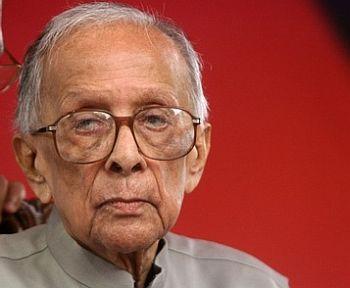 Communist Party of India-Marxist patriarch Jyoti Basu, the longest serving chief minister in Indian political history, is no more.
 The 95-year-old Marxist breathed his last on Sunday afternoon at the AMRI Hopsital in Kolkata [Images] where he had been admitted on January 1 with a pneumonic infection.
A founder member of the CPI-M [Images] politburo from the days of its inception in 1964, Basu was regarded as many as the 'cornerstone of Bengal politics.'
Born on July 8, 1914, in an upper middle class Bengali family in Kolkata, Basu's father Nishikantha Basu was a doctor. After attaining school education from St Xavier's Collegiate School and graduation from Presidency College Arts Faculty in Kolkata, Basu travelled to the United Kingdom to study law, where he was introduced to the Communist Party of Britain.
Basu returned to India [Images] in 1940, and after qualifying for the bar, he became a full-timer in the Communist Party of India. Basu was elected to the Bengal legislative assembly in 1946, contesting the railway constituency.
When the Communist Party of India split in 1964, Basu became one of the first nine members of the Politburo of the newly formed Communist Party of India-Marxist. In 1967 and 1969, Basu became deputy chief minister of West Bengal [Images] in the United Front government.
However, the CPI-M politburo decided not to participate in the government, and Janata Dal-Secular leader H D Deve Gowda [Images] instead became the Prime Minister.
Basu resigned from the chief ministership of West Bengal in 2000 for health reasons and was succeeded by fellow CPI-M politician Buddhadeb Bhattacharya [Images].
| © 2009 Rediff.com India Limited. All Rights Reserved. Disclaimer | Feedback |